College Station in Brazos County, Texas — The American South (West South Central)
Community
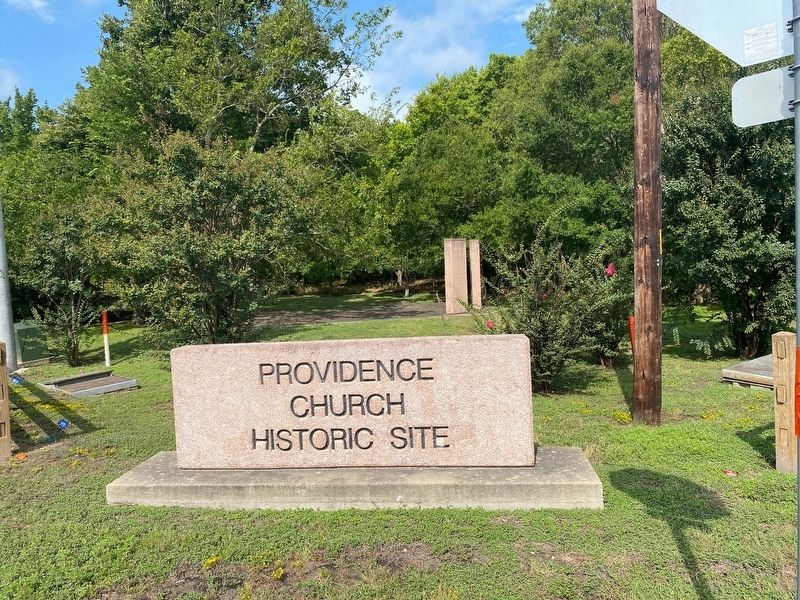
Providence Church Historic Site
Photographed by Morgan Petermann
1. Community Marker
Inscription.
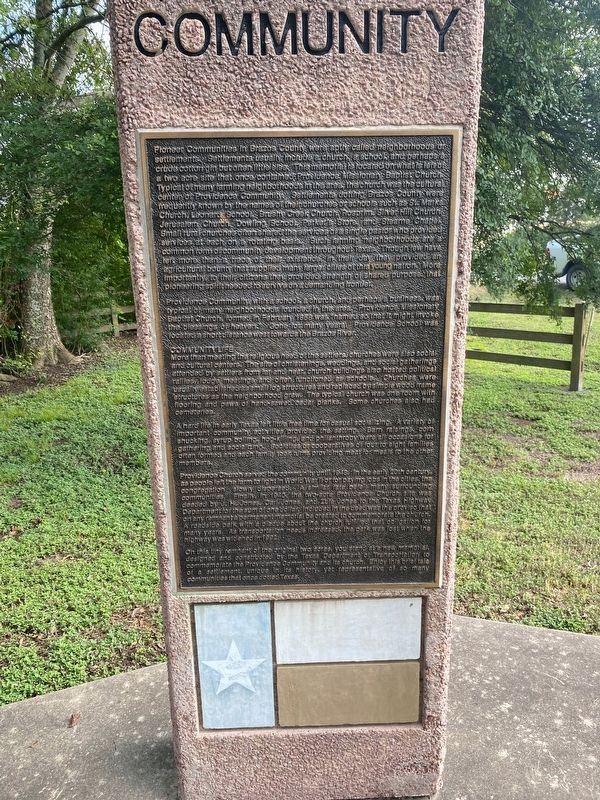
Community. Providence Church Historic Site. Pioneer Communities in Brazos County were aptly called neighborhoods or settlements. Settlements usually include a church, a school, and perhaps a crude cotton gin but often little else. This memorial is located on what is left of a two acre site that once contained Providence Missionary Baptist Church. Typical of many farming neighborhoods in the area, the church was the cultural center of Providence Community. Settlements dotting Brazos County were frequently known by the names of their churches or schools such as St. Marks Church, Leonard School, Brushy Creek Church, Rosprim, Silver Hill Church, Jerusalem Church, Dowling School, Parker's Store, and Stearne Chapel. Small rural churches often shared the services or a single pastor who provided services at each on a rotating basis. Such farming neighborhoods are a common form of community development throughout Texas. Though few have left more than a trace to their existence, in their day they provided an agricultural bounty that supplied many larger cities of this young nation. More importantly, to their citizens they provided strength of shared purpose, that pioneering spirit needed to survive a demanding frontier., Providence Community, with a school, a church, and perhaps a business, was typical of many neighborhoods founded in the area. Providence Missionary Baptist Church, formed in February 1858 was named so that it might invoke the blessings of heaven. Gone for many years, Providence School was located a short distance west towards the Brazos River., Community Life , More than meeting the religious needs of the settlers, churches were also social and cultural centers. The site of christenings, weddings, and social gatherings attended by settlers from far and near, church buildings also hosted political rallies, lodge meetings and often functioned as schools. Churches were usually established as small log structures and replaced by simple wood frame structures as the neighborhood grew. The typical church was one room with flooring and pews of hand-sawed cedar planks. Some churches also had cemeteries., A hard life in early Texas left little free time for casual socializing. A variety of important community activities provided the setting. Barn raisings, corn shucking, syrup boiling, hog killings, and philanthropy were all occasions for gathering and socializing. Socieities of cooperatives of four to eight families often formed and each family took turns providing meat for meals to the other members., Providence Church served the community until 1948. In the early 20th century, as people left the farm to fight in World War II or for paying jobs in the cities, the congregation slowly dispersed. A similar fate befell many surrounding communities. Finally, in 1940, the two acre Providence Church site was deeded by J. H. Jones, Carl Jones, and Zula Jones to the Texas Highway Department for the sum of one dollar. Included in the deed was the provison that on any remnant a permanent memorial be created to commemorate the church. A roadside park with a plaque about the church fulfilled that obligation for many years. As transportation needs increased, the park was lost when the highway was widened in 1992., On this tiny remnant of the original two acres, you stand as a new memorial, designed and constructed by the Texas Department of Transportation to commemorate the Providence Community and its church. Enjoy this brief tale of a settlement, unique in its history, yet representative of so many communities that once dotted Texas.
Pioneer Communities in Brazos County were aptly called neighborhoods or settlements. Settlements usually include a church, a school, and perhaps a crude cotton gin but often little else. This memorial is located on what is left of a two acre site that once contained Providence Missionary Baptist Church. Typical of many farming neighborhoods in the area, the church was the cultural center of Providence Community. Settlements dotting Brazos County were frequently known by the names of their churches or schools such as St. Marks Church, Leonard School, Brushy Creek Church, Rosprim, Silver Hill Church, Jerusalem Church, Dowling School, Parker's Store, and Stearne Chapel. Small rural churches often shared the services or a single pastor who provided services at each on a rotating basis. Such farming neighborhoods are a common form of community development throughout Texas. Though few have left more than a trace to their existence, in their day they provided an agricultural bounty that supplied many larger cities of this young nation. More importantly, to their citizens they provided strength of shared purpose, that pioneering spirit needed to survive a demanding frontier.
Providence Community, with a school, a church, and perhaps a business, was typical of many neighborhoods founded in the area. Providence Missionary Baptist Church,
Click or scan to see this page online
formed in February 1858 was named so that it might invoke the blessings of heaven. Gone for many years, Providence School was located a short distance west towards the Brazos River.
Community Life
More than meeting the religious needs of the settlers, churches were also social and cultural centers. The site of christenings, weddings, and social gatherings attended by settlers from far and near, church buildings also hosted political rallies, lodge meetings and often functioned as schools. Churches were usually established as small log structures and replaced by simple wood frame structures as the neighborhood grew. The typical church was one room with flooring and pews of hand-sawed cedar planks. Some churches also had cemeteries.
A hard life in early Texas left little free time for casual socializing. A variety of important community activities provided the setting. Barn raisings, corn shucking, syrup boiling, hog killings, and philanthropy were all occasions for gathering and socializing. Socieities of cooperatives of four to eight families often formed and each family took turns providing meat for meals to the other members.
Providence Church served the community until 1948. In the early 20th century, as people left the farm to fight in World War II or for paying jobs in the cities, the congregation slowly dispersed. A similar fate
Photographed by Morgan Petermann
2. Community Marker
befell many surrounding communities. Finally, in 1940, the two acre Providence Church site was deeded by J. H. Jones, Carl Jones, and Zula Jones to the Texas Highway Department for the sum of one dollar. Included in the deed was the provison that on any remnant a permanent memorial be created to commemorate the church. A roadside park with a plaque about the church fulfilled that obligation for many years. As transportation needs increased, the park was lost when the highway was widened in 1992.
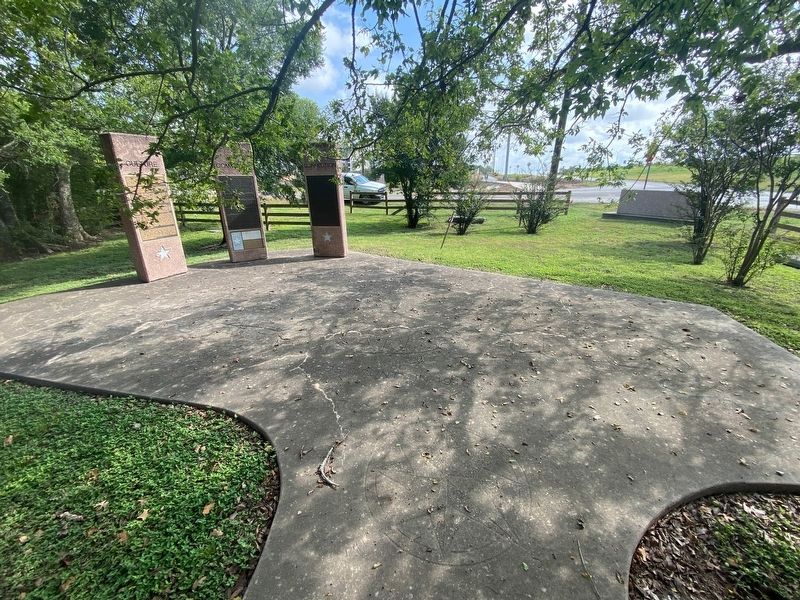
On this tiny remnant of the original two acres, you stand as a new memorial, designed and constructed by the Texas Department of Transportation to commemorate the Providence Community and its church. Enjoy this brief tale of a settlement, unique in its history, yet representative of so many communities that once dotted Texas.
Erected 2008 by Brazos County Historical Commission.
Location. 30° 35.867′ N, 96° 22.304′ W. Marker is in College Station, Texas, in Brazos County. It can be reached from the intersection of Turkey Creek Road and Raymond Stotzer Frontage, on the left when traveling north. Touch for map. Marker is at or near this postal address: 8878 Turkey Creek Rd, College Station TX 77845, United States of America. Touch for directions.

Photographed by Morgan Petermann
3. Community Marker
Regionally, this marker is in the Prairies & Lakes Region. It is also in the American South. Globally, it is in North America, a Gulf of Mexico state, the Western Hemisphere, the Western World, and the Anglosphere. Historically, it finds itself in what was once New Spain, the Republic of Texas, one of the Confederate States of America, and the Antebellum South.
Credits. This page was last revised on September 4, 2025. It was originally submitted on September 2, 2025, by Morgan Petermann of Hurst, Texas. This page has been viewed 89 times since then and 30 times this year. Photos:1, 2, 3. submitted on September 2, 2025, by Morgan Petermann of Hurst, Texas. • James Hulse was the editor who published this page.
