
Vinci in Città Metropolitana di Firenze, Tuscany, Italy — Southern and Western Europe (Mediterranean)
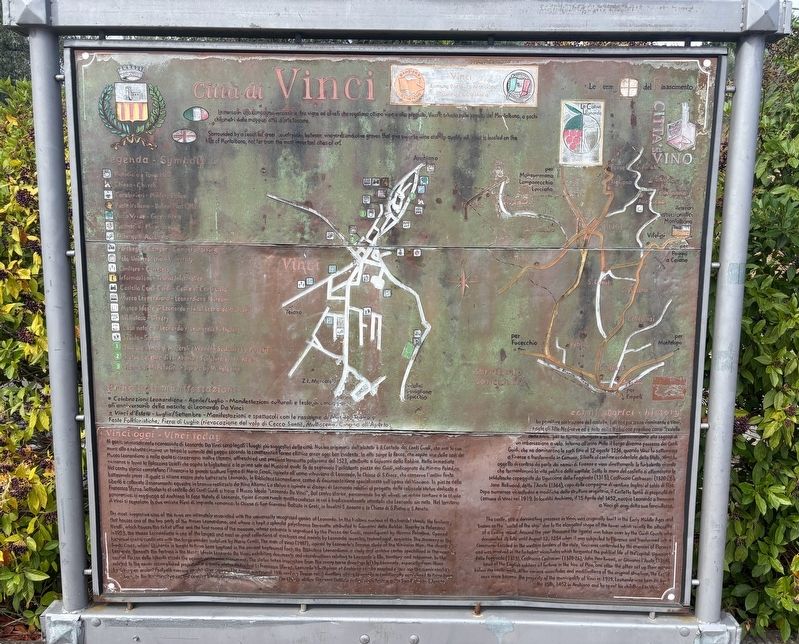
Città di Vinci
Photographed by Sean P. Flynn, July 29, 2025
1. Città di Vinci Marker
Surrounded by a beautiful green countryside, between vineyards and olive groves that give superbe wine and top quality oil, Vinci is located on the hills of Montalbano, not far from the most important cities of art.
Vinci oggi - Vinci today
Al genio universalmente riconosciuto di Leonardo Da Vinci sono legati i luoghi più suggestivi della città. Nucleo originario dell'abitato è il Castello dei Conti Guidi, che con le sue mura alte e robuste circuiva un tempo la sommità del poggio secondo la caratteristica forma ellittica ancor oggi ben evidente. In alto sorge la Rocca, che ospita una delle sedi del Museo Leonardiano e nella quale si conservano inoltre stemmi, affreschi ed una preziosa terracotta policroma del 1523, attribuita a Giovanni della Robbia. Nelle immediate vicinanze si trova la Palazzina Uzielli che ospita la biglietteria e le prime sale del Musco al quale fa da segnacolo l'antistante piazza dei Guidi, ridisegnata
this page online
The most suggestive sites of the town are intimately associated with
Photographed by Sean P. Flynn, July 29, 2025
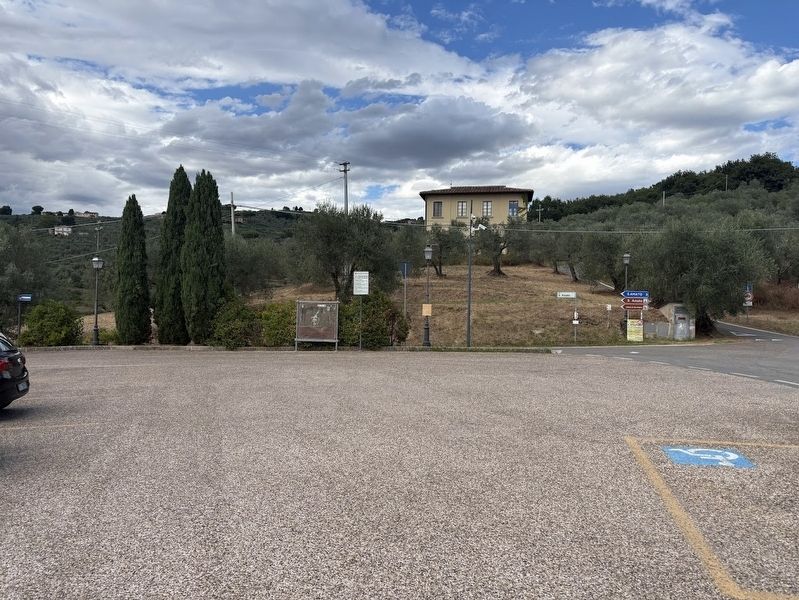
2. Città di Vinci Marker
Photographed by Sean P. Flynn, July 29, 2025
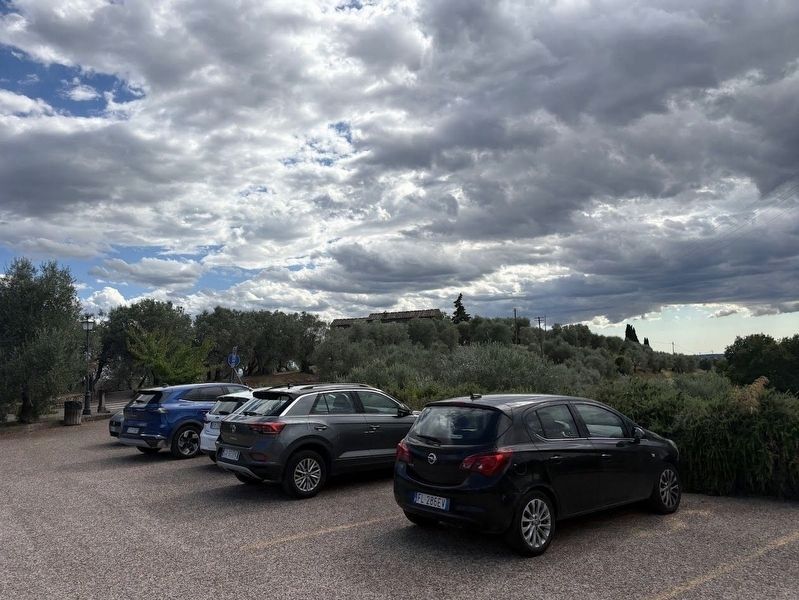
3. Leonardo da Vinci's Birthplace
The home is visible in the distance, past the parking lot and above the trees. The Città di Vinci sign is behind where this photo was taken.
cenni storici - history
La primitiva costruzione del castello, tutt'ora presenza dominante a Vinci, risale all'Alto Medioevo ed è noto nella tradizione popolare come "castello della nave" per la forma allungata e la torre che rimandano alla sagoma di un'imbarcazione a vela. Intorno all'anno Mille il borgo divenne possesso dei Conti Guidi, che ne dominarono le sorti fino al 12 agosto 1254, quando Vinci fu sottomesso a Firenze e trasformato in Comune, Situata al confine occidentale dello Stato, Vinci fu oggetto di contesa da parte dei nemici di Firenze e visse direttamente le turbolente vicende che tormentarono la vita politica della capitale. Sotto le mura del castello si alternarono le soldatesche capeggiate da Uguccione della Faggivala (1315), Castruccio Castracani (1320-26), Jona Hakwood, detto l'Acuto (1364), capo delle compagnie di ventura Inglesi al soldo di Pisa. Dopo numerose vicissitudini e modifiche della struttura originaria, il Castello tomo di proprietà del Comune di Vinci nel 1919. In località Anchiano, il 15 Aprile del 1452, nacque Leonardo e trascorse a Vinci gli anni della sua fanciullezza.
The castle, still a dominating presence in Vinci, was originally built in the Early Middle Ages and known as the "castel of the ship" due to the elongated shape of the tower which recalls the silhouette of a sailing vessel. Around the year thousand the hamlet was taken over by the Guidi Counts who dominated its fate until August 12, 1254 when it was subjected to Florence and trasformed into a Commune. Located on the western borders of the state, Vinci was contended by the enemies of Florence and was involved in the turbolent vicissitudes which tormented the political life of the capital. Uguccione della Faggivola (1315), Castruccio Castracani (1320-26), John Hawkwood, or Giovanni l'Acuto (1364) head of the English soldiers of fortune in the hire of Pisa, one after the other set up their camps below the castle walls. After various vicissitudes and modifications of the original structure, the Castel once more became the property of the municipality of Vinci in 1919. Leonardo was born on April the 15th, 1452 in Anchiano and he spent his childhood in Vinci.
Topics. This historical marker is listed in these topic lists: Arts, Letters, Music • Forts and Castles • Religion & Religious Structures • Settlements & Settlers. A significant historical year for this entry is 1254.
Location. 43° 48.003′ N, 10° 56.344′ E. Marker is in Vinci, Toscana (Tuscany), in Città Metropolitana di Firenze. It is at the intersection of Via S. Amato and Via S. Lucia, on the right when traveling east on Via S. Amato. The marker is in the parking lot for Leonardo da Vinci's birthplace. Touch for map. Marker is in this post office area: Vinci, Toscana 50059, Italy. Touch for directions.

Regionally, it is in Europe, the European Union, the Schengen Area, a coastal Mediterranean country, and the Western World. Historically, it finds itself in what was once the Roman Empire and specifically also the Holy Roman Empire.
Other nearby markers. At least 8 other markers are within 3 kilometers of this marker, measured as the crow flies: Leonardo da Vinci's Birthplace (within shouting distance of this marker); Piazzale Charles C. Dent (within shouting distance of this marker); il Castello dei Conti Guidi / The Castle of the Guidi Counts (approx. 1.7 kilometers away); I Volti Femminili di Leonardo / The Female Faces of Leonardo (approx. 1.7 kilometers away); Vittorio Emanuele II / Victor Emmanuel II (approx. 1.8 kilometers away); The Liberation of Vinci, Italy (approx. 1.8 kilometers away); Francesco Domenichini (approx. 1.8 kilometers away); Bruno Domenichini (approx. 1.8 kilometers away). Touch for a list and map of all markers in Vinci.
More about this marker. This area about 3 kilometers north of Vinci is known as Anchiano, in an area of foothills called Montalbano.
Also see . . . Vinci: Birthplace of a Genius. An article by Italy Magazine (Submitted on September 2, 2025, by Sean P. Flynn of Oak Park, Illinois.)
Credits. This page was last revised on September 2, 2025. It was originally submitted on September 2, 2025, by Sean P. Flynn of Oak Park, Illinois. This page has been viewed 113 times since then and 12 times this year. Photos: 1, 2. submitted on September 2, 2025, by Sean P. Flynn of Oak Park, Illinois. 3. submitted on September 1, 2025, by Sean P. Flynn of Oak Park, Illinois.
