Near Goleta in Santa Barbara County, California — The American West (Pacific Coastal)
Rigs: Drilling the Deep
Photographed by Craig Baker
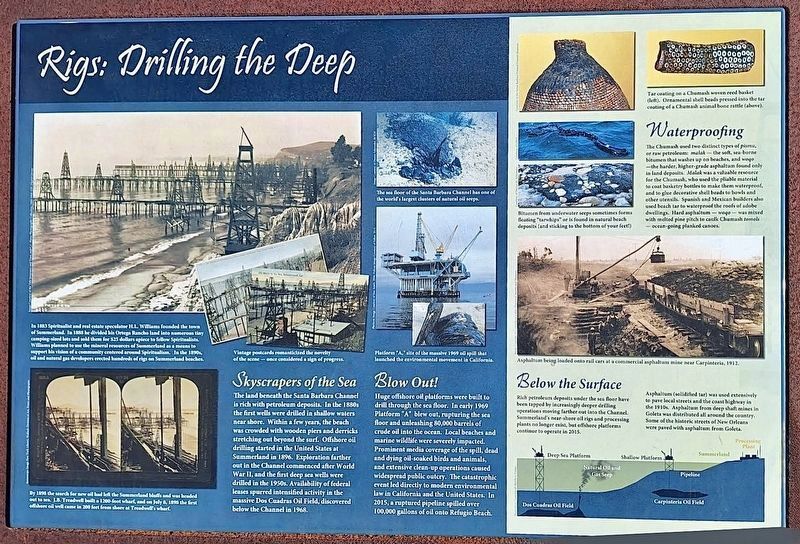
1. Rigs Drilling Marker
Skyscrapers of the Sea
The land beneath the Santa Barbara Channel is rich with petroleum deposits. In the 1880s the first wells were drilled in shallow waters near shore. Within a few years, the beach was crowded with wooden piers and derricks stretching out beyond the surf. Offshoreoil drilling started in the United States at Summerland in 1896. Exploration farther out in the Channel commenced after World War II, and the first deep sea wells were drilled in the 1950s. Availability of federal Icases spurred intensified activity in the massive Dos Cuadras Oil Field, discovered below the Channel in 1968.
Blow Out!
Huge offshore oil platforms were built to drill through the sea floor. In carly 1969 Platform "A" blew out, rupturing the sen floor and unleashing 80,000 barrels of crude oil into the ocean. Local beaches and marine wildlife were severely impacted. Prominent media coverage of the spill, dead and dying oil-soaked birds and animals, and extensive clean-up Operations caused widespread public outcry. The catastrophic event led directly to modern environmental law in California and the United
this page online
Waterproofing
The Chumash used two distinct types of pismu, or raw petroleum: malak - the soft, sea-borne bitumen that washes up on beaches, and wogo — the harder, higher grade asphaltum found only in land deposits. Malak was a valuable resource for the Chumash, who used the pliable material to coat basketry bottles to make them waterproof, and to glue decorative shell beads to bowls and other utensils. Spanish and Mexican builders also used beach tar to waterproof the roofs of adobe dwellings. Hard asphaltum - wogo — was mixed with melted pine pitch to caulk Chumash tomols - ocean-going planked canoes.
Below the Surface
Rich petroleum deposits under the sea floor have been tapped by increasingly deeper drilling operations moving farther out into the Channel. Summerland's near-shore oil rigs and processing plants no longer exist, but offshore platforms continue to operate in 2015. Asphaltum (solidified tar) was used extensively to pave local streets and the coast highway in the 1910s. Asphaltum from deep shaft
Photographed by Craig Baker
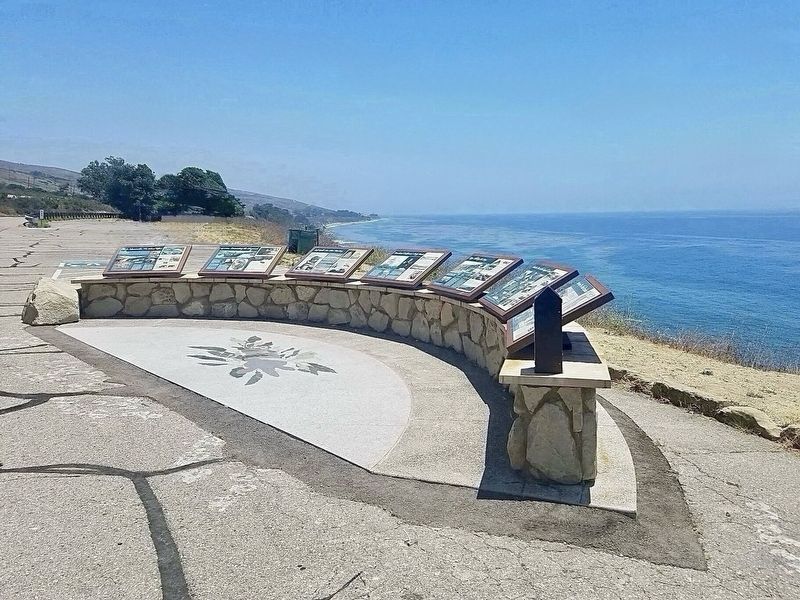
2. Rigs Drilling Marker
Topics. This historical marker is listed in these topic lists: Industry & Commerce • Natural Resources.
Location. 34° 28.439′ N, 120° 8.216′ W. Marker is near Goleta, California, in Santa Barbara County. It is on U.S. 101, on the right when traveling east. Located at Arroyo Hondo Vista Point, only accessible from the eastbound lanes. Touch for map. Marker is in this post office area: Goleta CA 93117, United States of America. Touch for directions.

Regionally, this marker is on the Central Coast, specifically on the Coast Ranges, and specifically in the Transverse Ranges. It is also on the American Pacific Coast. Globally, it is in North America, on the Ring of Fire, on the Pacific Rim, in the Western Hemisphere, in the Western World, and in the Anglosphere. Historically, it finds itself in what was once New Spain and also Mexico’s Alta California.
Other nearby markers. At least 8 other markers are within 6 miles of this marker,
Photographed by Craig Baker
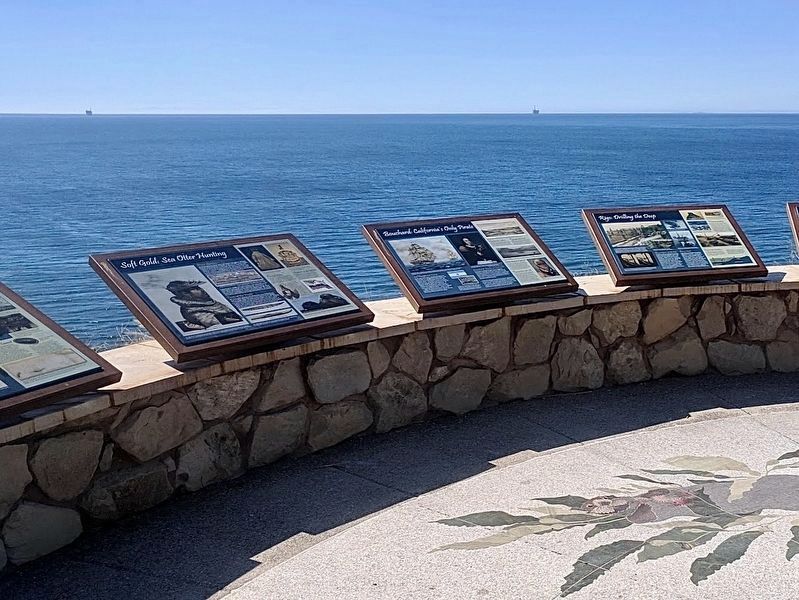
3. Oil Drilling Rigs are visible on the horizon
Credits. This page was last revised on September 3, 2025. It was originally submitted on September 3, 2025, by Craig Baker of Sylmar, California. This page has been viewed 99 times since then and 26 times this year. Photos: 1, 2, 3. submitted on September 3, 2025, by Craig Baker of Sylmar, California.
