Siena in Provincia di Siena, Tuscany, Italy — Southern and Western Europe (Mediterranean)
Ferdinand III
Photographed by Sean P. Flynn, July 31, 2025
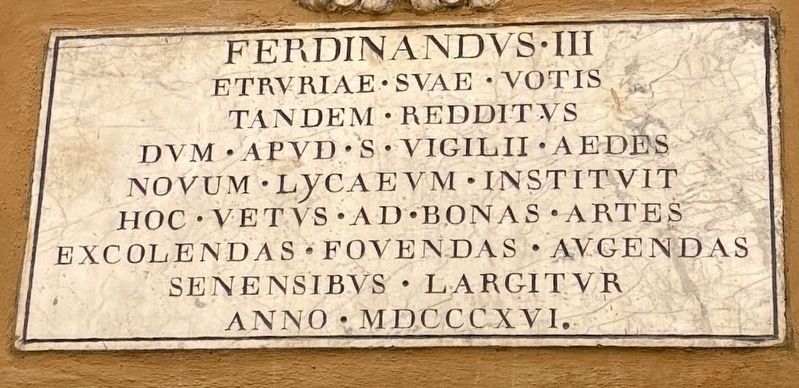
1. Ferdinand III Marker
Ferdinandus III Etruriae suae votis tandem redditus dum apud san vigilii aedes novum lycaeum instituit hoc vetus ad bonas artes excolendas fovendas augendas senensibus largitur
[English translation of the Latin text:]
Ferdinand III, having finally returned to Etruria by his own wishes, founded a new lyceum at the house of San Vigilio, and bestowed this old one to cultivate, foster and increase the good arts.
Erected 1816.
Topics. This historical marker is listed in these topic lists: Education • Government & Politics. A significant historical year for this entry is 1816.
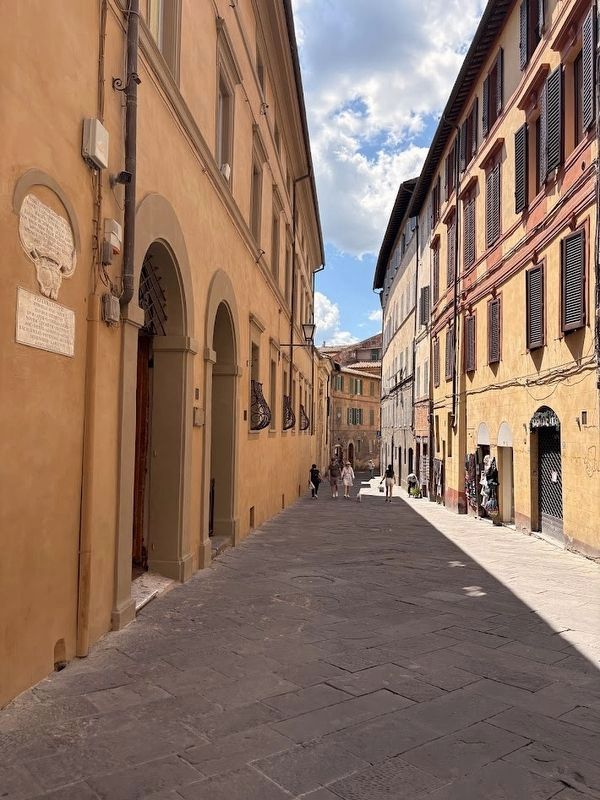
Location. 43° 19.243′ N, 11° 19.771′ E. Marker is in Siena, Toscana (Tuscany), in Provincia di Siena. It is on Via della Sapienza west of Via delle Terme, on the left when traveling east. Touch for map. Marker is at or near this postal address: Via della Sapienza 3, Siena, Toscana 53100, Italy. Touch for directions.

Regionally, it is in Europe, the European Union, the Schengen Area, a coastal Mediterranean country, and the Western World. Historically, it finds itself in what was once the Roman Empire and specifically also the Holy Roman
this page online
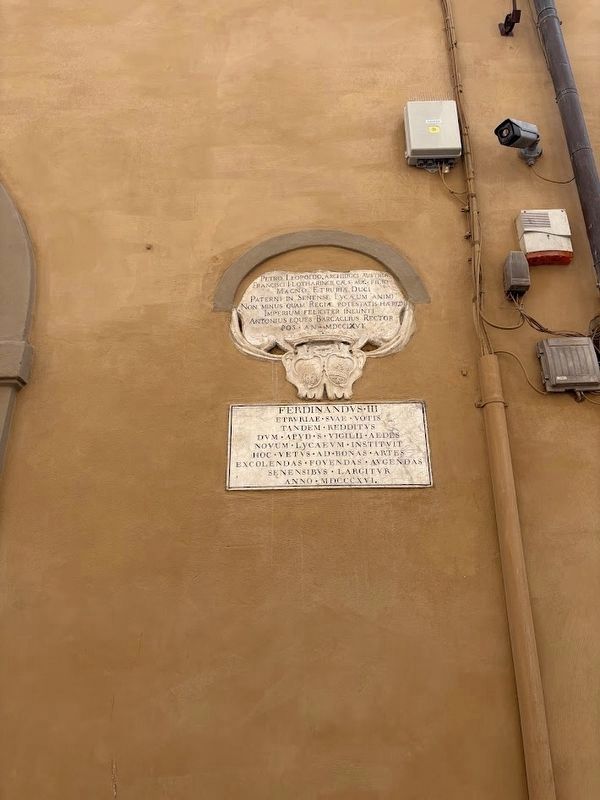
Other nearby markers. At least 8 other markers are within 21 kilometers of this marker, measured as the crow flies: Peter Leopold, Archduke of Austria (here, next to this marker); Santuario Casa di Santa Caterina da Siena (about 90 meters away, measured in a direct line); Sant'Antonio in San Domenico (about 240 meters away); 1868-69 Renovation of the Siena Cathedral Façade (approx. 0.3 kilometers away); Il Cristallo Colligiano / Colligian Crystal (approx. 0.3 kilometers away); Cesare Brandi (approx. 0.4 kilometers away); Santa Caterina Benincasa (approx. 0.4 kilometers away); Resti del Ponte di Spugna / Remains of the Spugna Bridge (approx. 19.6 kilometers away). Touch for a list and map of all markers in Siena.
Regarding Ferdinand III. Details of the lyceum described on this marker and the one above it, dating to 1766, could not be found. This marker and the one directly above it are links to the period when Tuscany was ruled by the House of Habsburg-Lorraine.
Tuscany was ruled by the Medici family from 1569 until 1737, when Gian Gastone died with no heirs and the House of Lorraine was awarded the vacant throne. The
Photographed by Sean P. Flynn, July 31, 2025
2. Two markers on Via della Sapienza
Ferdinand III was born in Florence in 1769, the second-born son of Leopold and his wife Maria Luisa of Spain. In 1790, when his father was elected Emperor Leopold II of the Holy Roman Empire, Ferdinand III succeeded him as Grand-Duke of Tuscany. (When Leopold died in 1792, his first-born son, Francis, was elevated to Holy Roman Emperor; he would later be the first Emperor of Austria.) In 1799 and again in 1800, Ferdinand was forced into exile by French forces, and in 1801 he was forced to surrender his throne. The Grand Duchy was replaced by the short-lived Kingdom of Etruria, which was annexed by France in 1807. After Napoleon fell in 1814, Tuscany was restored as a Grand Duchy, and Ferdinand regained his title as Grand-Duke. He died in 1824.
Also see . . . Grand Duke Ferdinand III of Tuscany – a regent in times of change.
Photographed by Sean P. Flynn, July 31, 2025
3. Two markers on Via della Sapienza
Excerpt: "Profoundly disturbed by the upheavals, Ferdinand became a staunch representative of the ancien régime, the old system of princely rule, for the rest of his life. While he was open to the ideas of the Enlightenment, revolutionary furore was deeply alien to him. He displayed a complete lack of understanding for the ideals of the French Revolution, in particular the concept of the modern nation state. Nonetheless, the emerging idea of the unification of Italy as a nation state was soon to put an end to the rule of his descendants in Tuscany."(Submitted on September 3, 2025, by Sean P. Flynn of Oak Park, Illinois.)
Courtesy of Österreichische Nationalbibliothek, Austria, circa 1820
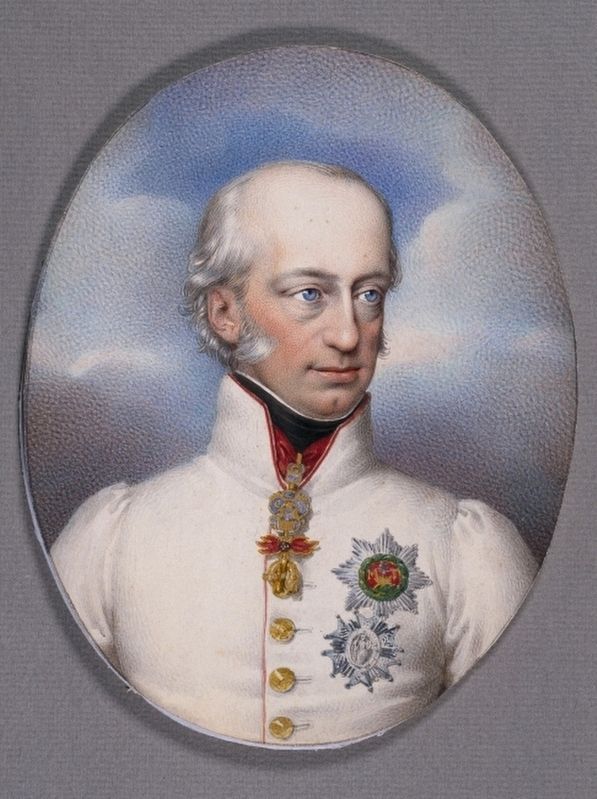
4. Ferdinand III (1769-1824)
A late-in-life portrait of Ferdinand III, Grand-Duke of Tuscany.
Credits. This page was last revised on June 9, 2026. It was originally submitted on September 3, 2025, by Sean P. Flynn of Oak Park, Illinois. This page has been viewed 71 times since then and 13 times this year. Photos: 1, 2, 3, 4. submitted on September 3, 2025, by Sean P. Flynn of Oak Park, Illinois.
