Ironton in Lawrence County, Ohio — The American Midwest (Great Lakes)
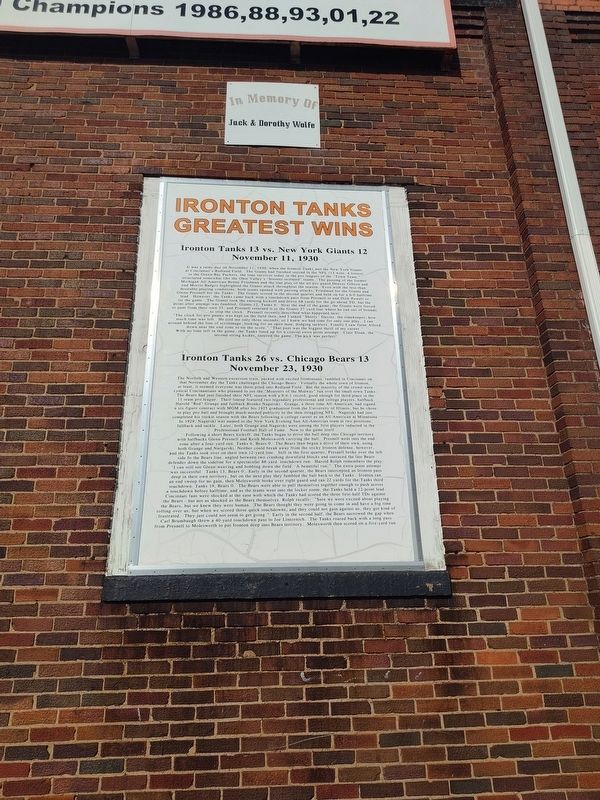
Ironton Tanks Greatest Wins
Photographed by Craig Doda, August 16, 2025
1. Ironton Tanks Greatest Wins Marker
Inscription.
Ironton Tanks Greatest Wins. .
Ironton Tanks 13 vs. New York Giants 12 November 11, 1930. It was a rainy day on November 11, 1930, when the Ironton Tanks met the New York Giants at Cincinnati's Redland Field. The Giants had finished second in the NFL (13 wins, 4 losses) to the Green Bay Packers, the lone survivor today in the pro leagues of the "Town Team," structured somewhat like the Ohio Valley's "booster-oriented" teams. The passing of the former Michigan All American Benny Friedman and the line play of the all-pro guard Denver Gibson and end Morris Badgro highlighted the Giants attack throughout the season. Even with the less-than- desirable playing conditions, both teams opened with passing attacks, Friedman for the Giants and Glenn Presnell for the Tanks. The Giants scored in the second quarter and held on for a 6-0 halftime lead. However, the Tanks came back with a touchdown pass from Presnell to end Dick Powell to tie the game. The Giants took the ensuing kickoff and drove 68 yards for the go-ahead TD, but the point-after attempt was fumbled. Giants 12, Tanks 6. Near the end of the game, the Giants were forced to punt from their own 33, and Presnell returned it to the Giants 27 yard line where he ran out of bounds to stop the clock. Presnell recently described what happened next:
"The clock for pro games was kept on the field then, and I asked "Shorty" Davies, the timekeeper, how much time was left. He told me only three seconds, so I knew we had time for only one play. I ran around behind the line of scrimmage, looking for an open man, dodging tacklers. Finally I saw Gene Alford down near the end zone to tie the score." "That pass was the biggest thrill of my career."
With no time left in the game, the Tanks lined up for a crucial extra point attempt. Clair Sloan, the second-string kicker, entered the game. The kick was perfect!,
Ironton Tanks 26 vs. Chicago Bears 13 November 23, 1930. The Norfolk and Western excursion train, packed with excited Irontonians, rumbled in Cincinnati on that November day the Tanks challenged the Chicago Bears. Virtually the whole town of Ironton, at least, it seemed everyone was there, piled into Redland Field. But the majority of the crowd were cynical Cincinnatians who planned to see the "Monsters of the Midway" run over the small-town Tanks., The Bears had just finished their NFL season with a 9-4-1 record, good enough for third-place in the 11-team pro league. Their lineup featured two legendary professional and college players, halfback Harold "Red" Grange and fullback Bronko Nagurski. Grange, a three-time All-American, had signed a six-figure contract with MGM after his 1925 graduation from the University of Illinois, but he chose to play pro ball and brought much-needed publicity to the then-struggling NFL. Nagurski had just completed his rookie season with the Bears following a college career as an All-American at Minnesota., In 1929, Nagurski was named to the New York Evening Sun All-American team at two positions, fullback and tackle. Later, both Grange and Nagurski were among the first players inducted in the Professional Football Hall of Fame. Now to the game itself , Following a short Bears kickoff, the Tanks began to drive the ball deep into Chicago territory with halfbacks Glenn Presnell and Keith Molesworth carrying the ball. Presnell went into the end zone after a four-yard run. Tanks 6, Bears 0. The Bears then began a drive of their own, using both Grange and Nargurski. Neither could break away from the sticky Ironton defense, however, and the Tanks took over on their own 12-yard line. Still in the first quarter, Presnell broke over the left side for the Bears line, angled between two crushing downfield blocks and outraced the last Bears defender down the sideline for a spectacular 88-yard touchdown run. Harold Rolph remembers the play: "I can still see Glenn weaving and bobbing down the field. A beautiful run." The extra-point attempt was successful. Tanks 13, Bears 0. Early in the second quarter, the Bears intercepted an Ironton pass deep in their own territory, but on the next play they fumbled the ball back to the Tanks. Ironton ran an end sweep for no gain, then Molesworth broke over right guard and ran 22 yards for the Tanks third touchdown. Tanks 19, Bears 0. The Bears were able to pull themselves together enough to push across a touchdown before halftime, and as the teams went into the locker room, the Tanks held a 12-point lead. Cincinnati fans were shocked at the ease with which the Tanks had scored the three first-half TDs against the Bears but not as shocked as the Bears themselves. Rolph recalls: "Sure we were excited about playing the Bears, but we knew they were human. The Bears thought they were going to come in and have a big time rolling over us, but when we scored those quick touchdowns, and they could not gain against us, they got kind of frustrated. They just could not seem to get going." Early in the second half, the Bears narrowed the gap when Carl Brumbaugh threw a 40-yard touchdown pass to Joe Lintzenich. The Tanks roared back with a long pass from Presnell to Molesworth to put Ironton deep into Bears territory. Molesworth then scored on a five-yard run.
Ironton Tanks 13 vs. New York Giants 12
November 11, 1930
It was a rainy day on November 11, 1930, when the Ironton Tanks met the New York Giants at Cincinnati's Redland Field. The Giants had finished second in the NFL (13 wins, 4 losses) to the Green Bay Packers, the lone survivor today in the pro leagues of the "Town Team," structured somewhat like the Ohio Valley's "booster-oriented" teams. The passing of the former Michigan All American Benny Friedman and the line play of the all-pro guard Denver Gibson and end Morris Badgro highlighted the Giants attack throughout the season. Even with the less-than- desirable playing conditions, both teams opened with passing attacks, Friedman for the Giants and Glenn Presnell for the Tanks. The Giants scored in the second quarter and held on for a 6-0 halftime lead. However, the Tanks came back with a touchdown pass from Presnell to end Dick Powell to tie the game. The Giants took the ensuing kickoff and drove 68 yards for the go-ahead TD, but the point-after attempt was fumbled. Giants 12, Tanks 6. Near the end of the game, the Giants were forced to punt from their own 33, and Presnell returned it to the Giants 27 yard line where he ran out of bounds to stop the clock. Presnell recently described what happened next:
"The clock for pro games was
Click or scan to see this page online
kept on the field then, and I asked "Shorty" Davies, the timekeeper, how much time was left. He told me only three seconds, so I knew we had time for only one play. I ran around behind the line of scrimmage, looking for an open man, dodging tacklers. Finally I saw Gene Alford down near the end zone to tie the score." "That pass was the biggest thrill of my career."
With no time left in the game, the Tanks lined up for a crucial extra point attempt. Clair Sloan, the second-string kicker, entered the game. The kick was perfect!
Ironton Tanks 26 vs. Chicago Bears 13
November 23, 1930
The Norfolk and Western excursion train, packed with excited Irontonians, rumbled in Cincinnati on that November day the Tanks challenged the Chicago Bears. Virtually the whole town of Ironton, at least, it seemed everyone was there, piled into Redland Field. But the majority of the crowd were cynical Cincinnatians who planned to see the "Monsters of the Midway" run over the small-town Tanks.
The Bears had just finished their NFL season with a 9-4-1 record, good enough for third-place in the 11-team pro league. Their lineup featured two legendary professional and college players, halfback Harold "Red" Grange and fullback Bronko Nagurski. Grange, a three-time All-American, had signed a six-figure contract with MGM after his 1925 graduation
Photographed by Craig Doda, August 16, 2025
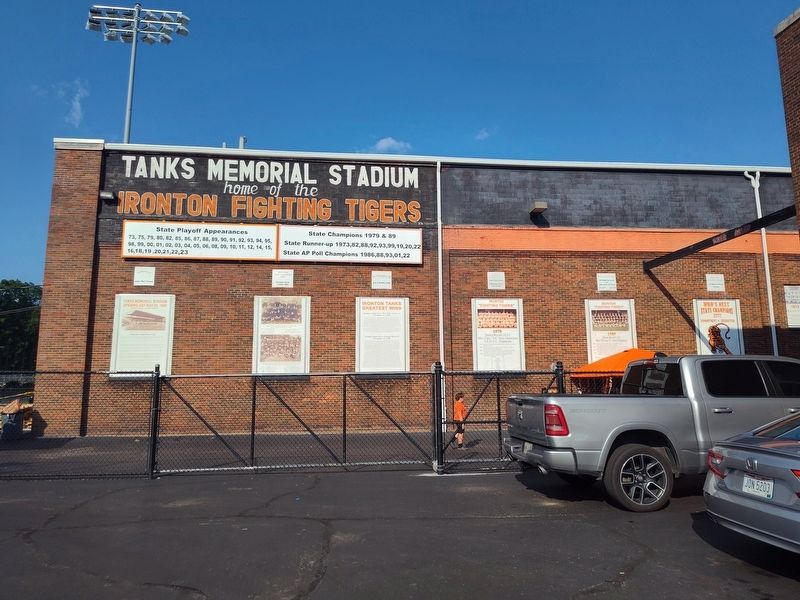
2. Ironton Tanks Greatest Wins Marker
from the University of Illinois, but he chose to play pro ball and brought much-needed publicity to the then-struggling NFL. Nagurski had just completed his rookie season with the Bears following a college career as an All-American at Minnesota.
In 1929, Nagurski was named to the New York Evening Sun All-American team at two positions, fullback and tackle. Later, both Grange and Nagurski were among the first players inducted in the Professional Football Hall of Fame. Now to the game itself
Following a short Bears kickoff, the Tanks began to drive the ball deep into Chicago territory with halfbacks Glenn Presnell and Keith Molesworth carrying the ball. Presnell went into the end zone after a four-yard run. Tanks 6, Bears 0. The Bears then began a drive of their own, using both Grange and Nargurski. Neither could break away from the sticky Ironton defense, however, and the Tanks took over on their own 12-yard line. Still in the first quarter, Presnell broke over the left side for the Bears line, angled between two crushing downfield blocks and outraced the last Bears defender down the sideline for a spectacular 88-yard touchdown run. Harold Rolph remembers the play:
"I can still see Glenn weaving and bobbing down the field. A beautiful run." The extra-point attempt was successful. Tanks 13, Bears 0. Early in the second quarter, the Bears intercepted an Ironton
pass deep in their own territory, but on the next play they fumbled the ball back to the Tanks. Ironton ran an end sweep for no gain, then Molesworth broke over right guard and ran 22 yards for the Tanks third touchdown. Tanks 19, Bears 0. The Bears were able to pull themselves together enough to push across a touchdown before halftime, and as the teams went into the locker room, the Tanks held a 12-point lead. Cincinnati fans were shocked at the ease with which the Tanks had scored the three first-half TDs against the Bears but not as shocked as the Bears themselves. Rolph recalls: "Sure we were excited about playing the Bears, but we knew they were human. The Bears thought they were going to come in and have a big time rolling over us, but when we scored those quick touchdowns, and they could not gain against us, they got kind of frustrated. They just could not seem to get going." Early in the second half, the Bears narrowed the gap when Carl Brumbaugh threw a 40-yard touchdown pass to Joe Lintzenich. The Tanks roared back with a long pass from Presnell to Molesworth to put Ironton deep into Bears territory. Molesworth then scored on a five-yard run.
Topics. This historical marker is listed in this topic list: Sports. A significant historical date for this entry is November 11, 1930.
Location. 38° 31.529′ N, 82° 40.204′ W. Marker is in Ironton, Ohio, in Lawrence County. It is at the intersection of South 7th Street and South Ellison Street, on the right when traveling north on South 7th Street. Touch for map. Marker is at or near this postal address: 1701 S 7th St, Ironton OH 45638, United States of America. Touch for directions.

Regionally, this marker is in Ohio’s Kyova Tri-State Region. It is also in the American Midwest, in the Ohio River Valley, in Appalachia, and specifically in Northern Appalachia. Globally, it is in North America, the Western Hemisphere, the Western World, and the Anglosphere. Historically, it finds itself in what was once the Haudenosaunee (Iroquois) Confederacy, the territory of the Mississippian Culture, and the Northwest Territory.
Credits. This page was last revised on September 25, 2025. It was originally submitted on September 3, 2025, by Craig Doda of Napoleon, Ohio. This page has been viewed 84 times since then and 38 times this year. Photos:1, 2. submitted on September 3, 2025, by Craig Doda of Napoleon, Ohio. • Devry Becker Jones was the editor who published this page.
