
Bristol in Morgan County, Ohio — The American Midwest (Great Lakes)
Big Muskie
Photographed by William Fischer, Jr., November 2, 2008
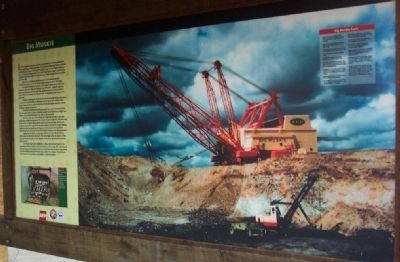
1. Big Muskie Marker
In the early 1960s, increased production was needed to meet rising demand for coal by Muskingum River Power Plant. The increased mining capability was achieved with Big Muskie, a Bucyrus-Erie 4250-W dragline. Huge by any standards, the 4250-W was the largest walking dragline ever built. It also was the biggest machine ever to move on land. Only seagoing vessels the scale of Navy aircraft carriers are larger and still mobile. Big Muskie took approximately two years to fabricate and another two years to construct on site. The Muskie began coal production in May 1969.
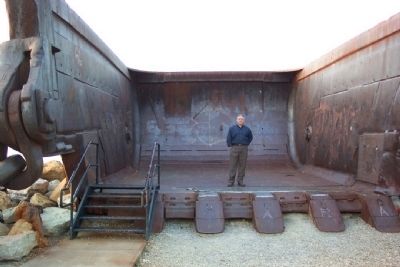
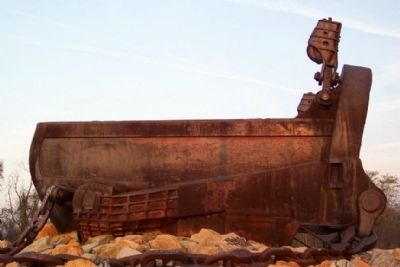
The 4250-W simply was enormous. The machine's boom was 310 feet long. The house revolved on a 105-foot diameter tub. The bucket - a gigantic 220 cubic yards, twice the capacity of the other large draglines that later would operate at Central Ohio Coal Company's Muskingum Mine - could grab 325 tons of earth in a single bite.
During its operating life, the Muskie moved more than 483 million cubic yards of material to uncover nearly 18 million tons of coal. Big Muskie worked in areas where smaller machines could not reach the full 180-foot depth needed to
this page online
When Big Muskie finished uncovering coal in one area, it moved to another. With an overall width of 151 feet, the Muskie required a road wider than an eight-lane highway. This road had to be kept to less than a 5 percent grade.
While the sheer size of the machine was its greatest strength, it also later proved to be a significant weakness. The Muskie's huge tub required a flat, level and stable surface to support the machine's 14,000-ton working weight. While most draglines drag the front edge of the tub when walking, the 4250-W's unique walking mechanism lifted the entire tub off the ground. This proved to be a significant disadvantage because it prevented the machine from working on cast-blasted material.
Big Muskie was idled in January 1991, sidelined by more efficient mining technologies and decreased demand for the mine's high-sulfur coal because of the Clean Air Act Amendments of 1990. Together, these things eliminated the need for this behemoth.
For the next eight years, Big Muskie sat like a sentinel watching over the reclaimed land it once walked across and mined. In January
Photographed by William Fischer, Jr., November 2, 2008
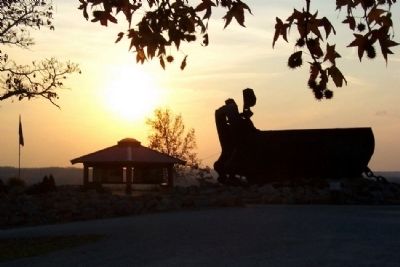
2. Big Muskie Marker Shelter and Bucket
Erected by American Electric Power (AEP).
Topics. This historical marker is listed in this topic list: Industry & Commerce. A significant historical month for this entry is January 1991.
Location. Marker has been permanently removed. It was located near 39° 41.946′ N, 81° 43.877′ W. Marker was in Bristol, Ohio, in Morgan County. It could be reached from Ohio 78. Marker is in an exhibit shelter next to the Big Muskie Bucket, in Miner's Memorial Park, on Ohio Route 78, about seven miles east of McConnelsville. Touch for map. Marker was in this post office area: McConnelsville OH 43756, United States of America.
We have been informed that this marker is no longer there and will not be replaced. This page is an archival view of what was.
Regionally, this marker was in the American Midwest, in the Ohio River Valley, in Appalachia, and specifically in Northern Appalachia. Globally, it was

Photographed by William Fischer, Jr., November 2, 2008
3. Contributor inside Big Muskie Bucket
Other nearby markers. At least 8 other markers are within walking distance of this location: Reclamation (here, next to this marker); Turning Coal To Power (here, next to this marker); Big Muskie / Coal Mining In Ohio (here, next to this marker); a different marker also named The Big Muskie (a few steps from this marker); History, Geology and Coal (a few steps from this marker); Shovels, Draglines And Mining Equipment (a few steps from this marker); Ronald V. Crews Memorial Park (a few steps from this marker); Big Muskie's Bucket (a few steps from this marker). Touch for a list and map of all markers in Bristol.
Photographed by William Fischer, Jr., November 2, 2008
4. Big Muskie Bucket
Credits. This page was last revised on September 17, 2025. It was originally submitted on November 15, 2008, by William Fischer, Jr. of Reynoldsburg, Ohio. This page has been viewed 4,126 times since then and 75 times this year. Last updated on September 4, 2025, by Craig Doda of Napoleon, Ohio. Photos: 1, 2, 3, 4. submitted on November 15, 2008, by William Fischer, Jr. of Reynoldsburg, Ohio. • Devry Becker Jones was the editor who published this page.
