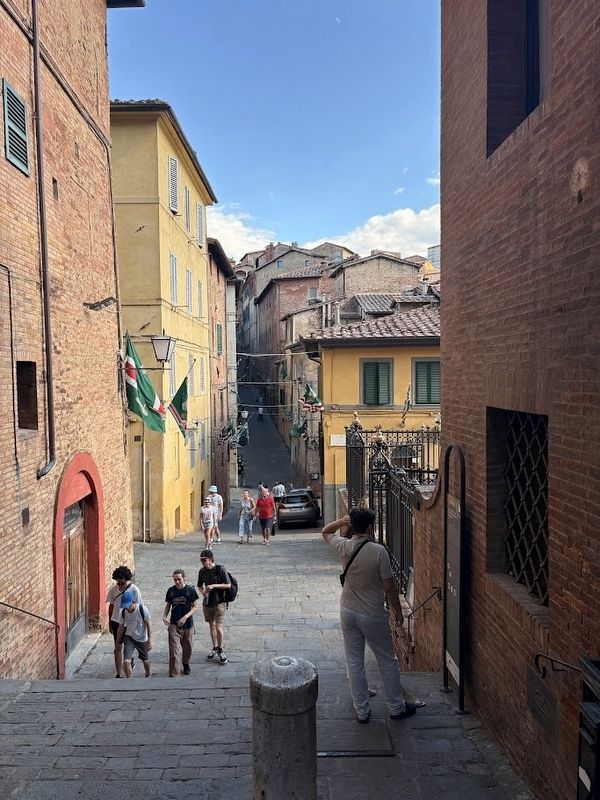
Siena in Provincia di Siena, Tuscany, Italy — Southern and Western Europe (Mediterranean)
Santuario Casa di Santa Caterina da Siena
XV Sec ⎯⎯⎯ 15th Century
Photographed by Sean P. Flynn, July 31, 2025
1. Santuario Casa di Santa Caterina da Siena Marker
Inscription.
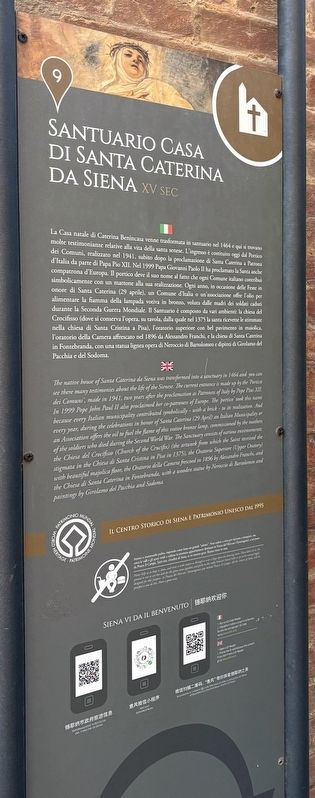
Santuario Casa di Santa Caterina da Siena. XV Sec, also, 15th Century. La Casa natale di Caterina Benincasa venne trasformata in santuario nel 1464 e qui si trovano molte testimonianze relative alla vita della santa senese. L'ingresso θ costituito oggi dal Portico dei Comuni, realizzato nel 1941, subito dopo la proclamazione di Santa Caterina a Patrona d'Italia da parte di Papa Pio XII. Nel 1999 Papa Giovanni Paolo II ha proclamato la Santa anche compatrona d'Europa. Il portico deve il suo nome al fatto che ogni Comune italiano contribui simbolicamente con un mattone alla sua realizzazione. Ogni anno, in occasione delle Feste in onore di Santa Caterina (29 aprile), un Comune d'Italia o un'associazione offre l'olio per alimentare la fiamma della lampada votiva in bronzo, voluta dalle madri dei soldati caduti durante la Seconda Guerra Mondiale. Il Santuario θ composto da vari ambienti: la chiesa del Crocifisso (dove si conserva l'opera, su tavola, dalla quale nel 1375 la santa ricevette le stimmate nella chiesa di Santa Cristina a Pisa), l'oratorio superiore con bel pavimento in maiolica, l'oratorio della Camera affrescato nel 1896 da Alessandro Franchi, e la chiesa di Santa Caterina in Fontebranda, con una statua lignea opera di Neroccio di Bartolomeo e dipinti di Girolamo del Pacchia e del Sodoma. , , The native house of Santa Caterina da Siena was transformed into a sanctuary in 1464 and you can see there many testimonies about the life of the Sienese. The current entrance is made up by the Portico dei Comuni', made in 1941, two years after the proclamation as Patroness of Italy by Pope Pius XII. In 1999 Pope John Paul II also proclaimed her co-patroness of Europe. The 'portico' took this name because every Italian municipality contributed symbolically - with a brick - to its realization. And every year, during the celebrations in honor of Santa Caterina (29 April) an Italian Municipality or an Association offers the oil to fuel the flame of this votive bronze lamp, commissioned by the mothers of the soldiers who died during the Second World War. The Sanctuary consists of various environments: the Chiesa del Crocifisso (Church of the Crucifix) (the artwork from which the Saint received the stigmata in the Chiesa di Sanza Cristina in Pisa in 1375), the Oratorio Superiore (Upper Oratory) with beautiful majolica floor, the Oratorio della Camera frescoed in 1896 by Alesandro Franchi, and the Chiesa di Santa Caterina in Fontebranda, with a wooden statue by Neraccio di Bartolomeo and paintings by Girolamo del Pacchia and Sodoma.
La Casa natale di Caterina Benincasa venne trasformata in santuario nel 1464 e qui si trovano molte testimonianze relative alla vita della santa senese. L'ingresso θ costituito oggi dal Portico dei Comuni, realizzato nel 1941, subito dopo la proclamazione di Santa Caterina a Patrona d'Italia da parte di Papa Pio XII. Nel 1999 Papa Giovanni Paolo II ha proclamato la Santa anche compatrona d'Europa. Il portico deve il suo nome al fatto che ogni Comune italiano contribui simbolicamente con un mattone alla sua realizzazione. Ogni anno, in occasione delle Feste in onore di Santa Caterina (29 aprile), un Comune d'Italia o un'associazione offre l'olio per alimentare la fiamma della lampada votiva in bronzo, voluta dalle madri dei soldati caduti durante la Seconda Guerra Mondiale. Il Santuario θ composto da vari ambienti: la chiesa del Crocifisso (dove si conserva l'opera, su tavola, dalla quale nel 1375 la santa ricevette le stimmate nella chiesa di Santa Cristina a Pisa), l'oratorio superiore con bel pavimento in maiolica, l'oratorio della Camera affrescato nel 1896 da Alessandro Franchi, e la chiesa di Santa Caterina in Fontebranda, con una statua lignea opera di Neroccio di Bartolomeo e dipinti di Girolamo del Pacchia e del Sodoma.
The native house of Santa Caterina da Siena was transformed into a sanctuary in 1464 and you
Click or scan to see this page online
can see there many testimonies about the life of the Sienese. The current entrance is made up by the Portico dei Comuni', made in 1941, two years after the proclamation as Patroness of Italy by Pope Pius XII. In 1999 Pope John Paul II also proclaimed her co-patroness of Europe. The 'portico' took this name because every Italian municipality contributed symbolically - with a brick - to its realization. And every year, during the celebrations in honor of Santa Caterina (29 April) an Italian Municipality or an Association offers the oil to fuel the flame of this votive bronze lamp, commissioned by the mothers of the soldiers who died during the Second World War. The Sanctuary consists of various environments: the Chiesa del Crocifisso (Church of the Crucifix) (the artwork from which the Saint received the stigmata in the Chiesa di Sanza Cristina in Pisa in 1375), the Oratorio Superiore (Upper Oratory) with beautiful majolica floor, the Oratorio della Camera frescoed in 1896 by Alesandro Franchi, and the Chiesa di Santa Caterina in Fontebranda, with a wooden statue by Neraccio di Bartolomeo and paintings by Girolamo del Pacchia and Sodoma.
2. Santuario Casa di Santa Caterina da Siena Marker
N, 11° 19.734′ E. Marker is in Siena, Toscana (Tuscany), in Provincia di Siena. It is on Costa Sant'Antonio near Vicolo del Tiratoio, on the left when traveling north. Touch for map. Marker is at or near this postal address: Costa Sant'Antonio 6, Siena, Toscana 53100, Italy. Touch for directions.
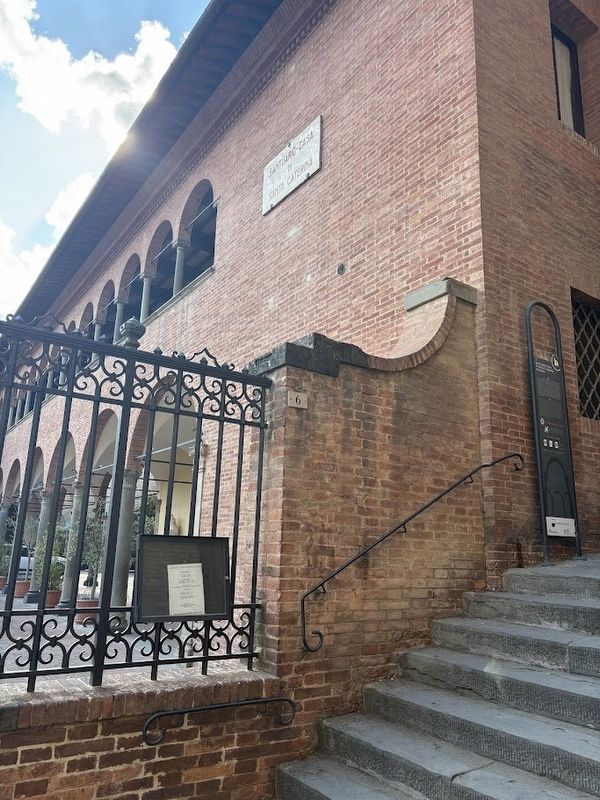
Regionally, it is in Europe, the European Union, the Schengen Area, a coastal Mediterranean country, and the Western World. Historically, it finds itself in what was once the Byzantine Empire, the Roman Empire, and specifically the Holy Roman Empire.
Regarding Santuario Casa di Santa Caterina da Siena. St. Catherine of Siena was born in Siena on March 25, 1347, and raised in this Tuscan town. Her head and other relics from her life are housed at the San Domenico Basilica, a short walk from here. The rest of her body is entombed in Rome.
Also see . . . Catherine of Siena (Wikipedia). (Submitted on September 4, 2025, by Sean P. Flynn of Oak Park, Illinois.)
Photographed by Sean P. Flynn, July 31, 2025
3. Santuario Casa di Santa Caterina da Siena Marker

Credits. This page was last revised on September 4, 2025. It was originally submitted on September 4, 2025, by Sean P. Flynn of Oak Park, Illinois. This page has been viewed 59 times since then and 11 times this year. Photos:1, 2, 3. submitted on September 4, 2025, by Sean P. Flynn of Oak Park, Illinois.