Roma in Città metropolitana di Roma Capitale, Latium, Rome, Italy — Central Italy (Tyrrhenian Coast)
Campo dei Fiori
Czesław Miłosz

Photographed by Sean P. Flynn, August 2, 2025
1. Campo dei Fiori Marker
Note: English language text for the poem can be found in the first link under "Also see...."
A Roma in Campo dei Fiori
ceste di olive e limoni,
spruzzi di vino per terra
e frammenti di fiori.
Rosati frutti di mare
vengono sparsi sui banchi,
bracciate d'uva nera
sulle pesche vellutate.
Proprio qui, su questa piazza
fu arso Giordano Bruno.
Il boia accese la fiamma
fra la marmaglia curiosa.
E non appena spenta la fiamma,
ecco di nuovo piene le taverne.
Ceste di olive e limoni
sulle teste dei venditori.
Mi ricordai di Campo dei Fiori
a Varsavia presso la giostra,
una chiara sera d'aprile,
al suono d'una musica allegra.
Le salve del muro del ghetto
soffocava l'allegra melodia
e le coppie si levavano
alte nel cielo sereno.
Il vento dalle case in fiamme
portava neri aquiloni,
la gente in corsa sulle giostre
acchiappava i fiocchi nell'aria.
Gonfiava le gonne alle ragazze
quel vento dalle case in fiamme,
rideva allegra la folla
nella bella domenica di Varsavia.
C'è chi ne trarrà la morale
che il popolo di Varsavia o Roma
commercia, si diverte, ama
indifferente ai roghi dei martiri.
Altri
this page online
sulla fugacità delle cose umane,
sull'oblio che cresce
prima che la fiamma si spenga.
Eppure io allora pensavo
alla solitudine di chi muore.
Al fatto che quando Giordano
sali sul patibolo
non trovò nella lingua umana
neppure un'espressione,
per dire addio all'umanità,
l'umanità che restava.
Rieccoli a tracannare vino,
a vendere bianche asterie,
ceste di olive e limoni
portavano con gaio brusio.
Ed egli già distava da loro
come fossero secoli,
essi attesero appena
il suo levarsi nel fuoco.
E questi, morenti, soli,
già dimenticati dal mondo,
la loro lingua ci è estranea
come lingua di antico pianeta.
Finché tutto sarà leggenda
e allora dopo molti anni
su un nuovo Campo dei Fiori
un poeta desterà la rivolta.
Varsavia, Pasqua 1943
Traduzione di Pietro Marchesani
Il poeta polacco Czesław Milosz (1911–2004), Premio Nobel per la Letteratura 1980, guardando il ghetto in fiamme paragonò la solitudine degli Ebrei morenti con quella di Giordano Bruno, morto sul rogo in Campo de' Fiori nell'anno 1600.
[English translation the Italian text at the bottom of this sign:]
The Polish poet Czesław Milosz (1911–2004), winner of the Nobel Prize in Literature in 1980, looking at the burning ghetto, compared the solitude of the dying Jews with that of Giordano Bruno, who died at the stake in Campo de' Fiori in 1600.
Topics and series.

Photographed by Sean P. Flynn, August 2, 2025
2. Campo de' Fiori
This historical marker is to the rear of the photo.
Location. 41° 53.717′ N, 12° 28.358′ E. Marker is in Roma, Lazio (Latium, Rome), in Città metropolitana di Roma Capitale. It is at the intersection of Campo de' Fiori and Via dei Giubbonari, on the right when traveling east on Campo de' Fiori. The marker is on the southeast end of Campo de' Fiori, near Cinema Farnese. Touch for map. Marker is at or near this postal address: Campo de' Fiori 56, Roma, Lazio 00186, Italy. Touch for directions.

Regionally, it is in Europe, the European Union, the Schengen Area, a coastal Mediterranean country, and the Western World. Historically, it finds itself in what was once the Roman Empire.
Other nearby markers. At least 8 other markers are within walking distance of this marker: Pio Papa IX / Pope Pius IX (within shouting distance of this marker); Giordano Bruno (within shouting distance of this marker); Guido Rattoppatore (about 90 meters away, measured in a direct line);
Photographed by Sean P. Flynn, August 2, 2025
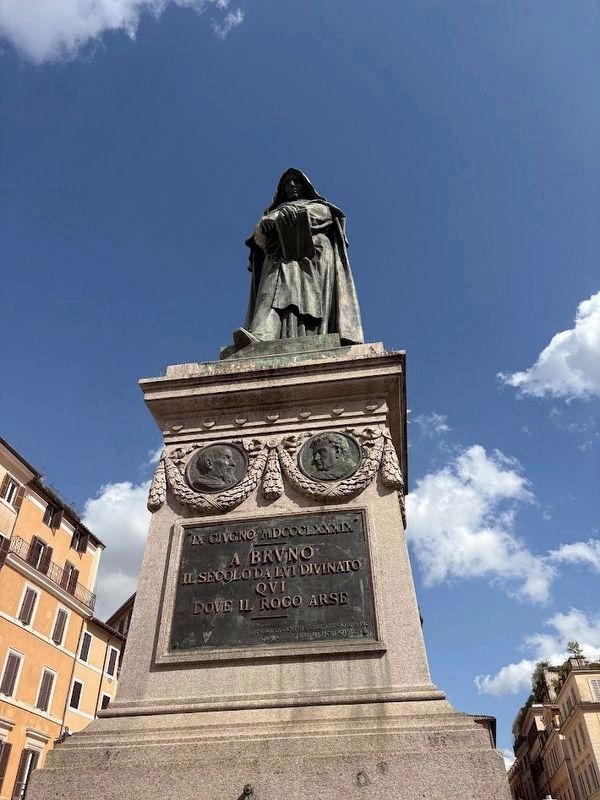
3. Giordano Bruno statue in Campo de' Fiori
This 1889 statue commemorates the spot in Campo de' Fiori where Giordano Bruno, an Italian philosopher, was burned at the stake for heresy. Bruno's killing is referenced in the poem honored on this historical marker.
More about this marker. "Varsavia" is Italian for Warsaw, and "Pasqua" means Easter.
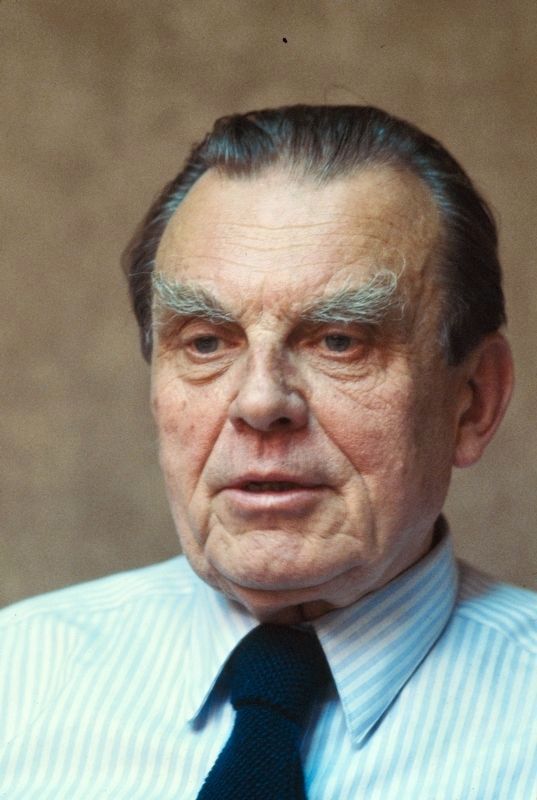
Regarding Campo dei Fiori. Born in Russian-occupied Lithuania in 1911, Czesław Miłosz lived in Warsaw for four years while it was occupied by German troops. Miłosz participated in underground activities, including aiding Warsaw's Jewish population, until Germany began destroying the city in 1944 after the Warsaw Uprising. Miłosz escaped captivity with his wife, Janina.
Giordano Bruno, whom Miłosz references in this poem, was a 16th-century Italian philosopher whose denial of Catholic doctrines drew the ire of the Church. Arrested in Venice in 1592, the next year he was transferred to Rome, where he was confined and tried by the Roman Inquisition for the next seven years. After a lengthy trial during which he defended his
Bernard Gotfryd; Courtesy of Library of Congress Prints and Photographs Division, 1980
4. Czesław Miłosz (1911-2004)
"Campo dei Fiori" was included in Miłosz's collection of poetry called Rescue, which was released in 1945 and included poetry written during the Nazi occupation of Warsaw.
Also see . . .
1. "Campo dei Fiori" poem in English. The poem is reprinted on the Poetry Foundation website. (Submitted on September 5, 2025, by Sean P. Flynn of Oak Park, Illinois.)
2. Britannica: Czesław Miłosz.
Excerpt: "Until 1980, when Miłosz was awarded the Nobel Prize for Literature, his work was banned in Poland because of his defiance of the country’s communist government. Yet he was widely admired there, and many underground editions of his poetry collections were printed. His winning the Nobel Prize led the Polish government to authorize an anthology of his poems, which sold a remarkable 200,000 copies."(Submitted on September 5, 2025, by Sean P. Flynn of Oak Park, Illinois.)
3. Poetry Foundation: Czesław Miłosz.
Excerpt: “Having lived under the two great totalitarian systems of modern history, national socialism and communism, Milosz wrote of the past in a tragic, ironic style that nonetheless affirmed the value of human life. While the faith of his Roman Catholic upbringing was severely tested, it remained intact. Terrence Des Pres, writing in the Nation, stated that 'political catastrophe has defined the nature of our [age], and the result—the collision of personal and public realms—has produced a new kind of writer. Czeslaw Milosz is the perfect example. In exile from a world which no longer exists, a witness to the Nazi devastation of Poland and the Soviet takeover of Eastern Europe, Milosz deals in his poetry with the central issues of our time: the impact of history upon moral being, the search for ways to survive spiritual ruin in a ruined world.'”(Submitted on September 5, 2025, by Sean P. Flynn of Oak Park, Illinois.)
Credits. This page was last revised on September 5, 2025. It was originally submitted on September 4, 2025, by Sean P. Flynn of Oak Park, Illinois. This page has been viewed 91 times since then and 17 times this year. Photos: 1. submitted on September 4, 2025, by Sean P. Flynn of Oak Park, Illinois. 2, 3, 4. submitted on September 5, 2025, by Sean P. Flynn of Oak Park, Illinois.
