Dolores in Montezuma County, Colorado — The American Mountains (Southwest)
Galloping Geese of the Rio Grande Southern Railroad
Photographed by Cosmos Mariner, July 17, 2025
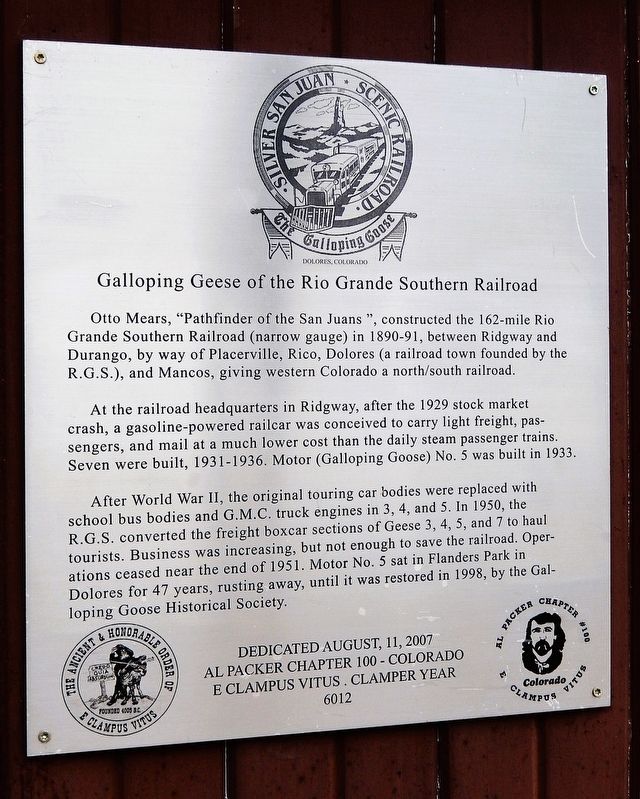
1. Galloping Geese of the Rio Grande Southern Railroad Marker
Otto Mears, “Pathfinder of the San Juans,” constructed the 162-mile Rio Grande Southern Railroad (narrow gauge) in 1890-91, between Ridgway and Durango, by way of Placerville, Rico, Dolores (a railroad town founded by the R.G.S.), and Mancos, giving western Colorado a north/south railroad.
At the railroad headquarters in Ridgway, after the 1929 stock market crash, a gasoline-powered railcar was conceived to carry light freight, passengers, and mail at a much lower cost than the daily steam passenger trains. Seven were built, 1931-1936. Motor (Galloping Goose) No. 5 was built in 1933.
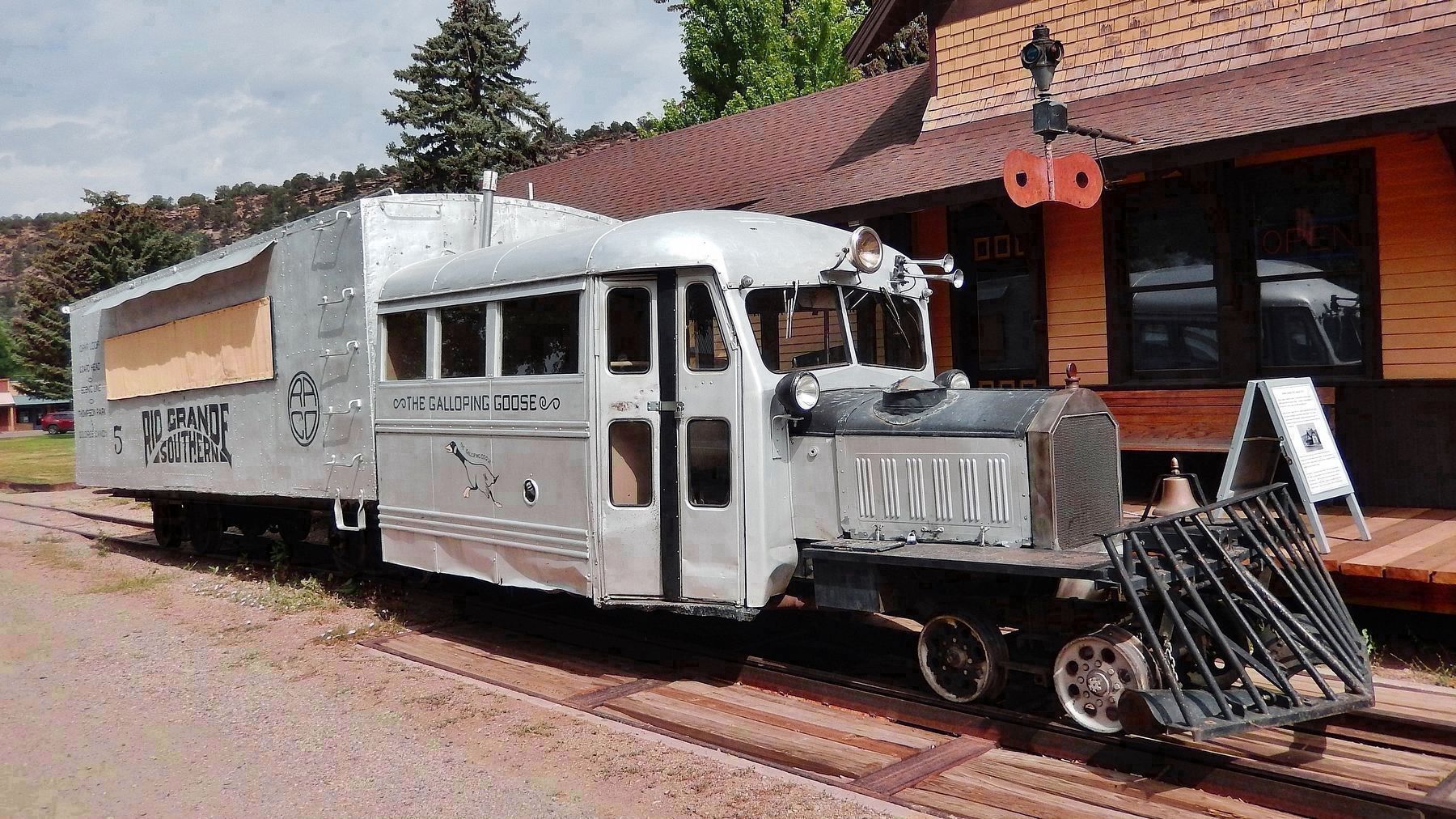
After World War II, the original touring car bodies were replaced with school bus bodies and G.M.C. truck engines in 3, 4, and 5. In 1950, the R.G.S. converted the freight boxcar sections of Geese 3, 4, 5, and 7 to haul tourists. Business was increasing, but not enough to save the railroad. Operations ceased near the end of 1951. Motor No. 5 sat in Flanders Park in Dolores for 47 years, rusting away, until it was restored in 1998, by the Galloping Goose Historical Society.
Erected 2007 by Al Packer Chapter 100, Colorado, E Clampus Vitus.
this page online
Topics and series. This historical marker is listed in these topic lists: Industry & Commerce • Railroads & Streetcars. In addition, it is included in the E Clampus Vitus series list. A significant historical year for this entry is 1933.
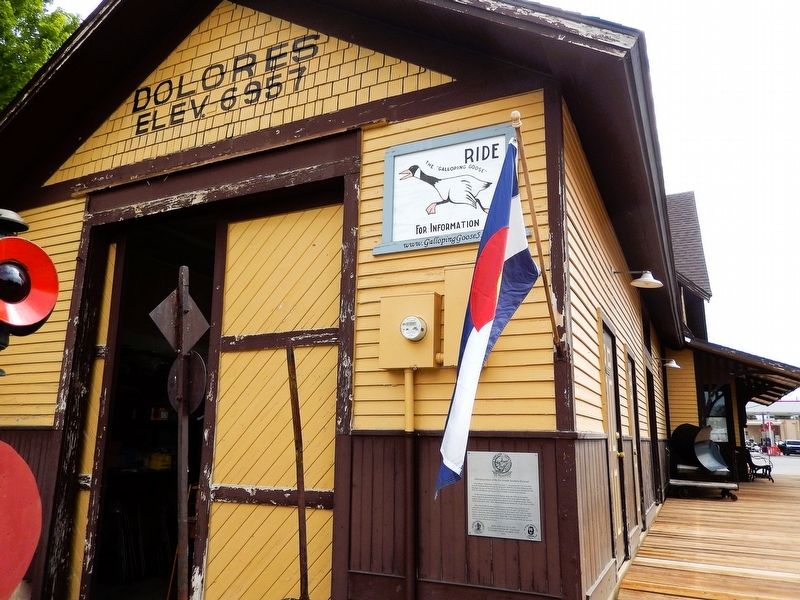
Location. 37° 28.413′ N, 108° 30.213′ W. Marker is in Dolores, Colorado, in Montezuma County. It can be reached from Railroad Avenue (State Highway 145) just west of 5th Street, on the left when traveling east. The marker is mounted on the west side of the Dolores Railroad Museum & Galloping Goose Historical Society building. Touch for map. Marker is at or near this postal address: 421 Railroad Avenue, Dolores CO 81323, United States of America. Touch for directions.

Regionally, this marker is in the American Mountain West, on the Colorado Plateau, and at the Four Corners. Globally, it is in North America, the Rocky Mountains, the Western Hemisphere, the Western World, and the Anglosphere. Historically, it finds itself in what was once the territory of the Ancestral Puebloans and also Mexico’s Alta California.
Other nearby markers. At least 8 other markers are within
Photographed by Cosmos Mariner, July 17, 2025
2. Galloping Geese of the Rio Grande Southern Railroad Marker
The marker is mounted on the west side of the Dolores Railroad Museum & Galloping Goose Historical Society building.
Related markers. Click here for a list of markers that are related to this marker. Galloping Geese of the Rio Grande Southern Railroad
Also see . . . Galloping Goose (Wikipedia).
Excerpt: “Galloping Goose” is the popular name given to a series of seven railcars built in the 1930s by the Rio Grande Southern Railroad (RGS) and operated until the end of service on the line in the early 1950s.(Submitted on September 6, 2025, by Cosmos Mariner of Cape Canaveral, Florida.)
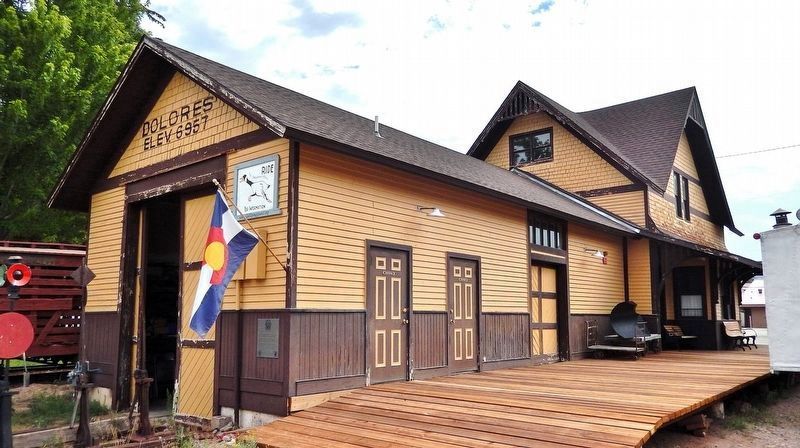
Originally running steam locomotives on narrow gauge railways, the perpetually struggling RGS developed the first of the “geese” as a way to keep its contract to run mailinto towns in the Rocky Mountains in Colorado. There was not enough passenger or cargo income to justify continuing the expensive steam train service at then-current levels.Photographed by Cosmos Mariner, July 17, 20253. Dolores Railroad Museum (southwest elevation)A recreation of the Dolores Railroad Station, it houses the Museum and the Galloping Goose Historical Society. This historical marker is visible on southwest [left] corner.
All of the “geese” were built in the railroad's shops at Ridgway, Colorado. The first was built in 1931 from the body of a Buick “Master Six” four-door sedan. It had a two-axle truck in place of the front axle. Part of the rear of the car was replaced by a truck stake-bed for carrying freight and mail; this was later enclosed and partially fitted with seating.
Initially, the “geese” were painted in black and dark green. In 1935 they were all painted in a silver scheme which they retain to this day, though the style of lettering and heralds changed over the years. In 1945, #3, #4, and #5 were rebuilt with Wayne bus bodies (at least the front half). This provided more passenger seating and comfort. A year later they also received new war surplus GMC engines.
In 1950, when the railroad finally lost its mail contract (in favor of highway mail carriers), #3, #4, #5, and #7 were converted for tourist operations. Large windows were cut into the sides of the freight compartments,and seating was added. A figure of a running goose and the words “Galloping Goose” were added to the carbody doors. This service lasted only two years, and the last work of the “geese” on their home line was to take up the rails.Photographed by Cosmos Mariner, July 17, 20254. Galloping Goose #5 on exhibit at the Dolores Railroad MuseumIt is unclear exactly where the name “Galloping Goose” comes from. It is mostly commonly suggested that it referred to the way the carbody and the freight compartment tended to rock back and forth on the line's sometimes precarious track.

Photographed by Cosmos Mariner, July 17, 2025
5. Galloping Goose #5: School bus body, G.M.C. truck engine, and a boxcar repurposed to haul tourists!
Credits. This page was last revised on March 24, 2026. It was originally submitted on September 4, 2025, by Cosmos Mariner of Cape Canaveral, Florida. This page has been viewed 114 times since then and 27 times this year. Photos: 1, 2, 3, 4, 5. submitted on September 6, 2025, by Cosmos Mariner of Cape Canaveral, Florida.
