Cranfills Gap in Bosque County, Texas — The American South (West South Central)
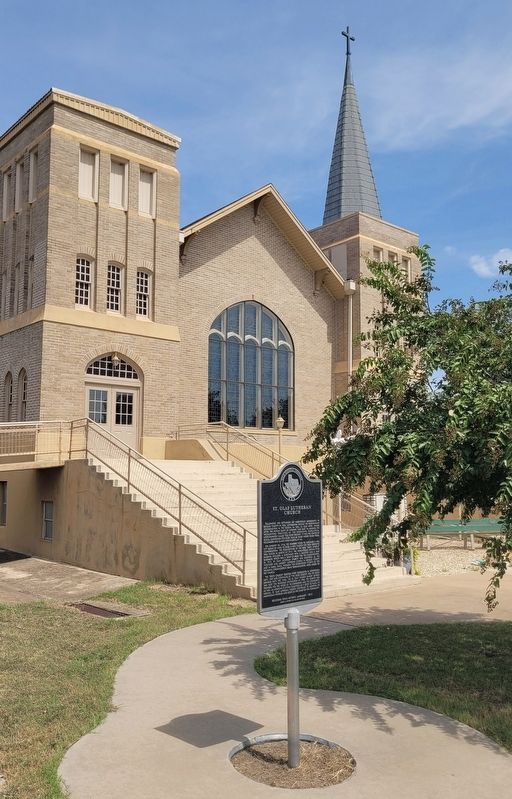
St. Olaf Lutheran Church

Photographed by James Hulse, September 5, 2025
1. St. Olaf Lutheran Church Marker
On January 10, 1914, the members voted to purchase a full city block of land to build a new church for their growing congregation. The cornerstone of the new "Brick Church" was placed in March of 1917. The Romanesque revival-style building included a sanctuary with a balcony and a half basement, which was a point of pride for the congregation. In 1917, St. Olaf Lutheran Church was described as the "costliest and largest" Lutheran Church in Bosque County and in rural Texas. Through the fundraising efforts of the Women's Organization many enhancements were added to the church.
The "Brick Church" services were conducted in Norwegian until 1927 and continued at "The Rock Church" for the older members until the 1940s. The St. Olaf Church Sunday School was built for religious instruction in 1954. The church has provided for the needs of its membership and the community, as well as missions in other countries as it seeks to fulfill its mission. St. Olaf Lutheran Church continues to maintain its Norwegian heritage and serve as the heart of the community.
Erected 2015 by Texas Historical Commission. (Marker Number 18219.)
Topics. This historical marker is listed in this topic list: Religion & Religious Structures. A significant historical date for this entry is January 10, 1914.
Location. 31° 46.498′ N, 97° 49.772′ W. Marker is in Cranfills Gap,
this page online

Regionally, this marker is in the Prairies & Lakes Region. Globally, it is in North America, a Gulf of Mexico state, the Western Hemisphere, the Western World, and the Anglosphere. Historically, it finds itself in what was once New Spain, the Republic of Texas, and one of the Confederate States of America.
Other nearby markers. At least 8 other markers are within 11 miles of this marker, measured as the crow flies: The Rock Church (approx. 3½ miles away); Cleng Peerson (approx. 8.8 miles away); Our Savior's Lutheran Church (approx. 8.9 miles away); Norse (approx. 9.4 miles away); Norwegian Settlements in Bosque County (approx. 10 miles away); Martin's Gap (approx. 10.4 miles away); United Methodist Church of Fairy (approx. 10.4 miles away); Fairy Cemetery (approx. 10½ miles away).
Photographed by James Hulse, September 5, 2025
2. St. Olaf Lutheran Church and Marker
Also see . . . Cranfills Gap: History and Community Overview. Texas State Historical Association (TSHA)
Cranfills Gap is at the intersection of State Highway 22 and Farm Road 219, forty-two miles northwest of Waco and fourteen miles southwest of Meridian in western Bosque County. The town is near a gap in a mountain on the border between Bosque and Hamilton counties. It is named for George Eaton Cranfill, who had settled near the site by 1851. Although the immediate area was a focus of settlement by 1858, the first sign of organized community development occurred in May 1879, when Sam Cranfill succeeded in moving a nearby Hamilton County post office, opened one month earlier by Samuel B. Crawford, across the county line into Cranfills Gap. The area may have had a horse-powered cotton gin at this time; Riley and Bud Ford opened the first store in 1882. By 1890 the town had two more stores, a blacksmith shop, a saloon, and two physicians. St. Olaf Kirche, a Lutheran church constructed of rock, was built in a rural Norwegian community in 1886 a few miles from Cranfills Gap. As the membership grew and more people lived in the(Submitted on September 5, 2025, by James Hulse of Medina, Texas.)gap, the parishioners grew tired of driving to the country for services and built a new brick church in Cranfills Gap in 1917. The old rock church, marked by a state historical marker, was still standing in 1989 and was used on special occasions.Photographed by James Hulse, September 5, 20253. The view of the St. Olaf Lutheran Church and Marker from the street

Credits. This page was last revised on September 5, 2025. It was originally submitted on September 5, 2025, by James Hulse of Medina, Texas. This page has been viewed 90 times since then and 41 times this year. Photos: 1, 2, 3. submitted on September 5, 2025, by James Hulse of Medina, Texas.
