Berliner Innenstadt in Tempelhof-Schöneberg, Germany — Northeast German Plain (The European Plain)
Die »Rote Insel«
The “Red Island”

Photographed by Andrew Ruppenstein, September 4, 2025
1. Die »Rote Insel« / The “Red Island” Marker - front side

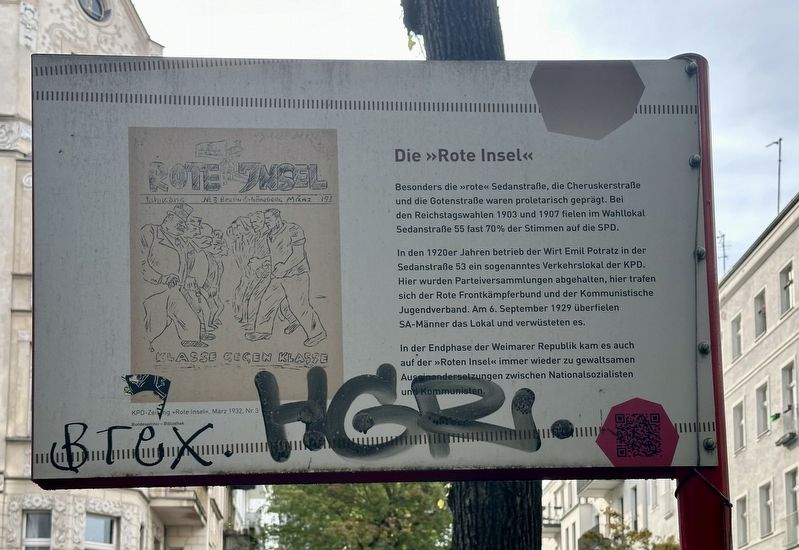
Die von Gleisen und Industrieanlagen gesäumte Insel war das »Eastend« von Schöneberg. Neben den Militärs lebten hier auch viele klassenbewusste Arbeiter. Sie standen politisch und kulturell den Sozialdemokraten und Kommunisten nahe, wählten also »rote«
Besonders die »rote« Sedanstraße, die Cheruskerstraße und die Gotenstraße waren proletarisch geprägt. Bei den Reichstagswahlen 1903 und 1907 fielen im Wahllokal Sedanstraße 55 fast 70% der Stimmen auf die SPD.
In den 1920er Jahren betrieb der Wirt Emil Potratz in der Sedanstraße 53 ein sogenanntes Verkehrslokal der KPD. Hier wurden Parteiversammlungen abgehalten, hier trafen sich
this page online
In der Endphase der Weimarer Republik kam es auch auf der »Rote Insel« immer wieder zu gewaltsamen Auseinandersetzungen zwischen Nationalsozialisten und Kommunisten.
(English translation:)
The origin and reason behind the nickname "Red Island" for Schöneberger Insel is a matter of debate. One story dates back to 1878 and claims that a local shopkeeper named Bäcker, who ran a drinks store at Sedanstraße 22 (now Leberstraße), hung a red flag out of his window as Emperor Wilhelm I passed by, in protest against the Anti-Socialist Laws. Another explanation derives the name from the red collar insignia worn by the railway troops stationed on the island.
The area, bordered by railway tracks and industrial facilities, was the "East End" of Schöneberg. Besides military personnel, many working-class residents lived there. Politically and culturally, they were close to the Social Democrats and Communists, and therefore tended to vote for "left-wing" parties.
The streets of Sedanstraße, Cheruskerstraße,
Photographed by Andrew Ruppenstein, September 4, 2025
2. Die »Rote Insel« / The “Red Island” Marker - rear side
In the 1920s, the innkeeper Emil Potratz ran a meeting place for the Communist Party of Germany (KPD) at Sedanstraße 53. Party meetings were held there, and it served as a gathering place for the Red Front Fighters League and the Communist Youth League. On September 6, 1929, members of the SA (Storm Detachments) raided the premises and vandalized it.
During the final years of the Weimar Republic, violent clashes between the Nazis and Communists occurred repeatedly in this area, which came to be known as the "Red Island."
Topics. This historical marker is listed in this topic list: Notable Places. A significant historical date for this entry is September 6, 1929.
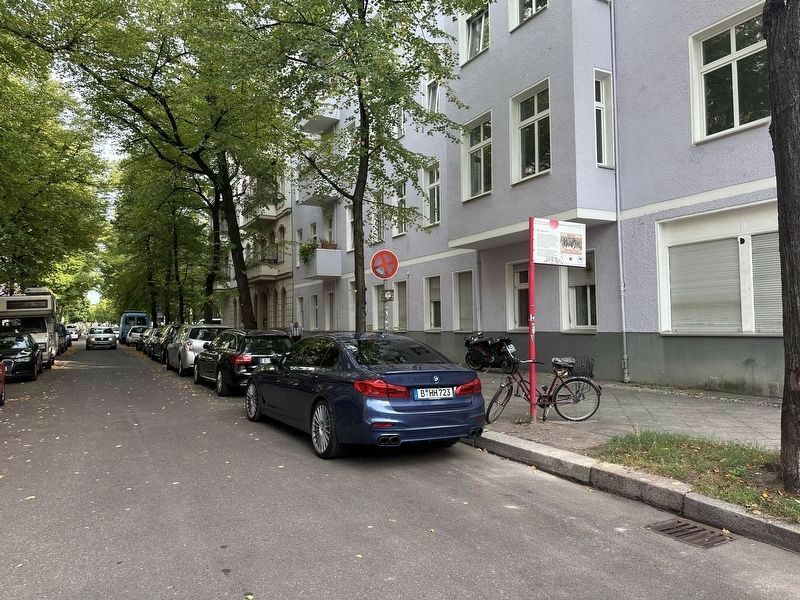
Location. 52° 28.88′ N, 13° 21.699′ E. Marker is in Berlin, in Tempelhof-Schöneberg. It is in Berliner Innenstadt. It is at the intersection of Leuthener Straße and Leberstraße, on the right when traveling east on Leuthener Straße. Touch for map. Marker is at or near this
Photographed by Andrew Ruppenstein, September 4, 2025
3. Die »Rote Insel« / The “Red Island” Marker - wide view, looking east on Leuthenerstraße

Regionally, it is in Europe, the European Union, Atlantic Europe, Central Europe, the Schengen Area, Western Europe, and the Western World. Historically, it finds itself in what was once the Holy Roman Empire, the former West Germany, and at the Berlin Wall.
Other nearby markers. At least 8 other markers are within 3 kilometers of this marker, measured as the crow flies: Hauptgeschäftsstraße der Insel / Main Commercial Street of the Island (about 150 meters away, measured in a direct line); Hildegard Knef (about 210 meters away); Die erste neue Straße / The First New Street (approx. 0.4 kilometers away); David Bowie (approx. 0.9 kilometers away); Kurt Hiller (approx. one kilometer away); Eagle Square (approx. 1.8 kilometers away); Hilde Radusch (approx. 1.9 kilometers away); Christopher Isherwood (approx. 2 kilometers away). Touch for a list and map of all markers in Berlin.
Also see . . . Rote Insel (Wikipedia). Overview:
On the Berlin city map, the neighborhood is located within a distinctive triangle bordered by railway lines in the southwestern corner of the city center. The large trenches dug to accommodate the tracks for trains and light-rail make crossing one of the many bridges that span the tracks, and that form the area into an "island", the only ways to access this part of Schöneberg. Its comparative isolation from the adjoining parts of Berlin is why the area is considered insular. Its peculiar history is indicative of the sharp contrasts with which modern German history since 1871 abounds. Up until the end of World War I, roughly half of the Island's territory was marked by its extensive use by the Prussian army, whereas the other half was a distinctively working-class residential district, dominated by voters of left-wing parties (hence the "red").(Submitted on September 6, 2025.)
Credits. This page was last revised on August 25, 2026. It was originally submitted on September 6, 2025, by Andrew Ruppenstein of Lamorinda, California. This page has been viewed 118 times since then and 44 times this year. Photos: 1, 2, 3. submitted on September 6, 2025, by Andrew Ruppenstein of Lamorinda, California.
