Großziethen in Schönefeld in Dahme-Spreewald, Brandenburg, Germany — Central Europe
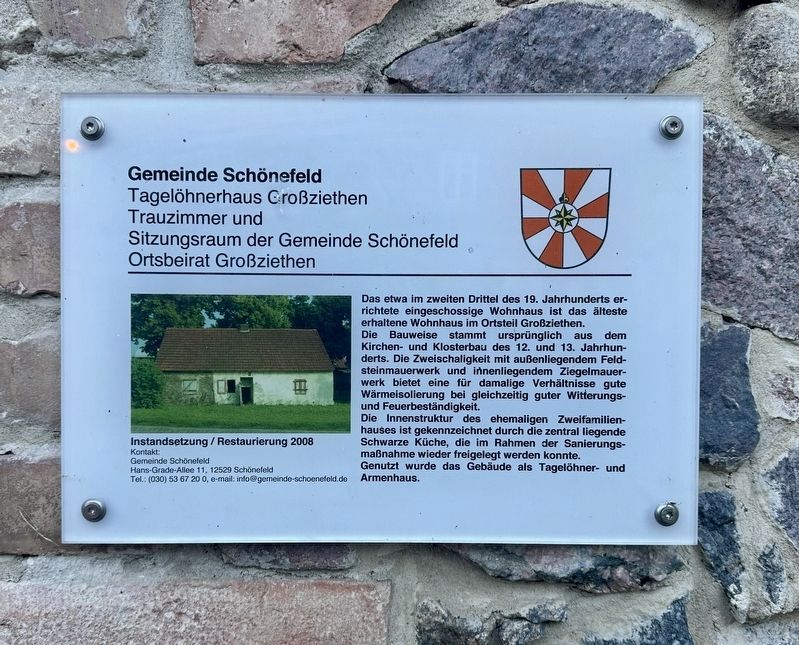
Tagelöhnerhaus
⎯⎯⎯
Day Laborers House
Photographed by Andrew Ruppenstein, September 2, 2025
1. Tagelöhnerhaus / Day Laborers House Marker

Trauzimmer und Sitzungsraum der Gemeinde Schönefeld
Ortsbeirat Großziethen
Das etwa im zweiten Drittel des 19. Jahrhunderts errichtete eingeschossige Wohnhaus ist das älteste erhaltene Wohnhaus im Ortsteil Großziethen.
Die Bauweise stammt ursprünglich aus dem Kirchen- und Klosterbau des 12. und 13. Jahrhunderts. Die Zweischaligkeit mit außenliegendem Feldsteinmauerwerk und innenliegendem Ziegelmauerwerk bietet eine für damalige Verhältnisse gute Wärmeisolierung bei gleichzeitig guter Witterungs- und Feuerbeständigkeit.
Die Innenstruktur des ehemaligen Zweifamilienhauses ist gekennzeichnet durch die zentral liegende Schwarze Küche, die im Rahmen der Sanierungsmaßnahme wieder freigelegt werden konnte.
Genutzt wurde das Gebäude als Tagelöhner- und Armenhaus.
Former laborers' house in Großziethen
Wedding ceremony and meeting room of the municipality of Schönefeld
Local council office for Großziethen
Built around the middle of the 19th century, this single-story house is the oldest surviving residential building in the Großziethen district.
This
this page online
The interior layout of the former two-family house is characterized by the central "black kitchen," which was uncovered during the renovation work.
The building was used as housing for day laborers and the poor.
Erected by Gemeinde Schönefeld.
Topics. This historical marker is listed in this topic list: Notable Buildings.
Location. 52° 23.715′ N, 13° 26.766′ E. Marker is in Schönefeld, Brandenburg, in Dahme-Spreewald. It is in Großziethen. It is on Alt Großziethen, in the median. Touch for map. Marker is at or near this postal address: Alt Großziethen 7, Schönefeld BB 12529, Germany. Touch for directions.

Regionally, this marker is in German Lusatia. Globally, it is in Europe, the European Union, Atlantic Europe, Central Europe, the Schengen
Photographed by Andrew Ruppenstein, September 2, 2025
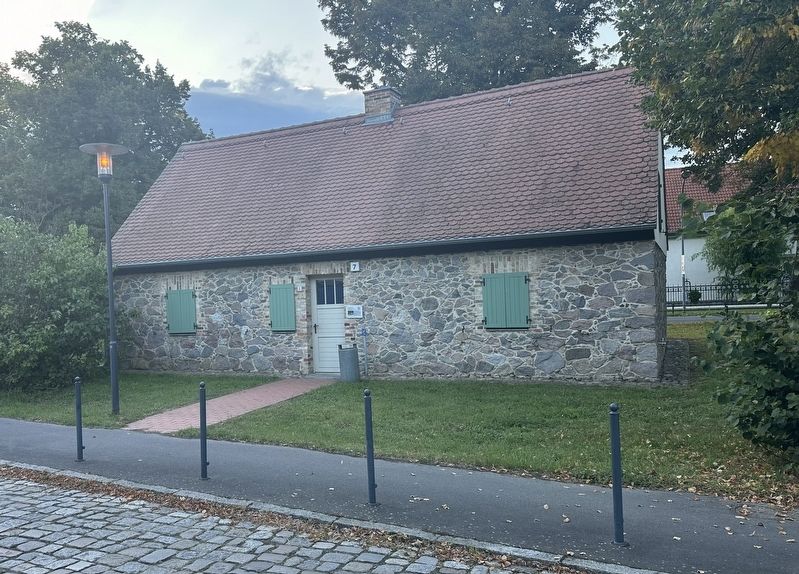
2. Tagelöhnerhaus / Day Laborers House and Marker
Other nearby markers. At least 8 other markers are within 11 kilometers of this marker, measured as the crow flies: Die Glocken der Dorfkirche Schönefeld / The Bells of the Schönefeld Village Church (approx. 4.2 kilometers away); Die Geschichte dahinter / The history behind (approx. 4.6 kilometers away); Berliner Mauer / Berlin Wall (approx. 4.6 kilometers away in Berlin); NS Zwangsarbeit in Adlerhof / Nazi Forced Labour in Adlerhof (approx. 7.9 kilometers away in Berlin); Rudolf Wagner Régeny (approx. 7.9 kilometers away in Berlin); Anna Seghers (approx. 8 kilometers away in Berlin); Eagle Square (approx. 10.6 kilometers away in Berlin); Die »Rote Insel« (approx. 11.2 kilometers away in Berlin). Touch for a list and map of all markers in Schönefeld.
Also see . . . Ziethener Lichterglanz: Tagelöhnerhaus (Grossziethener Kulturschmiede, in German). Excerpt:
The stone house, probably built in the second third of the 19th century, is, apart from the church, the oldest building and the oldest surviving residential building in Großziethen, and therefore has considerable historical and cultural significance for the village. The last resident was Katharina Glor. The building, which is a listed historic landmark, was purchased by the municipality of Großziethen in 2003 for 30,000 euros, and in 2008 it was extensively renovated by the municipality in accordance with the guidelines of the heritage conservation authorities. The total cost was 300,000 euros.(Submitted on September 7, 2025.)
The Schönefeld civil registry office has established a wedding ceremony room in the former farm worker's house. The first civil marriage ceremony took place there on June 13, 2008. The village council meetings were also held there, and the village mayor held his office hours in this building.
Inside the former two-family house is a so-called "black kitchen" (a central chimney for smoke extraction), which is visible from the outside by the chimney located in the center of the house. Around the kitchen are a common hallway, and on either side, two identical apartments, each consisting of a living room and one or two smaller rooms. "Here, two families and their animals once lived in very cramped quarters," says architect Karsten Standke, who supervised the renovation of the old farm worker's house.
Credits. This page was last revised on September 7, 2025. It was originally submitted on September 7, 2025, by Andrew Ruppenstein of Lamorinda, California. This page has been viewed 64 times since then and 10 times this year. Photos: 1, 2. submitted on September 7, 2025, by Andrew Ruppenstein of Lamorinda, California.
