Roma in Città metropolitana di Roma Capitale, Latium, Rome, Italy — Central Italy (Tyrrhenian Coast)
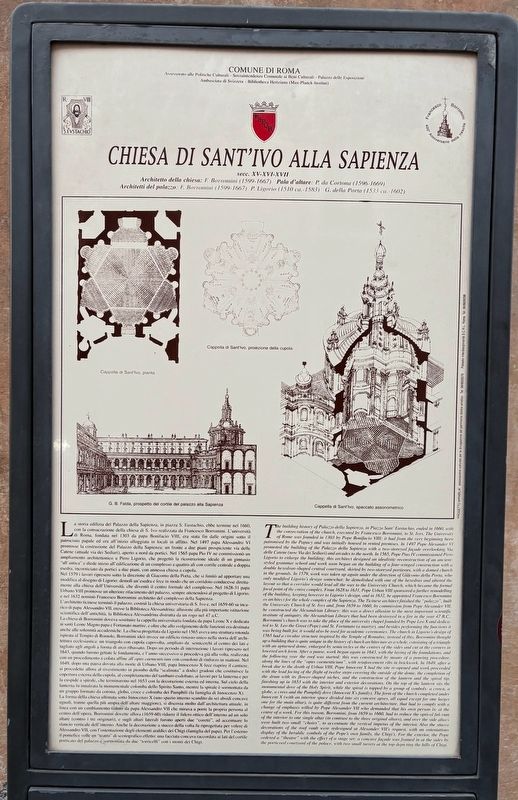
Chiesa di Sant'Ivo Alla Sapienza
secc. XV-XVI-XVII
⎯⎯⎯
The Church of Sant'Ivo alla Sapienza
15th-16th-17th century
Photographed by Sean P. Flynn, August 2, 2025
1. Chiesa di Sant'Ivo Alla Sapienza / The Church of Sant'Ivo alla Sapienza Marker
Architetti del palazzo: F. Borromini (1599-1667) P. Ligorio (1510 ca.-1583) G. della Porta (1533 са.-1602)
La storia edilizia del Palazzo della Sapienza, in piazza S. Eustachio, ebbe termine nel 1660, con la consacrazione della chiesa di S. Ivo realizzata da Francesco Borromini. L'università di Roma, fondata nel 1303 da papa Bonifacio VIII, era stata fin dalle origini sotto il patrocinio papale ed era all'inizio alloggiata in locali in affitto. Nel 1497 papa Alessandro VI promosse la costruzione del Palazzo della Sapienza: un fronte a due piani prospiciente via delle Catene (attuale via dei Sediari), aperto a nord da portici. Nel 1565 papa Pio IV ne commissionò un ampliamento architettonico a Pirro Ligorio, che progettò la ricostruzione ideale di un ginnasio "all'antica" e diede inizio all'edificazione di un complesso a quattro ali con cortile centrale a doppia esedra, incorniciato da portici a due piani, con annessa chiesa a cupola.
Nel 1579 i lavori ripresero sotto la direzione di Giacomo della Porta, che si limitò ad apportare una modifica al disegno di Ligorio: demolì un'esedra e fece in modo che un corridoio conducesse direttamente alla chiesa dell'Università, che diventò il centro formale del complesso. Nel 1628-31 papa Urbano VIII promosse un ulteriore rifacimento del palazzo, sempre attenendosi al progetto di Ligorio. e nel 1632 nomino Francesco Borromini architetto del complesso della Sapienza.
L'architetto ticinese terminò il palazzo, costrui la chiesa universitaria di S. Ivo e, nel 1659-60 su inca-rico di papa Alessandro VII, eresse la Biblioteca Alessandrina: allusione alla più importante istituzione scientifica dell'antichità, la Biblioteca Alessandrina distrutta da un rogo nel 47 a.C.
La
this page online
Photographed by Sean P. Flynn, August 2, 2025
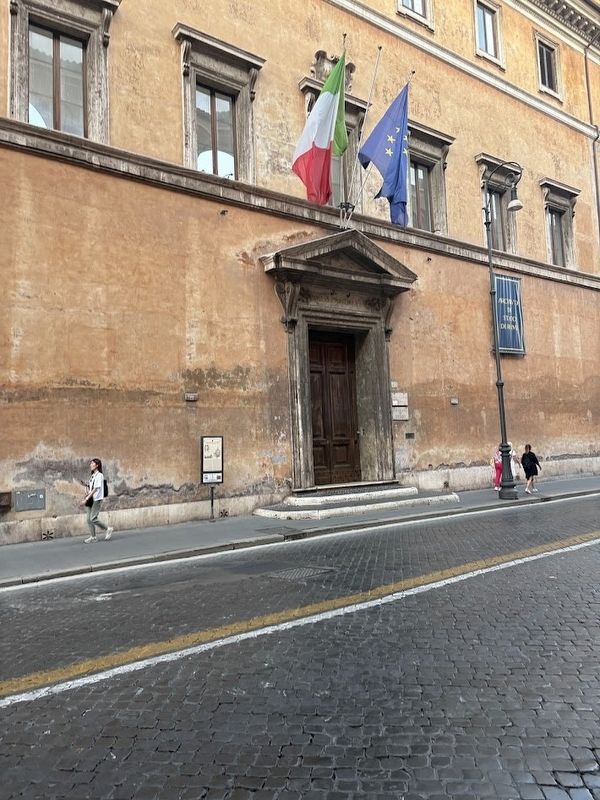
2. Chiesa di Sant'Ivo Alla Sapienza / The Church of Sant'Ivo alla Sapienza Marker
La forma della chiesa ultimata sotto Innocenzo X (uno spazio interno scandito da sei absidi concave uguali, tranne quella più ampia dell'altare maggiore), si discosta molto dall'architettura attuale, in linea con un cambiamento voluto da papa Alessandro VII che mirava a porre la propria persona al centro dell'opera. Borromini dovette allora (1659-60) ridurre il fulcro ottico dell'interno ad un solo altare (contro i tre originari), e sugli altari laterali furono aperti due "coretti", ad accentuare lo slancio verticale dell'interno. Anche la decorazione a stucco della volta fu riprogettata per volere di Alessandro VII, con l'ostentazione degli elementi araldici dei Chigi (famiglia del papa). Per l'esterno il pontefice volle un "teatro" di scenografico effetto, una facciata concava raccordata ai lati del cortile porticato del palazzo e sormontata da due "torricelli" con i monti
Photographed by Sean P. Flynn, August 2, 2025
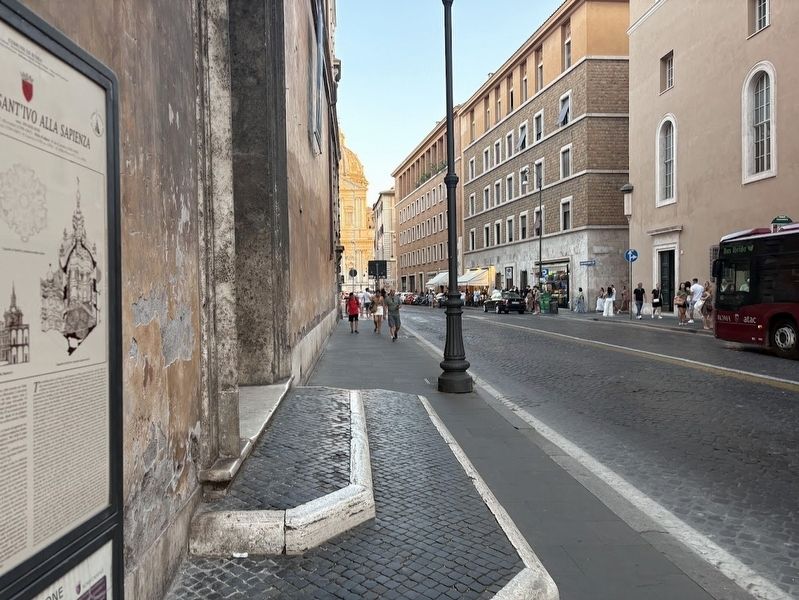
3. Chiesa di Sant'Ivo Alla Sapienza
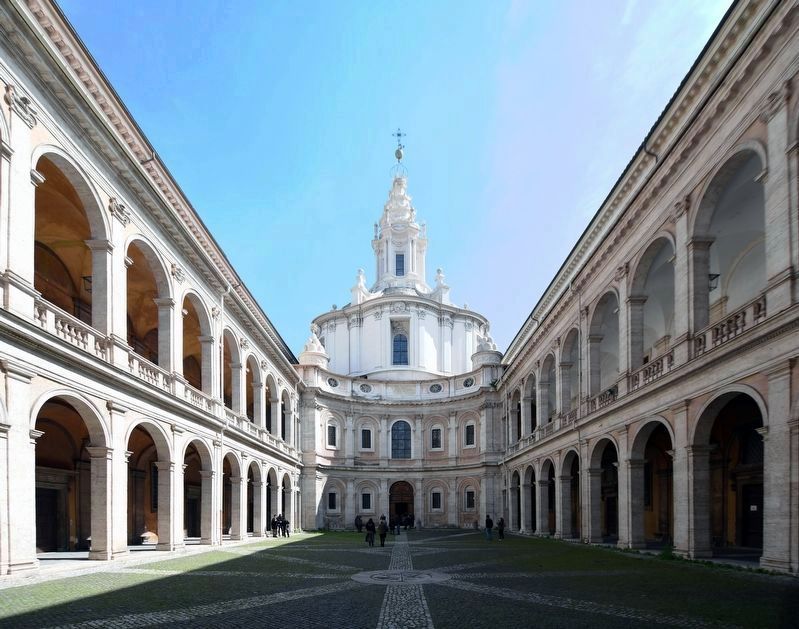
The building history of Palazzo della Sapienza, in Piazza Sant'Eustachio, ended in 1660, with the consecration of the church, executed by Francesco Borromini, to St. Ives. The University of Rome was founded in 1303 by Pope Bonifacio VIII: it had from the very beginning been patronised by the Papacy and was initially housed in rented premises. In 1497 Pope Alexander VI promoted the building of the Palazzo della Sapienza with a two-storeyed façade overlooking Vio delle Catene (now Via dei Sediari) and arcades to the north. In 1565, Pope Pius IV commissioned Pirro Ligorio to enlarge the building; this architect designed an idealistic reconstruction of an ancient-styled grammar school and work soon began on the building of a four-winged construction with a double hexedran-shaped central courtyard, skirted by two-storeyed porticoes, with a domed church in the grounds. In 1579, work was taken up again under the direction of Giacomo della Porta, who only modified Ligorio's design somewhat: he demolished with one of the hexedrus and altered the layout so that a corridor would lead all the way to the University Church, which became the formal focal point of the entire complex. From 1628 to 1631, Pope Urban VIII sponsored a further remodelling of the building, keeping however to Ligorio's design, and in 1632, he appointed Francesco Borromini as architect for the whole complex of the Sapienza. The Ticinese architect finished the "palazzo", built the University Church of St. Ives and, from 1659 to 1660, by commission from Pope Alexander VII, he constructed the Alexandrian Library: this was a direct allusion to the most important scientific institute of antiquity, the Alexandrian Library that had been destroyed in a fire in the year 47 B.C.. Borromini's church was to take the place of the university chapel founded by Pope Leo X and dedicated to St. Leo the Great (Pope) and St. Fortunato (a martyr), and besides performing the functions it was being built for, it would also be used for academic ceremonies. The church in Ligorio's design of 1565 had a circular structure inspired by the Temple of Romulus; instead of this, Borromini thought up a building that is quite unique in the history of church architecture as a whole, consisting of a triangle with an upturned dome, enlarged by semicircles at the centres of the sides and cut at the corners in lowered arch form. After a purse, work began again in 1643, with the laying of the foundations, and the following year the roof was started: this was constructed by means of a pouring procedure. along the lines of the "opus cuementician", with reinforcement ribs in brickwork. In 1649, after a break due to the death of Urban VIII, Pope Innocent X hod the site re-opened and work proceeded with the lead facing of the flight of twelve steps covering the outside of the dome, the completion of the drum with its flower-shaped niches, and the construction of the lantern and the spiral tip, finishing up in 1653 with the interior and exterior decorations. On the top of the lantern sits the monumental dove of the Holy Spirit, while the spirul is topped by a group of symbols: a crown, a globe, a cross and the Pamphilj dove (Innocent X's family). The form of the church completed under Innocent X (with an interior space divided into six concave apses, all equal except for one larger one for the main altar), is quite different from the current architecture, that had to comply with a change of emphasis willed by Pope Alesunder VII who demanded that his own person be at the centre of a work. For this reason, Borromini, from 1659 to 1660, had to reduce the optical fulcrum of the interior to one single altar (in contrast to the three original altars), and over the side altars were built two small "choirs", to accentuate the vertical impetus of the interior. Also the stucco decorations of the roof vault were redesigned at Alexander VII's request, with an ostentatious display of the heraldic symbols of the Pope's own family, the Chigi's. For the exterior, the Pope ordered a "theatre" with the effect of a stage set: a concave façade wax framed in at the sides by the porticoed courtyard of the palace, with two small turrets at the top depicting the hills of Chigi.
Erected by the
Paris Orlando (CC BY-SA 4.0), courtesy of Wikimedia Commons, March 25, 2018
4. Inside the courtyard of the Church of Sant'Ivo alla Sapienza
Topics. This historical marker is listed in these topic lists: Architecture • Religion & Religious Structures. A significant historical year for this entry is 1660.
Location. 41° 53.892′ N, 12° 28.434′ E. Marker is in Roma, Lazio (Latium, Rome), in Città metropolitana di Roma Capitale. It is on Corso del Rinascimento north of Via dei Canestrari, on the left when traveling south. The marker is in front of the church's west entrance. Touch for map. Marker is at or near this postal address: Corso del Rinascimento 40, Roma, Lazio 00186, Italy. Touch for directions.

Regionally, it is in Europe, the European Union, the Schengen Area, a coastal Mediterranean country, and the Western World. Historically, it finds itself in what was once the Roman Empire.
Other nearby markers. At least 8 other markers are within walking distance of this marker: Pilastro dello Stadio di Domiziano / Pillar of the Stadium of Domitian (about 90 meters away, measured in a direct line); Pamphilj Palace on Navona Square (about 90 meters away); 13th Century St. Gregory Monastery Cross-stone (about 120 meters away); Galleria Spada / Spada Gallery (about 150 meters away); Piazza Massimo Alle Colonne (about 180 meters away); Libreria Croce (about 180 meters away); Adelaide Ristori and Aldo Palazzeschi (about 180 meters away); Adelaide Ristori Capranica del Grillo and Aldo Palazzeschi (about 180 meters away). Touch for a list and map of all markers in Roma.
More about this marker. Architetto della chiesa" translates to architect of the church. "Pala d'altare" is altarpiece. "Architetti del palazzo" is architects of the palace.
Regarding Chiesa di Sant'Ivo Alla Sapienza / The Church of Sant'Ivo alla Sapienza. Saint Ivo of Kermartin (often in English as Yves or Ives) was a priest and lawyer who lived in France's Brittany region in the late 13th century. He is the patron saint of Brittany, lawyers and abandoned children.
Also see . . . The Church of Sant'Ivo alla Sapienza. From Rome's official tourism site. (Submitted on September 8, 2025, by Sean P. Flynn of Oak Park, Illinois.)
Credits. This page was last revised on September 8, 2025. It was originally submitted on September 8, 2025, by Sean P. Flynn of Oak Park, Illinois. This page has been viewed 129 times since then and 37 times this year. Photos: 1, 2, 3, 4. submitted on September 8, 2025, by Sean P. Flynn of Oak Park, Illinois.
