Old University in Guelph in Wellington County, Ontario — Central Canada (North America)
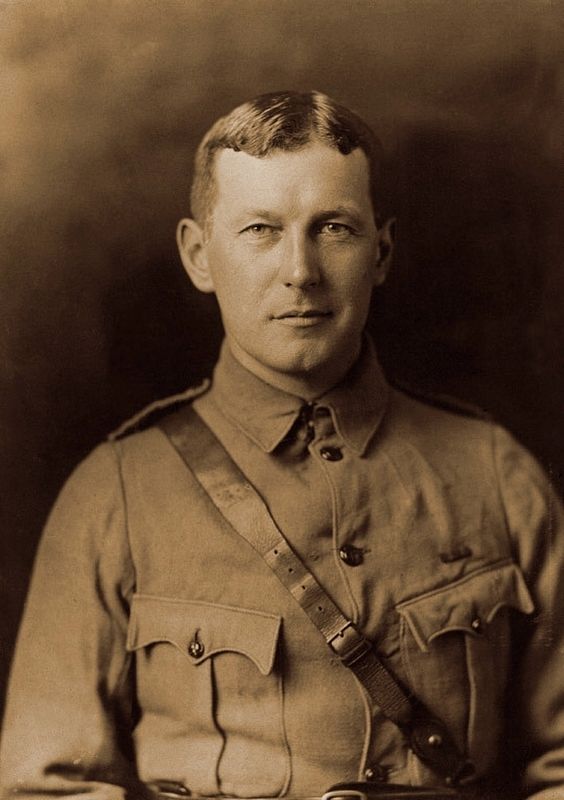
Lieutenant-Colonel John McCrae
1872-1918
Photographed by Tim Boyd, September 1, 2025
1. Lieutenant-Colonel John McCrae Marker
Inscription.
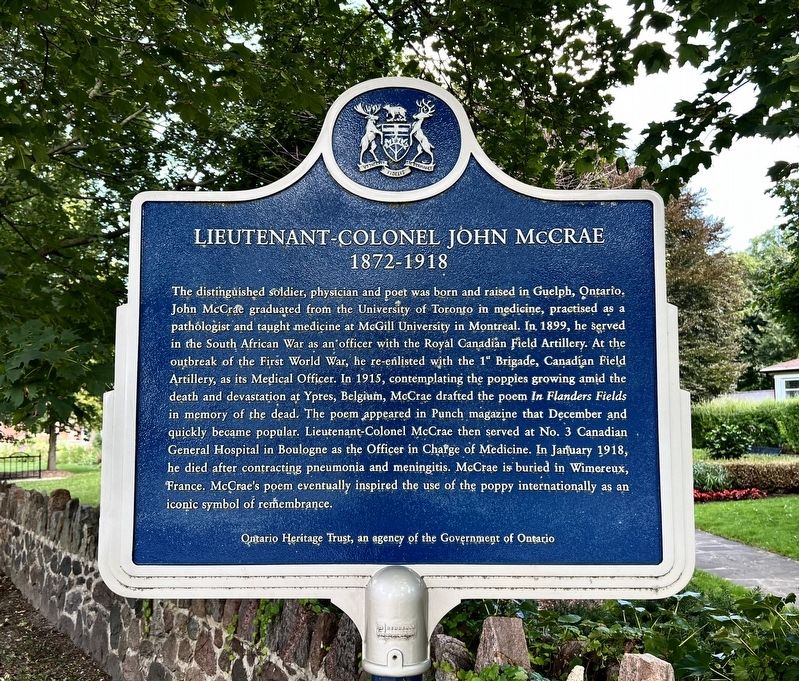
The distinguished soldier, physician and poet was born and raised in Guelph, Ontario. John McCrae graduated from the University of Toronto in medicine, practised as a pathologist and taught medicine at McGill University in Montreal. In 1899, he served in the South African War as an officer with the Royal Ganadian Field Artillery. At the outbreak of the First World War, he re-enlisted with the 1st Brigade, Canadian Field Artillery, as its Medical Officer. In 1915, contemplating the poppies growing amid the death and devastation at Ypres, Belgium, McCrae drafted the poem In Flanders Fields in memory of the dead. The poem appeared in Punch magazine that December and quickly became popular. Lieutenant-Colonel McCrae then served at No. 3 Canadian General Hospital in Boulogne as the Officer in Charge of Medicine. In January 1918, he died after contracting pneumonia and meningitis. McCrae is buried in Wimereux, France. McCrae's poem eventually inspired the use of the poppy internationally as an iconic symbol of remembrance.
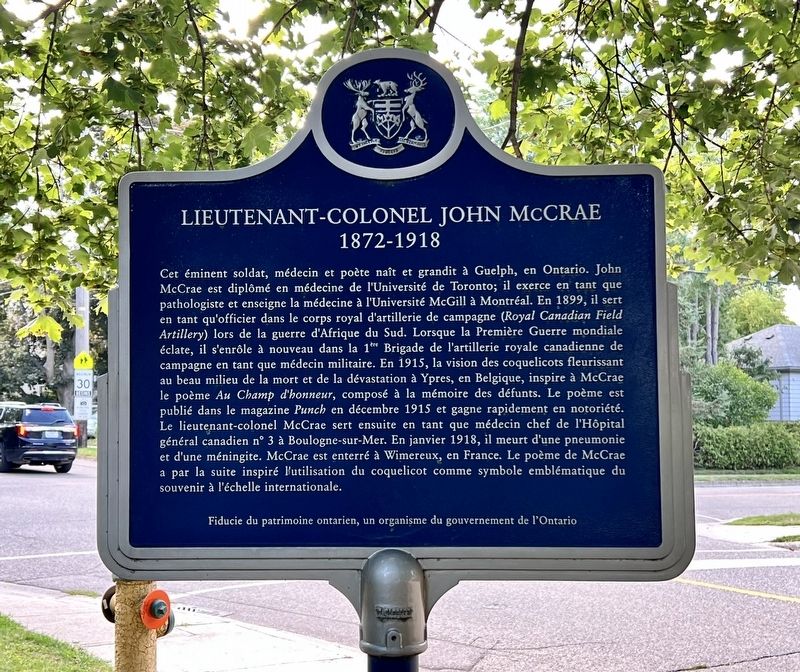
Cet éminent soldat, médecin et poète naît et grandit à Guelph, en Ontario. John McCrae est diplômé
Click or scan to see this page online
en médecine de l'Université de Toronto; il exerce en tant que pathologiste et enseigne la médecine à l'Université McGill à Montréal. En 1899, il sert en tant qu'officier dans le corps royal d'artillerie de campagne (Royal Canadian Field Artillery) lors de la guerre d'Afrique du Sud. Lorsque la Première Guerre mondiale éclate, il s'enrôle à nouveau dans la 1ère Brigade de l'artillerie royale canadienne de campagne en tant que médecin militaire. En 1915, la vision des coquelicots fleurissant au beau milieu de la mort et de la dévastation à Ypres, en Belgique, inspire à McCrae le poème Au Champ d'honneur, composé à la mémoire des défunts. Le poème est publié dans le magazine Punch en décembre 1915 et gagne rapidement en notoriété.
Le lieutenant-colonel McCrae sert ensuite en tant que médecin chef de l'Hôpital général canadien n° 3 à Boulogne-sur-Mer. En janvier 1918, il meurt d'une pneumonie et d'une méningite. McCrae est enterré à Wimereux, en France. Le poème de McCrae a par la suite inspiré l’utilisation du coquelicot comme symbole emblématique du souvenir à l'échelle internationale.
Erected by Ontario Heritage Trust.
Topics and series.
Photographed by Tim Boyd, September 1, 2025
2. Lieutenant-Colonel John McCrae Marker [français]
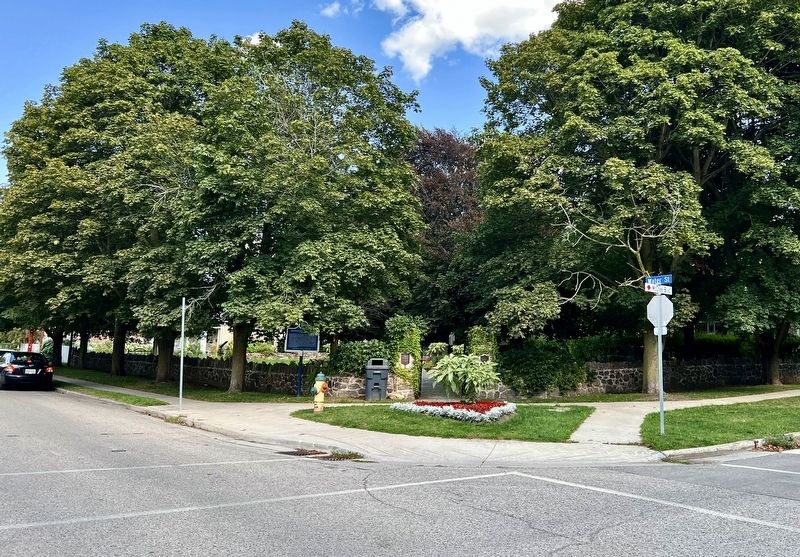
Location. 43° 32.16′ N, 80° 14.708′ W. Marker is in Guelph, Ontario, in Wellington County. It is in Old University. It is at the intersection of Water Street and McCrae Boulevard, on the right when traveling east on Water Street. Touch for map. Marker is at or near this postal address: 10 McCrae Boulevard, Guelph ON N1G N1G, Canada. Touch for directions.
Regionally, this marker is in the Huron-Perth-Waterloo-Wellington Area and in Southwestern Ontario. It is also in Central Canada. Globally, it is in North America, the Western Hemisphere, the Western World, and the Anglosphere. Historically, it finds itself in what was once a British colony, the Viceroyalty of New France, the Haudenosaunee (Iroquois) Confederacy, and Rupert’s Land.
Other nearby markers. At least 8 other markers are within walking distance of this marker: McCrae House / La Maison McCrae (within shouting distance of this marker);
Photographed by Tim Boyd, September 1, 2025
3. Lieutenant-Colonel John McCrae Marker
At the northeast corner of the McCrae House National Historic Site
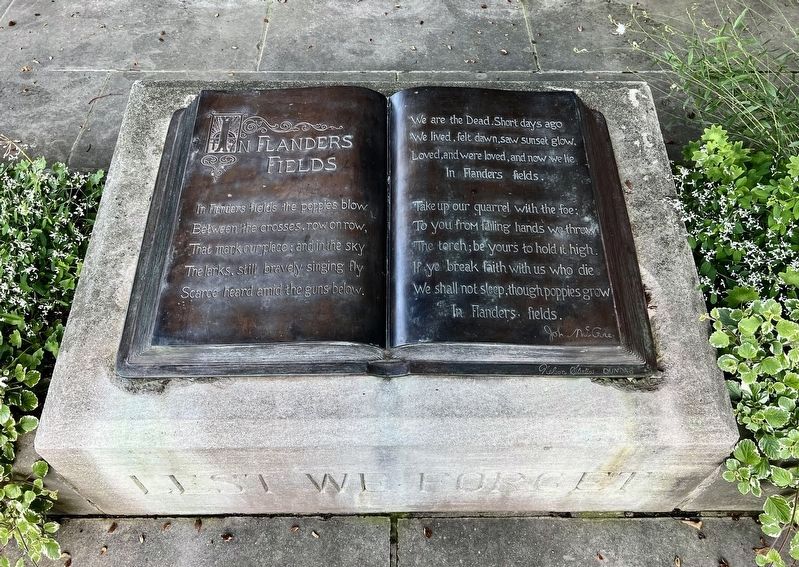
Part of the memorial in the John McCrae Memorial Gardens of the McCrae House
Photographed by Tim Boyd, September 1, 2025
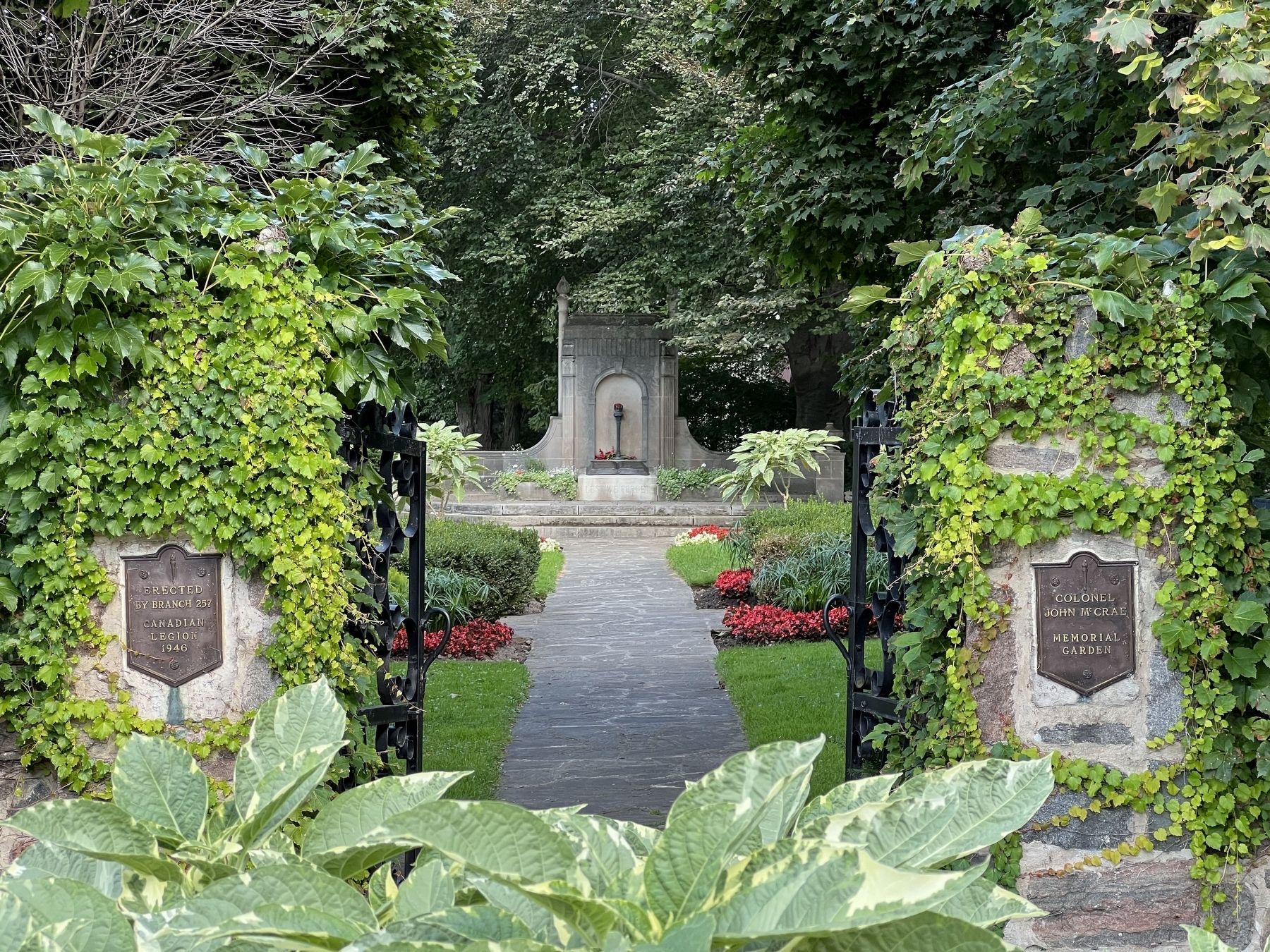
6. Entrance to the John McCrae Memorial Garden, McCrae House National Historic Site
Credits. This page was last revised on September 14, 2025. It was originally submitted on September 8, 2025, by Tim Boyd of Hamilton, Ontario. This page has been viewed 70 times since then and 25 times this year. Photos:1, 2, 3, 4, 5, 6. submitted on September 8, 2025, by Tim Boyd of Hamilton, Ontario. • Andrew Ruppenstein was the editor who published this page.