Roma in Città metropolitana di Roma Capitale, Latium, Rome, Italy — Central Italy (Tyrrhenian Coast)
Palazzo del Monte di Pietà
secc. XV-XVII-XVIII-XIX
⎯⎯⎯
Palace of the Pawnshop
15th-17th-18th-19th century
Photographed by Sean P. Flynn, August 2, 2025
1. Palazzo del Monte di Pietà Marker
Scultori: D. Guidi (1625-1701) F. Moderati (1680 ca.-post 1724) P. Le Gros il Giovane (1666-1719) R. Cametti (1669-1736) G. Mazzuoli (1644-1725) J. B. Theodon (1646-1713) A. Cornacchini (1683-1740)
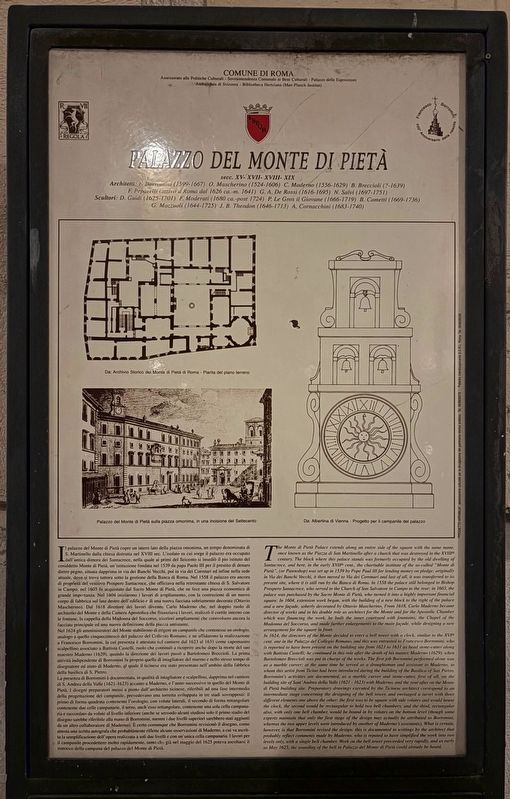
Il palazzo del Monte di Pietà copre un intero lato della piazza omonima, un tempo denominata di S. Martinello dalla chiesa distrutta nel XVIII sec. L'isolato su cui sorge il palazzo era occupato dall'antica dimora dei Santacroce, nella quale ai primi del Seicento si insedio il pio istituto del cosiddetto Monte di Pietà, un'istituzione fondata nel 1539 da papa Paolo III per il prestito di denaro dietro pegno, situata dapprima in via dei Banchi Vecchi, poi in via dei Coronari ed infine nella sede attuale, dove si trova tuttora sotto la gestione della Banca di Roma. Nel 1558 il palazzo era ancora di proprietà del vescovo Prospero Santacroce, che officiava nella retrostante chiesa di S. Salvatore in Campo; nel 1603 fu acquistato dal Sacro Monte di Pietà, che ne fece una piazza economica di grande importanza. Nel 1604 iniziarono i lavori di ampliamento, con la costruzione di un nuovo corpo di fabbrica sul lato destro dell'edificio e di una nuova facciata sobriamente decorata (Ottavio Mascherino). Dal 1618 direttore dei lavori divenne Carlo Maderno che, nel doppio ruolo di architetto del Monte e della Camera Apostolica che finanziava i lavori, realizzó il cortile interno con le fontane, la cappelia della Madonna del Soccorso, ulteriori ampliamenti che coinvolsero ancora la facciata principale ed una nuova definizione della piazza antistante.
Nel 1624 gli amministratori del Monte stabilirono di erigere un campanile che contenesse un orologio, analogo a quello cinquecentesco del palazzo del Collegio Romano, e ne affidarono la realizzazione a Francesco Borromini, la cui presenza è attestata nel cantiere dal 1623 al 1631 come capomastro scalpellino associato a Battista Castelli, ruolo che continuò a ricoprire anche dopo la morte del suo maestro Maderno
this page online
La presenza di Borromini è documentata, in qualità di mtagliatore e scalpellino, dapprima nel cantiere di S. Andrea della Valle (1621-1623) accanto a Maderno, e l'anno successivo in quello del Monte di Pietà. I disegni preparatori messi a punto dall'architetto ticinese, riferibili ad una fase intermedia della progettazione del campanile, prevedevano una torretta sviluppata in tre stadi sovrapposti: il primo di forma quadrata contenente l'orologio, con volute laterali, il secondo di forma rettangolare contenente due celle campanarie, il terzo, anch'esso rettangolare, contenente una sola cella campana-ria e raccordato da volute al livello inferiore (anche se secondo alcuni studiosi solo il primo stadio del disegno sarebbe riferibile alla mano di Borromini, mentre i due livelli superiori sarebbero stati aggiunti da un altro collaboratore di Maderno). È certo comunque che Borromini revisionò il disegno, come attesta una scritta autografa che probabilmente riflette alcune osservazioni di Maderno, a cui va ascrita la semplificazione dell'opera realizzata a soli due livelli e con un'unica cella campanaria. I lavoni per il campanile procedettero molto rapidamente, tanto

Photographed by Sean P. Flynn, August 2, 2025
2. Palazzo del Monte di Pietà / Palace of the Pawnshop Marker
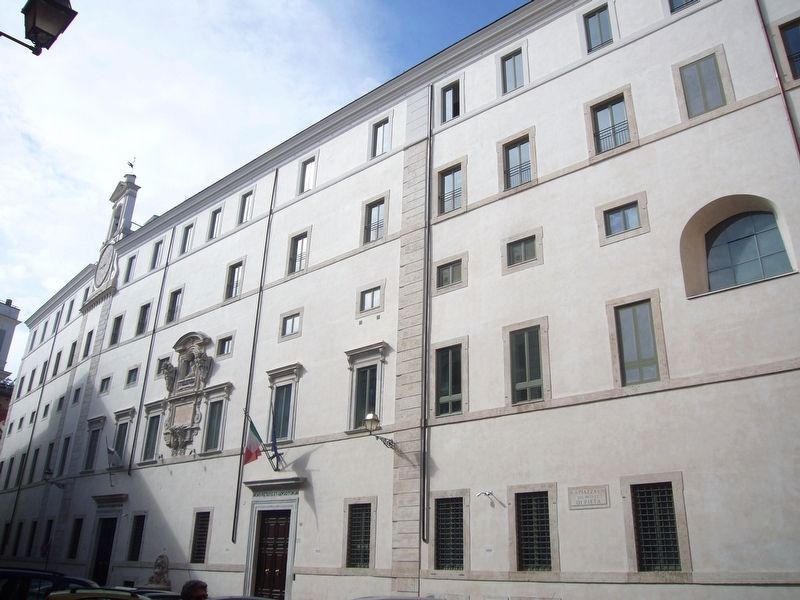
The Monte di Pietà Palace extends along an entire side of the square with the same name. Once known as the Piazza di San Martinello after a church that was destroyed in the XVIIIth century. The block where this palace stands was formerly occupied by the old dwelling of Santacroce, and here, in the early XVIIth cent., the charitable institute of the so-called "Monte di Pietà", (or Pawnshop) was set up in 1539 by Pope Paul III for lending money on pledge: originally in Via dei Banchi Vecchi, it then moved to Via dei Coronari and last of all, it was transferred to its present site, where it is still run by the Banca di Roma. In 1558 the palace still belonged to Bishop Prospero Santacroce, who served in the Church of San Salvatore in Campo to the rear; in 1603, the palace was purchased by the Sacro Monte di Pietà, who turned it into a highly important financial square. In 1604, extension work began, with the building of a new block to the right of the palace and a new façade, soberly decorated by Ottavio Mascherino, From 1618, Carlo Maderno became director of works and in his double role as architect for the Monte and for the Apostolic Chamber which was financing the work, he built the inner courtyard with fountains, the Chapel of the Madonna del Soccorso, and made further enlargements to the main façade, while designing a new arrangement for the square in front.
In 1624, the directors of the Monte decided to erect a bell tower with a clock, similar to the XVI cent. one in the Palazzo del Collegio Romano, and this was entrusted to Francesco Borromini, who is reported to have been present on the building site from 1623 to 1631 as head stone-cutter along with Battista Castelli; he continued in this role after the death of his master, Maderno (1629), when Bartolomeo Breccioli was put in charge of the works. The first job Borromini performed alone was as a marble carver, at the same time he served as a draughtsman and assistant to Maderno, to whom this artist from Ticino had been introduced during the building of the Basilica of San Pietro. Borromini's activities are documented, as a marble carver and stone-cutter, first of all, on the building site of Sant' Andrea della Valle (1621-1623) with Maderno, and the year after on the Monte di Pietà building site. Preparatory drawings executed by the Ticinese architect correspond to an intermediate stage concerning the designing of the bell tower, and envisaged a turret with three different elements one above the other: the first was to be square with side volutes and would house the clock, the second would be rectangular to hold two bell chambers, and the third, rectangular also, with only one bell chamber, would be bound in by volutes on the bottom level (though some experts maintain that only the first stage of the design may actually be attributed to Borromini, whereas the two upper levels were introduced by another of Maderno's assistants), What is certain, however, is that Borromini revised the design: this is documented in writings by the architect that probably reflect comments made by Maderno, who is reputed to have simplified the work into two levels only, with a single bell chamber. Work on the bell tower proceeded very rapidly, and as early as May 1625, the sounding of the bell in Palazzo del Monte di Pietà could already be heard.
Topics and series.
Photographed by Lalupa (CC BY-SA 3.0), via Wikimedia Commons, June 10, 2012
3. Rome's Monte di Pietà
Location. 41° 53.652′ N, 12° 28.399′ E. Marker is in Roma, Lazio (Latium, Rome), in Città metropolitana di Roma Capitale. It is on Piazza del Monte di Pietà, on the right when traveling east. Touch for map. Marker is in this post office area: Roma, Lazio 00186, Italy. Touch for directions.

Regionally, it is in Europe, the European Union, the Schengen Area, a coastal Mediterranean country, and the Western World. Historically, it finds itself in what was once the Roman Empire.
Other nearby markers. At least 8 other markers are within walking distance of this marker: Guido Rattoppatore (within shouting distance of this marker); Pio Papa IX / Pope Pius IX (about 90 meters away, measured in a direct line); Campo dei Fiori (about 120 meters away); Parione (about 150 meters away); Hotel Teatro di Pompeo (about 150 meters away); Giordano Bruno (about 180 meters away); Chiesa di Sant'Andrea della Valle / Church of Saint Andrew of the Valley (about 240 meters away); Libreria Croce (approx. 0.3 kilometers away). Touch for a list and map of all markers in Roma.
Also see . . . The Pope's Pawn Shop. From the Walking Tours of Rome website.
Excerpt: "The Roman branch of the Monte di Pietà was founded in 1539, during the reign of Pope Paul III (r. 1534-49), who was one of its patrons. The Monte di Pietà was a charitable institution, which lent small sums of money on pledges (pegni), but without charging interest. (On larger sums of money it did charge interest.)"(Submitted on September 8, 2025, by Sean P. Flynn of Oak Park, Illinois.)
Credits. This page was last revised on September 25, 2025. It was originally submitted on September 8, 2025, by Sean P. Flynn of Oak Park, Illinois. This page has been viewed 91 times since then and 22 times this year. Photos: 1, 2. submitted on September 8, 2025, by Sean P. Flynn of Oak Park, Illinois. 3. submitted on September 25, 2025, by Sean P. Flynn of Oak Park, Illinois.
