Roma in Città metropolitana di Roma Capitale, Latium, Rome, Italy — Central Italy (Tyrrhenian Coast)
Santa Caterina da Siena
Chiesa Giubilare
⎯⎯⎯
Saint Catherine of Siena
Jubilee Church

Photographed by Sean P. Flynn, August 2, 2025
1. Santa Caterina da Siena / Saint Catherine of Siena Marker
La facciata presenta lo scudo araldico di Siena e due ovali in stucco, di Wander Elsken, con i simboli del Senato Senese e Romolo e Remo con la lupa.
L'interno è costituito da una navata unica, quattro cappelle e il presbiterio leggermente rialzato. L'intera decorazione si ispira al gusto tardo barocco. Sulla volta, Angeli di Ermenegildo Costantini, cui si affiancano le figure monocrome di Taddeo Kuntz.
Lungo le pareti della navata una serie di ovali racconta episodi della vita di Caterina. Le varie cappelle propongono all'attenzione dei visitatori le figure di altri santi senesi, quali San Bernardino e San Bernardo Tolomei o episodi storici, come pure l'Assunta in una tela di Tommaso Conca.
L'altare maggiore risplende per il dipinto dello Sposalizio di Caterina con Gesù (di Gaetano Lapis, fine Settecento). Dello stesso autore sono anche i due ovali Cristo portacroce appare a Caterina e Cristo mostra a Caterina i segni del suo costato. L'affresco nel catino absidale è di Laurent Pecheux (1773): raffigura Caterina che accompagna papa Gregorio XI da Avignone a Roma.
La memoria di Paolo Posi è riecheggiata da un busto di Giuseppe Palazzi (1778).
Annesso alla chiesa è l'oratorio,
this page online
Il complesso edilizio si estende anche a Via di Monserrato: qui, nel 1912, fu realizzata la facciata a imitazione della casa di Caterina nella sua contrada di Fontebranda a Siena.
As is the case with many other churches in Rome, the origins of the Church of Santa Caterina da Siena are linked to an association, in this case the Archconfraternity of the Sienese, which has been in existence since the end of the 14th century. This association, which is committed to helping the Sienese community passing through Rome and more generally assisting the needy, received further impetus and encouragement with the canonization of the most famous daughter of the great Tuscan city, Catherine of Siena, which took place in 1461, and was carried out by a Sienese Pope, Pius II. In 1526 construction began, based on a design by Baldassarre Peruzzi. He was succeeded by other architects. Paolo Posi carried out a major stylistic renovation of the church in 1764.
The façade features the heraldic shield of Siena and two stucco ovals, by Wander Eisken, with the symbols of the Sienese
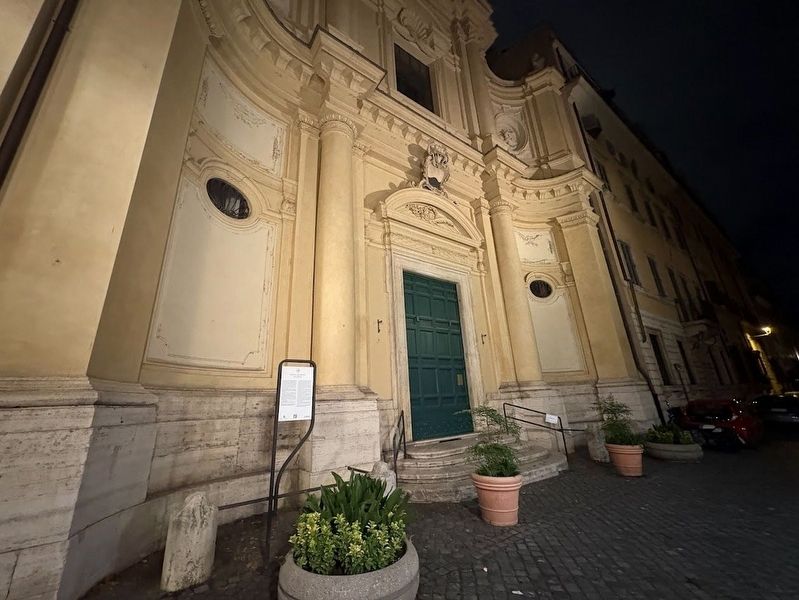
Photographed by Sean P. Flynn, August 2, 2025
2. The Church of Saint Catherine of Siena on Via Giulia
The marker is on the front door.
The interior consists of a single nave, four chapels and a slightly raised sanctuary area. The decoration is late Baroque. On the vault, the Angels by Ermenegildo Costantini, are flanked by monochrome figures by Taddeo Kuntz.
Along the walls of the nave, a series of ovals depicts episodes from the life of Catherine. The various chapels direct visitors' attention to other Sienese saints, such as Saint Bernardine and Saint Bernard Tolomei or various historical episodes. Not to be missed is the Assumption by Tommaso Conca.
The high altar is adorned with the painting of the Marriage of Catherine to Jesus (by Gaetano Lapis, late eighteenth century). The two ovals Christ Carrying the Cross Appears to Catherine and Christ Shows Catherine the Marks of His Side are by the same artist. The fresco in the apse is by Laurent Pecheux (1773). It depicts Catherine accompanying Pope Gregory XI from Avignon to Rome.
In memory of the work carried out in the church by Paolo Posi there is a bust of the architect by Giuseppe Palazzi (1778).
Attached to the church is the oratory, where, among various works, the Resurrection
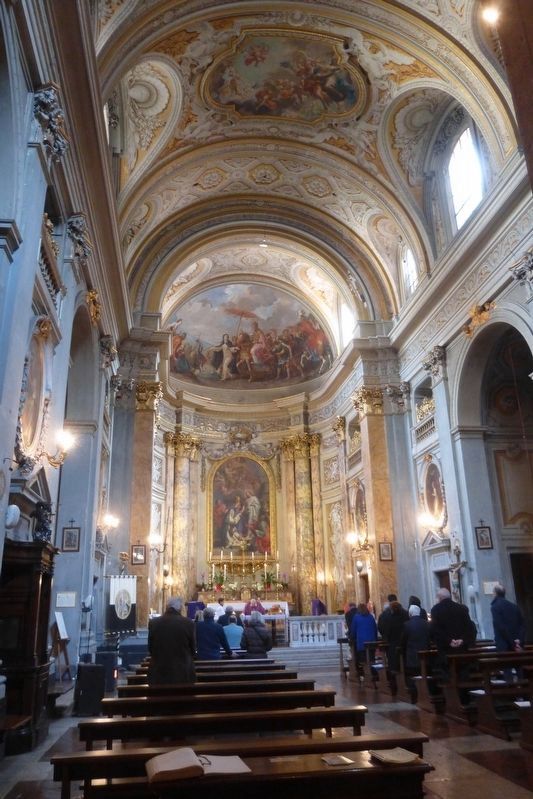
Photographed by Lalupa (CC BY-SA 4.0), via Wikimedia Commons, March 12, 2017
3. Inside the Church of St. Catherine of Siena on Via Giulia
The building complex extends into Via di Monserrato and here, in 1912, a facade was built in imitation of Caterina's house in her home district of Fontebranda in Siena.
Erected 2025 by The Roman Catholic Church Dicastery for Evangelization; Italian Tourism Ministry.
Topics. This historical marker is listed in these topic lists: Arts, Letters, Music • Religion & Religious Structures. A significant historical year for this entry is 1526.
Location. 41° 53.731′ N, 12° 28.134′ E. Marker is in Roma, Lazio (Latium, Rome), in Città metropolitana di Roma Capitale. It is on Via Giulia north of Via dell'Armata, on the left when traveling south. Touch for map. Marker is at or near this postal address: Via Giulia 151, Roma, Lazio 00186, Italy. Touch for directions.

Regionally, it is in Europe, the European Union, the Schengen Area, a coastal Mediterranean country, and the Western World. Historically, it finds itself in what was once the Roman Empire.
Other nearby markers. At least 8 other markers are within walking distance of this marker: A different marker also named Santa Caterina da Siena / Saint Catherine of Siena (here, next to this marker); Giorgio Labò and Gianfranco Mattei (within shouting distance of this marker); Santa Maria in Monserrato degli Spagnoli / Holy Mary in Monserrat of the Spaniards (within shouting distance of this marker); La Venerabile Mary Ward / The Venerable Mary Ward (about 90 meters away, measured in a direct line); Spirito Santo dei Napoletani / Holy Spirit of the Neapolitans (about 120 meters away); Parione (approx. 0.2 kilometers away); Giordano Bruno (approx. 0.3 kilometers away); Campo dei Fiori (approx. 0.3 kilometers away). Touch for a list and map of all markers in Roma.
More about this marker. The marker was one of several
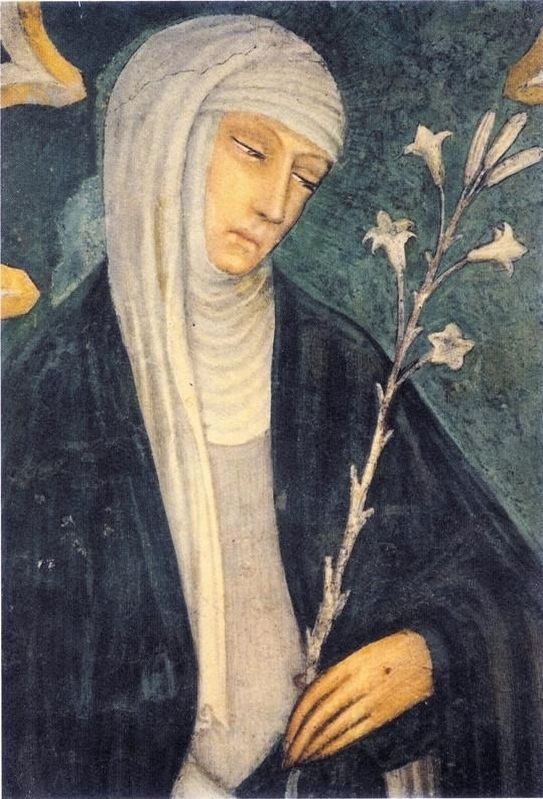
Painting by Andrea Vanni; via Wikimedia Commons, circa 1400
4. Saint Catherine of Siena
Another small marker about the church can be found on the entry door nearby.
Regarding Santa Caterina da Siena / Saint Catherine of Siena. Saint Catherine died in Rome in 1380 and is buried at Santa Maria sopra Minerva church, about a kilometer east of here near the Pantheon.
Credits. This page was last revised on June 16, 2026. It was originally submitted on September 8, 2025, by Sean P. Flynn of Oak Park, Illinois. This page has been viewed 73 times since then and 26 times this year. Photos: 1, 2. submitted on September 8, 2025, by Sean P. Flynn of Oak Park, Illinois. 3. submitted on September 9, 2025, by Sean P. Flynn of Oak Park, Illinois. 4. submitted on September 2, 2025, by Sean P. Flynn of Oak Park, Illinois.
