Roma in Città metropolitana di Roma Capitale, Latium, Rome, Italy — Central Italy (Tyrrhenian Coast)
Spirito Santo dei Napoletani
Chiesa Giubilare
⎯⎯⎯
Holy Spirit of the Neapolitans
Jubilee Church

Photographed by Sean P. Flynn, August 2, 2025
1. Spirito Santo dei Napoletani / Holy Spirit of the Neapolitans Marker
Quando nel 1861 il regno crollò nel crogiuolo del risorgimento, la chiesa divenne un sostegno per i Borbone in esilio, accogliendo anche per mezzo secolo le salme dell'ultimo re Francesco II e della moglie Maria Sofia, successivamente traslate a Napoli.
L'interno, a un'unica navata, è vivace e accogliente. Sull'arco di trionfo si ammira la scena della Pentecoste di Pietro Gagliardi, mentre lo Spirito Santo campeggia sulla volta
this page online
Le cappelle laterali concorrono a definire lo spazio e nel contempo propongono testimoni di santità coinvolti nelle vicende del Mezzogiorno d'Italia: tra loro, il Beato Giuseppe Benedetto Dusmet, San Francesco di Paola, i Santi Ferdinando, Teresa, Cristina e Sofia, San Vincenzo Pallotti, San Tommaso d'Aquino e, in modo eminente, San Gennaro che qui appare nell'ultimo capolavoro di Luca Giordano (1705).
Anche le memorie funebri, alcune delle quali monumentali e solenni, contribuiscono a creare una comunione tra le generazioni. Né può mancare un'opera tipica dell'artigianato artistico partenopeo, il Presepe, con grande forza simbolica accostato al Crocifisso.
Il presbiterio accoglie l'altare maggiore costruito su disegno di Carlo Fontana del 1719. Sulla cupoletta, la Gloria della Santissima Trinità di Giuseppe Passeri (1707) e, nell'abside, affreschi del Gagliardi. Qui erano collocate le tombe degli ultimi re Borbone prima del loro trasferimento nel 1984.
Altra opera importante è la Madonna e il Bambino di Antoniazzo Romano, detta Madonna del Fulmine, risalente all'ultimo decennio

Photographed by Sean P. Flynn, August 2, 2025
2. Church of the Holy Spirit of the Neapolitans
The marker is left of the door (partially obscured by the palm).
This is the church which the Bourbon Kingdom of the Two Sicilies used as a reference point in the city of Rome. The façade is very sober, on the portal is the scene of the Adoration of the Holy Spirit by the angels, frescoed by Pietro Gagliardi in the years 1880-1890, while in the stained glass of Oscar Guarnieri in the central window, framed between four Bourbon lilies, the dove of the Holy Spirit can be seen. The church was built thanks to the commitment of a Confraternity of Neapolitans resident in Rome and was consecrated in 1619. Famous architects have worked on it over the years, including Domenico Fontana and Ottaviano Mascherino, who were succeeded in later periods by Carlo Fontana and Antonio Cipolla.
When in 1861 the Kingdom of the Two Sicilies collapsed (at the time of Italian Unification) the church became a base for the Bourbon dynasty in exile. For fifty years the remains of the last king Francis II and his wife Maria Sofia were buried here before being later transferred to Naples.
The interior, with a single nave, is lively and welcoming. On the triumphal arch you can admire the scene of Pentecost by Pietro Gagliardi, while the Holy

Photographed by Sean P. Flynn, August 2, 2025
3. Church of the Holy Spirit of the Neapolitans
The side chapels help to define the space and at the same time present to the visitor some of the great figures of faith of Southern Italy: among them are Blessed Joseph Benedict Dusmet, Saint Francis of Paola, Saints Ferdinand, Teresa, Cristina and Sofia, Saint Vincent Pallotti, Saint Thomas Aquinas and, most eminently, Saint Januarius who appears here in Luca Giordano's final masterpiece (1705).
The memorials, some of which are quite monumental and solemn, seem to create a communion between generations. The Nativity Scene, a typical work of Neapolitan craftsmen, is placed to great symbolic effect next to the Crucifixion.
The sanctuary area houses the high altar built to a design by Carlo Fontana in 1719. On the dome, the Glory of the Holy Trinity by Giuseppe Passeri (1707) and, in the apse, frescoes by Gagliardi can be seen. The tombs of the last Bourbon kings were located here before their transfer in 1984.
Another important work is the Madonna and Child by Antoniazzo Romano, known as the Madonna del Fulmine, dating back to the last decade of the fifteenth century.
Erected 2025

Photographed by Peter1936F (CC BY-SA 4.0), via Wikimedia Commons, March 12, 2019
4. Inside Spirito Santo dei Napoletani
Topics. This historical marker is listed in these topic lists: Arts, Letters, Music • Government & Politics • Religion & Religious Structures. A significant historical year for this entry is 1619.
Location. 41° 53.784′ N, 12° 28.077′ E. Marker is in Roma, Lazio (Latium, Rome), in Città metropolitana di Roma Capitale. It is on Via Giulia near Via Sant'Aurea, on the right when traveling south. Touch for map. Marker is at or near this postal address: Via Giulia 34, Roma, Lazio 00186, Italy. Touch for directions.

Regionally, it is in Europe, the European Union, the Schengen Area, a coastal Mediterranean country, and the Western World. Historically, it finds itself in what was once the Roman Empire.
Other nearby markers. At least 8 other markers are within walking distance of this marker: Giorgio Labò and Gianfranco Mattei (within shouting distance of this marker); Santa Maria in Monserrato degli Spagnoli / Holy Mary in Monserrat of the Spaniards (about 120 meters away, measured in a direct line); Santa Caterina da Siena / Saint Catherine of Siena
Photographed by Alphonse Bernoud; courtesy of Wikimedia Commons, circa 1860
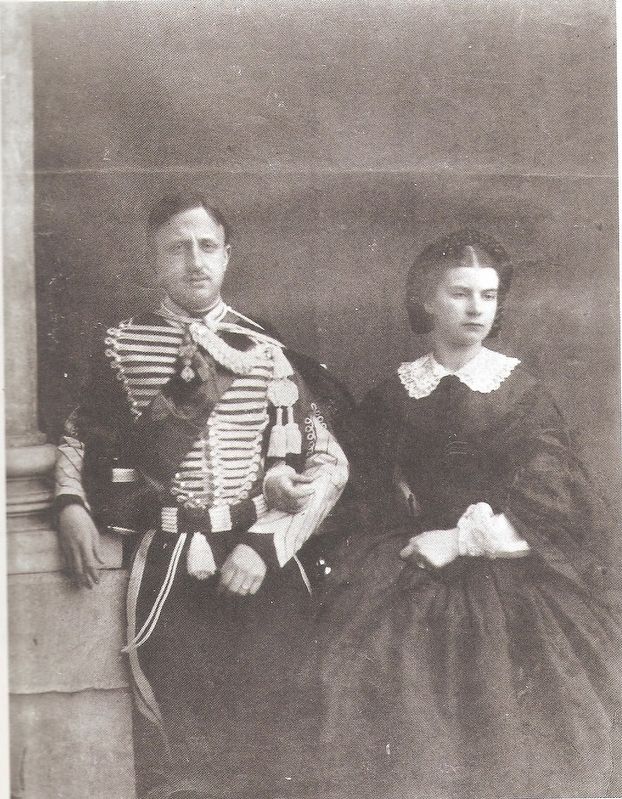
5. Francis II, King of the Two Sicilies, with his wife Maria Sophie
Francis died in 1894; Maria Sophie lived until 1925.
More about this marker. The marker is one of many erected in front of churches in Rome to honor the 2025 Jubilee, titled "Pilgrims of Hope."
Regarding Spirito Santo dei Napoletani / Holy Spirit of the Neapolitans. The Kingdom of Two Sicilies was formed in 1816 with the merger of the Kingdom of Sicily with the Kingdom of Naples, whose official name was also the Kingdom of Sicily. The House of Bourbon ruling family was a descendant branch of the French Bourbons. The kingdom was overthrown in 1860 and a year later was annexed into the newly unified Kingdom of Italy. Francis and his wife Maria Sophie found refuge in Rome, but were forced to flee in 1870 when the Italians occupied the city. He spent the rest of his life outside of Italy and died in Arco, now part of Italy but then in Austria-Hungary, in 1894. Francis was originally buried here at Spirito Santo, alongside his daughter Maria Christina, who had died in infancy in 1870. Maria Sophie died in 1925 and was buried here as well. In 1984, the remains of all three were removed and reinterred at the Church of Santa Chiara in Naples, the family's traditional burial site.
Also see . . .
1. The Bourbons in Exile.
Excerpt: “By the time the forces of Italy took Rome in September, 1870, the Bourbon court and all who had accompanied it had left. The queen returned to Bavaria, the king wandered for a while and settled in Paris, where he was rejoined, at least for a while, by his wife. The king became diabetic and sought treatment at various Italian clinics, always registering under a false name. In 1894, he saw his wife in Bavaria for one last time and then went to Arco in Trentino for the climate and treatment. He died there on December 27, 1894. Locals were surprised when they learned the true identity of 'Signor Fabiani.' His wife died in Bavaria in 1925.”(Submitted on September 9, 2025, by Sean P. Flynn of Oak Park, Illinois.)
2. Francesco II, King of the Two Sicilies. (Submitted on September 9, 2025, by Sean P. Flynn of Oak Park, Illinois.)
Credits. This page was last revised on September 9, 2025. It was originally submitted on September 9, 2025, by Sean P. Flynn of Oak Park, Illinois. This page has been viewed 111 times since then and 32 times this year. Photos: 1, 2, 3, 4, 5. submitted on September 9, 2025, by Sean P. Flynn of Oak Park, Illinois.
