Roma in Città metropolitana di Roma Capitale, Latium, Rome, Italy — Central Italy (Tyrrhenian Coast)
Santa Maria in Monserrato degli Spagnoli
Chiesa Giubilare
⎯⎯⎯
Holy Mary in Monserrat of the Spaniards
Jubilee Church
Photographed by Sean P. Flynn, August 2, 2025
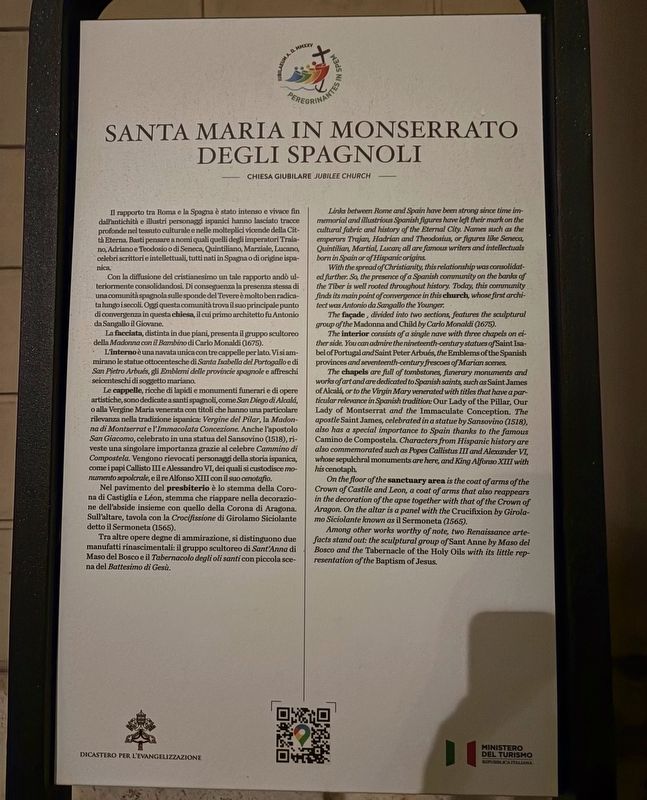
1. Santa Maria in Monserrato degli Spagnoli / Church of Holy Mary in Monserrat of the Spaniards Marker
Con la diffusione del cristianesimo un tale rapporto andò ulteriormente consolidandosi. Di conseguenza la presenza stessa di una comunità spagnola sulle sponde del Tevere è molto ben radicatalungo i secoli. Oggi questa comunità trova il suo principale punto di convergenza in questa chiesa, il cui primo architetto fu Antonio da Sangallo il Giovane.
La facciata, distinta in due piani, presenta il gruppo scultoreo della Madonna con il Bambino di Carlo Monaldi (1675).
L'interno è una navata unica con tre cappelle per lato. Visiammirano le statue ottocentesche di Santa Isabella del Portogallo e di San Pietro Arbués, gli Emblemi delle provincie spagnole e affreschi seicenteschi di soggetto mariano.
Le cappelle,
this page online
Nel pavimento del presbiterio è lo stemma della Corona di Castiglia e Léon, stemma che riappare nella decorazione dell'abside insieme con quello della Corona di Aragona. Sull'altare, tavola con la Crocifissione di Girolamo Siciolante detto il Sermoneta (1565).
Tra altre opere degne di ammirazione, si distinguono due manufatti rinascimentali: il gruppo scultoreo di Sant'Anna di Maso del Bosco e il Tabernacolo degli oli santi con piccola scena del Battesimo di Gesù.
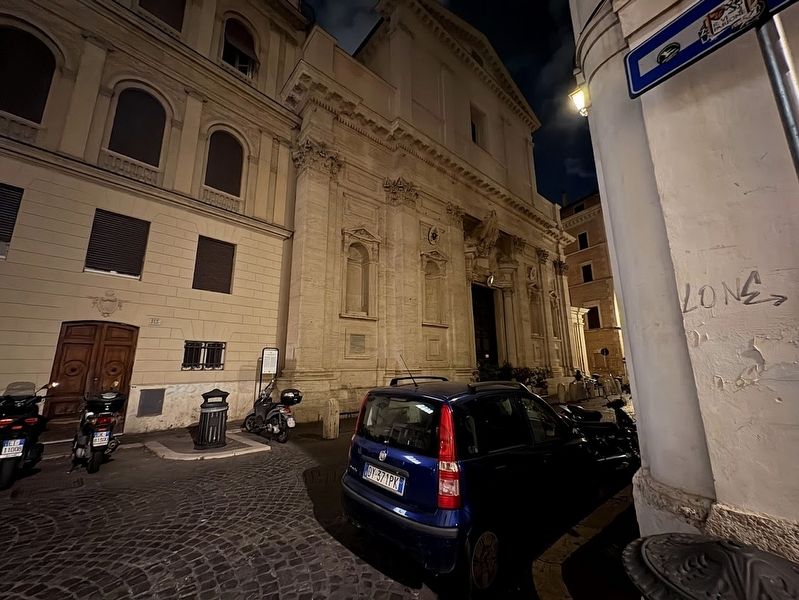
Links between Rome and Spain have been strong since time immemorial and illustrious Spanish figures have left their mark on the cultural fabric and history of the Eternal City. Names such as the emperors Trajan, Hadrian and Theodosius, or figures like Seneca, Quintilian, Martial, Lucan; all are famous writers and intellectuals born in Spain or of Hispanic origins.
With the spread of Christianity, this relationship was consolidated further. So, the presence of a Spanish community on the banks of the Tiber is well rooted throughout history. Today, this community finds its main point of convergence in this church, whose first architect was Antonio da Sangallo the Younger.
The façade, divided into two sections, features the sculptural group of the Madonna and Child by Carlo Monaldi (1675).
The interior consists of a single nave with three chapels on either side. You can admire the nineteenth-century statues of Saint Isabel of Portugal and Saint Peter Arbués, the Emblems of the Spanish provinces and seventeenth-century frescoes of Marian scenes.
The chapels are full of tombstones, funerary monuments and works of art and are dedicated to Spanish saints, such as Saint
Photographed by Sean P. Flynn, August 2, 2025
2. Santa Maria in Monserrato degli Spagnoli / Holy Mary in Monserrat of the Spaniards Marker
On the floor of the sanctuary area is the coat of arms of the Crown of Castile and Leon, a coat of arms that also reappears in the decoration of the apse together with that of the Crown of Aragon. On the altar is a panel with the Crucifixion by Girolamo Siciolante known as il Sermoneta (1565).
Among other works worthy of note, two Renaissance artefacts stand out: the sculptural group of Sant Anne by Maso del Bosco and the Tabernacle of the Holy Oils with its little representation of the Baptism of Jesus.
Erected 2025 by The Roman Catholic Church Dicastery for Evangelization; Italian Tourism Ministry.
Topics.

Photographed by Sean P. Flynn, August 2, 2025
3. Santa Maria in Monserrato degli Spagnoli
Location. 41° 53.762′ N, 12° 28.157′ E. Marker is in Roma, Lazio (Latium, Rome), in Città metropolitana di Roma Capitale. It is on Via di Monserrato south of Via di Sant'Eligio, on the right when traveling south. Touch for map. Marker is at or near this postal address: Via di Monserrato 39, Roma, Lazio 00186, Italy. Touch for directions.

Regionally, it is in Europe, the European Union, the Schengen Area, a coastal Mediterranean country, and the Western World. Historically, it finds itself in what was once the Roman Empire.
Other nearby markers. At least 8 other markers are within walking distance of this marker: La Venerabile Mary Ward / The Venerable Mary Ward (within shouting distance of this marker); Santa Caterina da Siena / Saint Catherine of Siena (within shouting distance of this marker); a different marker also named Santa Caterina da Siena / Saint Catherine of Siena (within shouting distance of this marker); Giorgio Labò and Gianfranco Mattei (within shouting
Courtesy of Wikimedia Commons
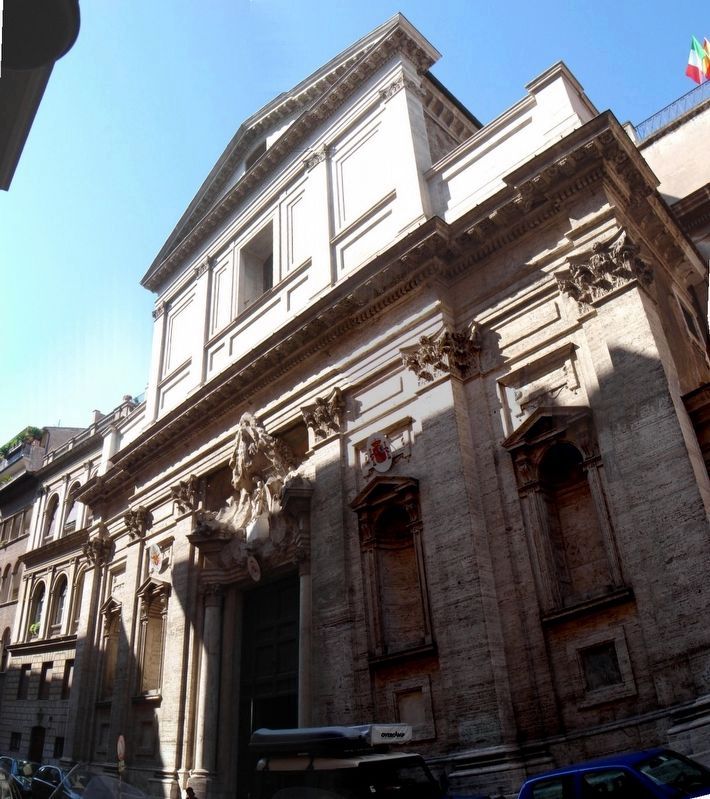
4. Daytime photo of Santa Maria in Monserrato degli Spagnoli
Regarding Santa Maria in Monserrato degli Spagnoli / Holy Mary in Monserrat of the Spaniards. This church, begun in 1518 but not consecrated until 1594, is the Spanish national church in Rome. The name is a reference to the Virgin of Montserrat, a Madonna and child statue at Santa Maria de Montserrat in Catalonia, Spain.
Also see . . . Santa Maria in Monserrato degli Spagnoli (Wikipedia). (Submitted on September 9, 2025, by Sean P. Flynn of Oak Park, Illinois.)
Credits. This page was last revised on March 17, 2026. It was originally submitted on September 9, 2025, by Sean P. Flynn of Oak Park, Illinois. This page has been viewed 105 times since then and 27 times this year. Photos: 1, 2, 3, 4. submitted on September 9, 2025, by Sean P. Flynn of Oak Park, Illinois.
