
Altstadt in Würzburg, Bavaria, Germany — Central Europe
Haus zum Falken
⎯⎯⎯
House of the Falcon
Tourist Information <= 60 m
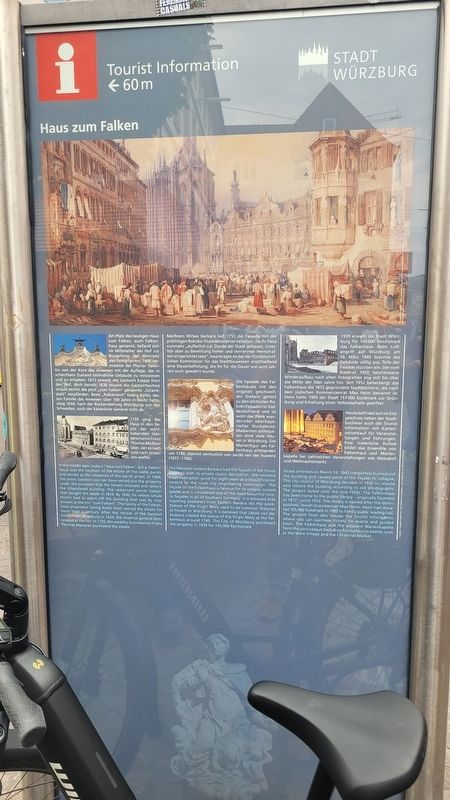
Photographed by James Hulse, July 14, 2025
1. Haus zum Falken / House of the Falcon Marker

Am Platz des heutigen Haus zum Falken, auch Falkenhaus genannt, befand sich im Mittelalter der Hof zur Burgpfarre, der Wohnsitz des Dompfarrers. 1406 vermietete der Pfarrer Valentin von der Kere das Anwesen mit der Auflage, das in schlechtem Zustand befindliche Gebäude zu renovieren und zu erhalten. 1612 erwarb der Gastwirt Kaspar Hort den Hof, doch bereits 1630 musste die Gastwirtswitwe Ursula Hortin die jetzt „zum Falken“ genannte „Schankstatt“ verpfänden. Beim „Falkenwirt“ Georg Keller, dessen Familie das Anwesen über 100 Jahre in Besitz hatte, stieg 1634, nach der Rückeroberung Würzburgs von den Schweden, auch der kaiserliche General Götz ab.
1735 ging das Haus in den Besitz des wohlhabenden Handelsmanns Franz Thomas Meißner über, der es nach und nach erneuern wollte.
Meißners Witwe Barbara ließ 1751 die Fassade mit der prächtigen Rokoko-Stuckdekoration versehen. Da ihr Haus nunmehr „eußerlich zur Zierde der Stadt gebauet, innerlich aber zu Bewirtung hoher und vornehmer Herrschaften eingerichtet seye“, beantragte sie bei der fürstbischöflichen Kommission für das Stadtbauwesen anschließend eine Steuerbefreiung, die ihr für die Dauer von acht Jahren auch gewährt wurde.
Die Fassade des Falkenhauses mit den originell geschweiften Giebeln gehört zu den schönsten Rokokofassaden in Süddeutschland und ist wohl das Werk wandernder oberbayerischer Stuckateure. Madonnen schmückten einst viele Häuser in Würzburg. Die Marienfigur am Falkenhaus, entstanden um 1740, stammt vermutlich von Jacob van der Auwera (1672-1760). 1939 erwarb die Stadt Würzburg für 145000 Reichsmark das Falkenhaus. Beim Luftangriff auf Würzburg am 16. März 1945 brannte das Gebäude völlig aus, Teile der Fassade stürzten ein. Der vom Stadtrat 1950 beschlossene Wiederaufbau nach alten Fotografien zog sich bis über die
this page online
Heute befindet sich im Erdgeschoss neben der Stadtbücherei auch die Tourist Information mit Kartenvorverkauf für Veranstaltungen und Führungen. Eine malerische Kulisse bildet das Ensemble von Falkenhaus und Marienkapelle bei zahlreichen Veranstaltungen wie Weindorf und Weihnachtsmarkt.
In the middle ages, today's "Haus zum Falken" (a.k.a. Falkenhaus) was the location of the estate of the castle parish and served as the residence of the parish priest. In 1406, the priest Valentin von der Kere rented out the property under the provision that the tenant renovate and restore the dilapidated building. The restaurant owner Kaspar Hort bought the estate in 1614. By 1630, his widow Ursula Hortin had to pawn off the building that was by now known as the Inn "zum Falken". The family of the Falkenhaus proprietor Georg Keller then owned the estate for more than a century. After
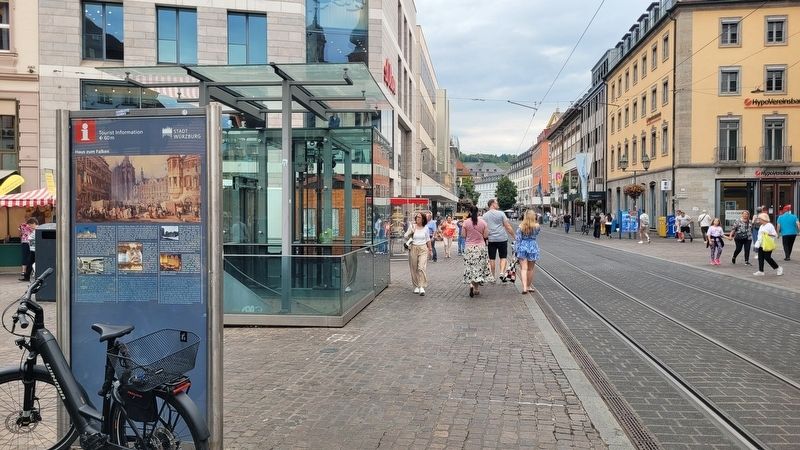
Photographed by James Hulse, July 14, 2025
2. The view of the House of the Falcon Marker along the street
The Meissner widow Barbara had the façade of the house adorned with its ornate stucco decoration. She received a tax exemption good for eight years as a beautification reward by the royal city engineering commission. The façade of the Falkenhaus is famous for its unique, curved gables and is considered one of the most beautiful rococo façades in all of Southern Germany. It is believed that traveling plasterers from Eastern Bavaria did the work. Statues of the Virgin Mary used to be common features at houses in Würzburg. It is believed that Jakob van der Auwera created the statue of the Virgin Mary at the Falkenhaus around 1740. The City of Würzburg purchased the property in 1939 for 145,000 Reichsmark.
Allied airstrikes on March 16, 1945 completely burned out the building and caused parts of the façade to collapse. The city council of Würzburg decided in 1950 to rebuild and restore the building according to old photographs. The project lasted until the
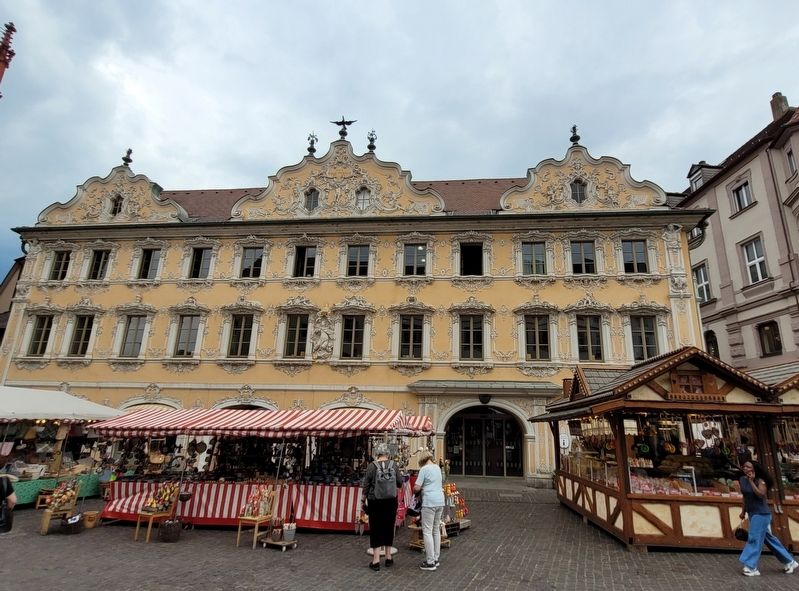
Photographed by James Hulse, July 14, 2025
3. The House of the Falcon
Erected by Stadt Würzburg.
Topics. This historical marker is listed in these topic lists: Architecture • Religion & Religious Structures • War, World II. A significant historical year for this entry is 1406.
Location. 49° 47.687′ N, 9° 55.851′ E. Marker is in Würzburg, Bayern (Bavaria). It is in Altstadt. It is on Marktplatz just north of Otto-Wels-Straße, on the left when traveling north. The marker is located in the plaza. Touch for map. Marker is at or near this postal address: Marktpl 38, Würzburg BY 97070, Germany. Touch for directions.

Regionally, it is in Europe, the European Union, Atlantic Europe, Central Europe, the Schengen Area, Western Europe, and the Western World. Historically, it finds itself in what was once the Holy Roman Empire.
Other nearby markers. At least 8 other markers are within walking distance of this marker: Haus zum Falken (within shouting distance of this marker); Neumünster (about 90 meters away, measured in a direct line); Der Kreuzgang des Neumuensterstiftes / The Cloister of the Neumuenster Seminary (about 90 meters away); Kaufhaus am Markt / Department Store at the Market (about 120 meters away); Lusam-Gärtlein (about 120 meters away); Marienkapelle / St. Mary's Chapel (about 120 meters away); Lusamgärtchen / Lusam Garden (about 120 meters away); Emy Roeder (about 120 meters away). Touch for a list and map of all markers in Würzburg.
Credits. This page was last revised on October 30, 2025. It was originally submitted on September 9, 2025, by James Hulse of Medina, Texas. This page has been viewed 62 times since then and 11 times this year. Photos: 1, 2, 3. submitted on September 12, 2025, by James Hulse of Medina, Texas.
