Cambridge in Waterloo Region, Ontario — Central Canada (North America)
Sergeant Frederick Hobson, VC
1873-1917
Photographed by Tim Boyd, October 19, 2024
1. Sergeant Frederick Hobson, VC Marker
Inscription.
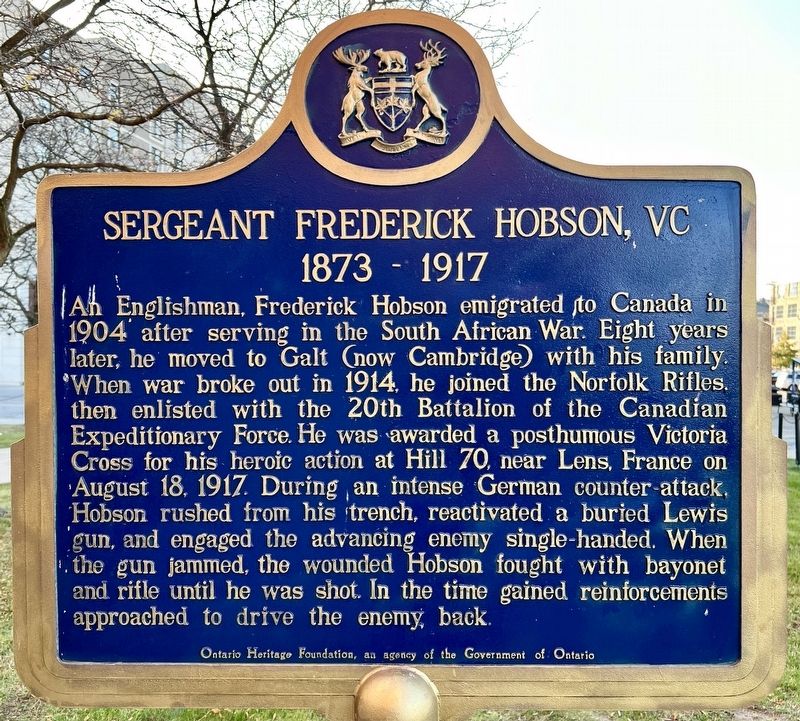
Sergeant Frederick Hobson, VC. , An Englishman, Frederick Hobson emigrated to Canada in 1904 after serving in the South African War. Eight years later, he moved to Galt (now Cambridge) with his family. When war broke out in 1914, he joined the Norfolk Rifles, then enlisted with the 20th Battalion of the Canadian Expeditionary Force. He was awarded a posthumous Victoria Cross for his heroic action at Hill 70, near Lens, France on August 18, 1917. During an intense German counter-attack, Hobson rushed from his trench, reactivated a buried Lewis gun, and engaged the advancing enemy single-handed. When the gun jammed, the wounded Hobson fought with bayonet and rifle until he was shot. In the time gained reinforcements approached to drive the enemy back., . This historical marker was erected by Ontario Heritage Foundation. It is in Cambridge in Waterloo Region Ontario
L'Anglais Frederick Hobson immigre au Canada en 1904 après avoir servi dans la guerre des Boers. Huit ans plus tard, il s'installe avec sa famille à Galt (devenu Cambridge) Quand la guerre éclate en 1914, il s'engage dans les Norfolk Rifles, puis dans le 20e Bataillon du Corps expéditionnaire canadien. Il est décoré de la Croix de Victoria, à titre posthume, pour son héroïsme le 18 août 1917 à la Côte 70 près de Lens en France. Pendant une intense contre-attaque allemande, Hobson quitte la tranchée, réactive une mitrailleuse Lewis ensevelie et assaille à lui seul l'ennemi qui avance Lorsque la mitrailleuse s'enraye, Hobson, blessé, se bat au fusil et à la baïonnette et meurt d'une balle. Pendant ce temps, le renfort arrive pour repousser l'ennemi.
An Englishman, Frederick Hobson emigrated to Canada in 1904 after serving in the South African War. Eight years later, he moved to Galt (now Cambridge) with his family.
When war broke out in 1914, he joined the Norfolk Rifles, then enlisted with the 20th Battalion of the Canadian Expeditionary Force. He was awarded a posthumous Victoria Cross for his heroic action at Hill 70, near Lens, France on August 18, 1917. During an intense German counter-attack, Hobson rushed from his trench, reactivated a buried Lewis gun, and engaged the advancing enemy single-handed. When the gun jammed, the wounded Hobson fought with bayonet and rifle until he was shot. In the time gained reinforcements approached to drive the enemy back.
L'Anglais Frederick Hobson immigre au Canada en 1904 après avoir servi dans la guerre des Boers. Huit ans plus tard, il s'installe avec sa famille à Galt (devenu Cambridge) Quand la guerre éclate en 1914, il s'engage dans les Norfolk Rifles, puis dans le 20e Bataillon du Corps expéditionnaire canadien. Il est décoré de la Croix de Victoria, à titre posthume, pour son héroïsme le 18 août 1917 à la
Click or scan to see this page online
Côte 70 près de Lens en France. Pendant une intense contre-attaque allemande, Hobson quitte la tranchée, réactive une mitrailleuse Lewis ensevelie et assaille à lui seul l'ennemi qui avance Lorsque la mitrailleuse s'enraye, Hobson, blessé, se bat au fusil et à la baïonnette et meurt d'une balle. Pendant ce temps, le renfort arrive pour repousser l'ennemi.
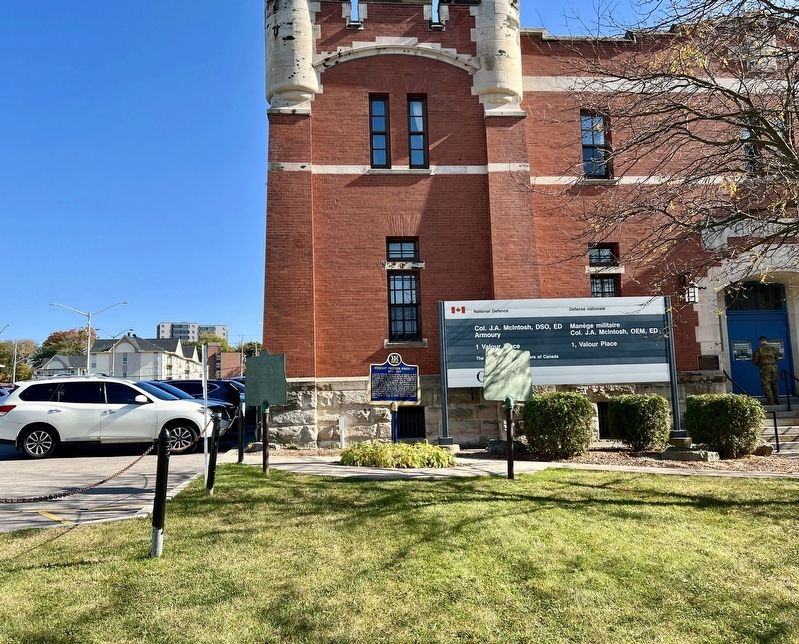
Location. 43° 21.486′ N, 80° 18.8′ W. Marker is in Cambridge, Ontario, in Waterloo Region. It is on Ainslie Street South 0.1 kilometers south of Mail Street, on the right when traveling north. Marker is on the grounds of the Col. J.A. Mcintosh, DSO, ED
Armoury. Touch for map. Marker is in this post office area: Cambridge ON N1R N1R, Canada. Touch for directions.
Regionally, this marker is in the Huron-Perth-Waterloo-Wellington Area and in Southwestern Ontario.
circa 1916
2. Sergeant Frederick Hobson, VC, ca 1916
It is also in Central Canada. Globally, it is in North America, the Western Hemisphere, the Western World, and the Anglosphere. Historically, it finds itself in what was once a British colony, the Viceroyalty of New France, the Haudenosaunee (Iroquois) Confederacy, and Rupert’s Land.
The Battle of Hill 70 Memorial Park opened to the public in August 2017 and was completed in October, 2019. The Memorial Park consists of a number of elements.
The centerpiece of the Memorial Park is an obelisk signifying the victory of the Canadian Corps at the Battle of Hill 70.
(Submitted on October 23, 2024, by Tim Boyd of Hamilton, Ontario.)
Photographed by Tim Boyd, October 19, 2024
3. Sergeant Frederick Hobson, VC Marker
Photographed by Tim Boyd, October 19, 2024
4. Sergeant Frederick Hobson, VC Marker
Credits. This page was last revised on July 5, 2026. It was originally submitted on October 23, 2024, by Tim Boyd of Hamilton, Ontario. This page has been viewed 135 times since then and 21 times this year. Last updated on September 10, 2025, by Kevin Westell of St. Catharines, Ontario. Photos:1, 2, 3, 4. submitted on October 23, 2024, by Tim Boyd of Hamilton, Ontario. • Devry Becker Jones was the editor who published this page.