
Exeter in Huron County, Ontario — Central Canada (North America)
The Founding of Exeter
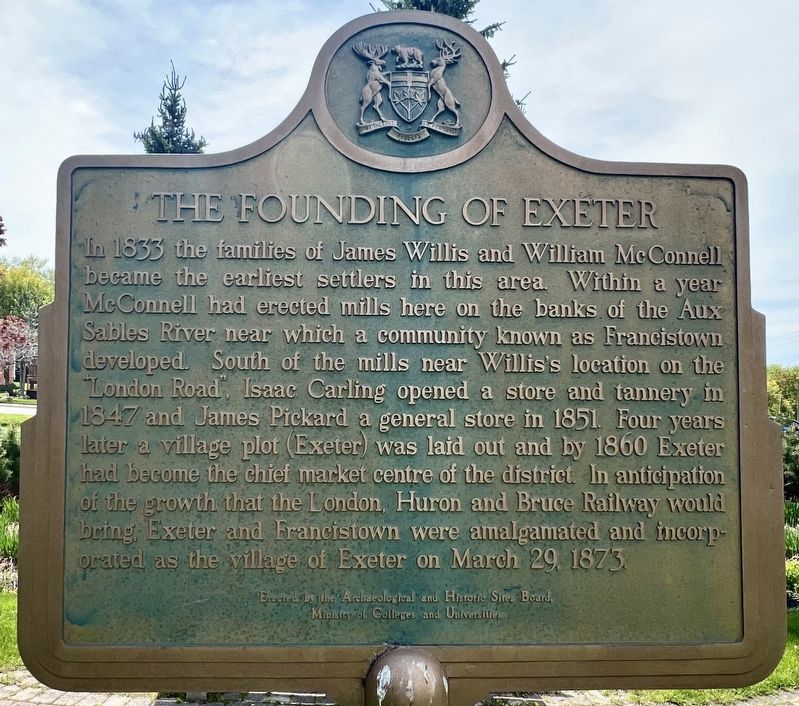
Photographed by Tim Boyd, May 12, 2025
1. The Founding of Exeter Marker
Erected by Archaeological and Historic Sites Board, Ministry of Colleges and Universities (of Ontario).
Topics and series. This historical marker is listed in these topic lists: Railroads & Streetcars • Settlements & Settlers. In addition, it is included in the Canada, Ontario Heritage Trust series list. A significant historical date for this entry is March 29, 1873.
Location. 43° 21.357′ N, 81° 28.916′ W. Marker is in Exeter, Ontario,
this page online

Regionally, this marker is in the Huron-Perth-Waterloo-Wellington Area and in Southwestern Ontario. It is also in Central Canada. Globally, it is in North America, on the Great Lakes, in the Western Hemisphere, in the Western World, and in the Anglosphere. Historically, it finds itself in what was once a British colony, the Viceroyalty of New France, the Haudenosaunee (Iroquois) Confederacy, and Rupert’s Land.
Other nearby markers. At least 8 other markers are within 21 kilometers of this marker, measured as the crow flies: Lewis or Grundy Corners (approx. 15.7 kilometers away); Lieut-Col. James Hodgins (approx. 17.8 kilometers away); St. James Anglican Church & Cemetery (approx. 17.8 kilometers away); Sauble Hill - Wilberforce Cemetery (approx. 18 kilometers away); The “Donnelly” Log Cabin (approx. 19.7 kilometers away); C. Frederick McLean 1875-1942

Photographed by Tim Boyd, May 12, 2025
2. The Founding of Exeter Marker
Also see . . . The London, Huron and Bruce Railway (trainweb.org).
Similar to other growing Southern Ontario towns of the time, the citizens of London desired to draw within their sphere of influence the rich agricultural lands to the north. In conjunction with this desire was the wanting for a terminal on Lake Huron to attract and divert western lake shipping through their community. A meeting was held on November 22, 1880 to see what interest existed in the matter. The idea was fully supported, in particular by the town's influential citizens, whom had profited greatly from the Great Western Railway that had been constructed through town during the 1850's.(Submitted on May 19, 2025, by Tim Boyd of Hamilton, Ontario.)
Consideration was given for the construction of a line extending to either Southampton or Kincardine. When it became known that the Wellington, Grey & Bruce Railway (WG&BR) by this time was then building to the same communities, it was decided instead to construct a railway that would connectwith it. The London, Huron & Bruce Railway (LH&BR) was incorporated on February 15, 1871 to construct a line from a point near London to a terminal in the Township of either Stanley or Tuckersmith.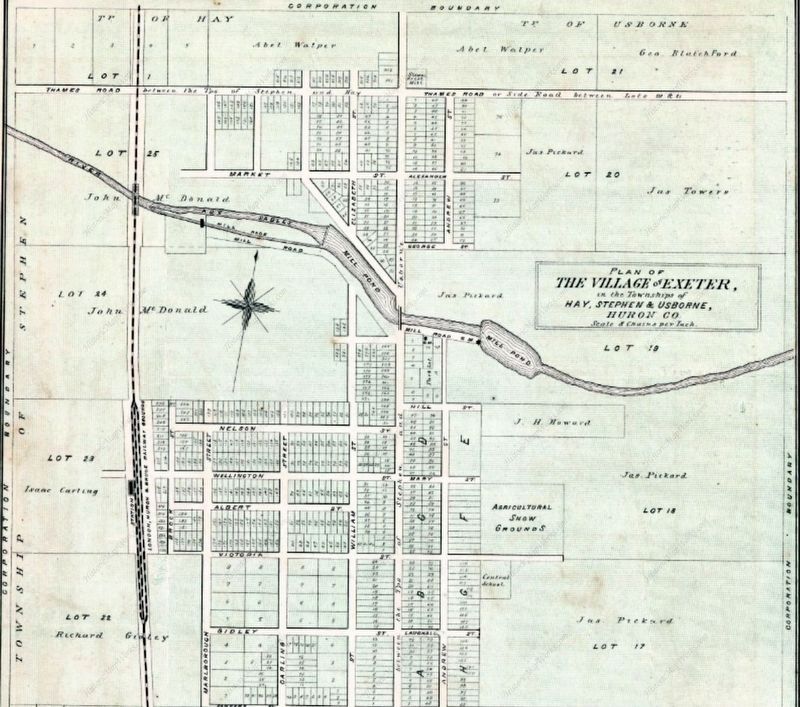 3. The Village of Exeter, 1879From Belden’s Atlas of Huron County
Credits. This page was last revised on September 16, 2025. It was originally submitted on May 19, 2025, by Tim Boyd of Hamilton, Ontario. This page has been viewed 390 times since then and 111 times this year. Last updated on September 10, 2025, by Kevin Westell of St. Catharines, Ontario. Photos: 1, 2, 3. submitted on May 19, 2025, by Tim Boyd of Hamilton, Ontario. • Devry Becker Jones was the editor who published this page.
