Roma in Città metropolitana di Roma Capitale, Latium, Rome, Italy — Central Italy (Tyrrhenian Coast)
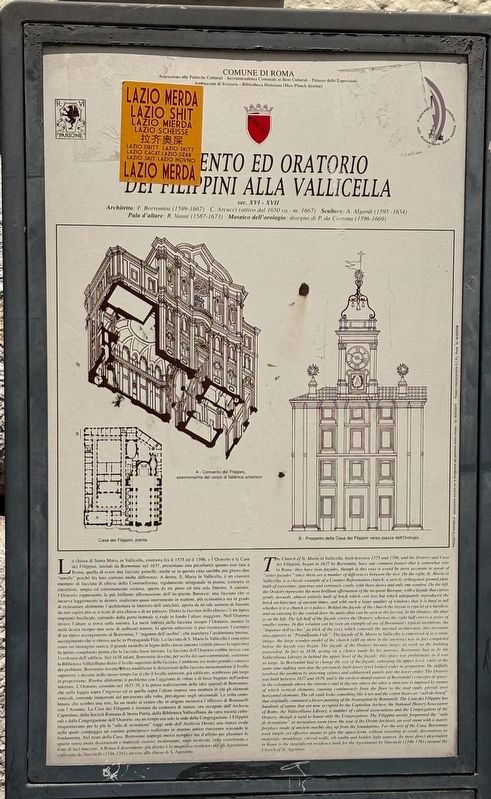
Convento ed Oratorio dei Filippini alla Vallicella
sec. XVI-XVII
⎯⎯⎯
Convent and Oratory of Saint Philip Neri
16th-17th century
Photographed by Sean P. Flynn, August 3, 2025
1. Convento ed Oratorio dei Filippini alla Vallicella / Convent and Oratory of Saint Philip Neri Marker
Pala d'altare: R. Vanni (1587-1673) Mosaico dell'orologio: disegno di P. da Cortona (1596-1669)
La chiesa di Santa Maria in Vallicella, costruita fra il 1575 ed il 1596, e l'Oratorio e la Casa dei Filippini, iniziati da Borromini nel 1637, presentano una peculiarità quanto mai rara a Roma, quella di avere due facciate gemelle, anche se in questo caso sarebbe più giusto dire "sorelle" poiché fra loro corrono molte differenze. A destra, S. Maria in Vallicella, è un classico esempio di facciata di chiesa della Controriforma rigidamente ortogonale in pianta, costruita in travertino, ampia ed estremamente costosa, aperta da tre porte ed una sola finestra. A sinistra, l'Oratorio rappresenta la più brillante affermazione dell'incipiente Barocco: una facciata che si incurva leggermente in dentro, realizzata quasi interamente in mattoni, più economica ma in grado di richiamare abilmente l'architettura in laterizio dell'antichità, aperta da un tale numero di finestre da non capire più se si tratti di una chiesa o di un palazzo. Dietro la facciata della chiesa c'è un tipico impianto basilicale, entrando dalla porta centrale si sede in fondo l'altare maggiore. Nell'Oratorio invece l'altare si trova sulla sinistra. La metà sinistra della facciata ricopre l'Oratorio, mentre la metà destra ricopre una serie di ambienti minori. In questa soluzione si può riconoscere l'esempio di un tipico accorgimento di Borromini, l' "inganno dell'occhio", che maschera l'architettura interna, accorgimento che si ritrova anche in Propaganda Fide. La facciata di S. Maria in Vallicella è concepita come un'immagine statica; il grande modello in legno della chiesa (ancora visibile presso la sagrestia) fu infatti completato prima
this page online
Photographed by Sean P. Flynn, August 3, 2025
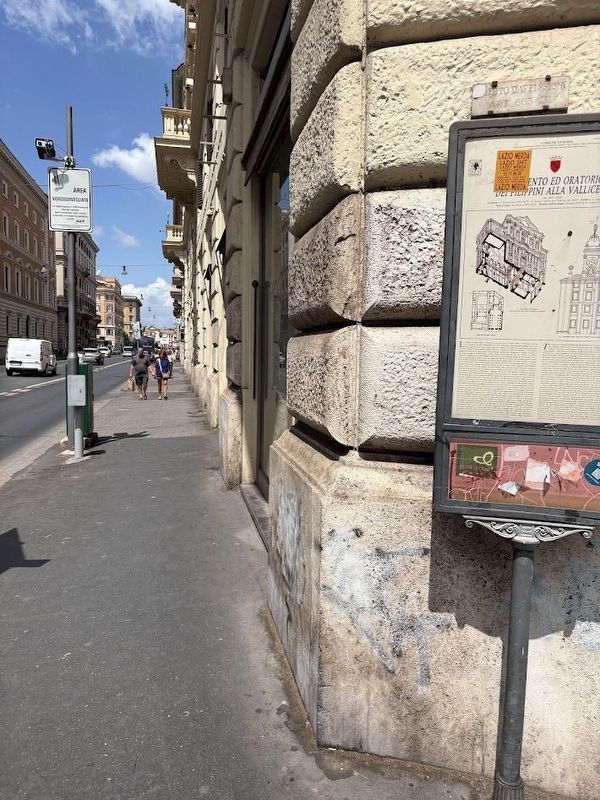
2. Convento ed Oratorio dei Filippini alla Vallicella / Convent and Oratory of Saint Philip Neri Marker
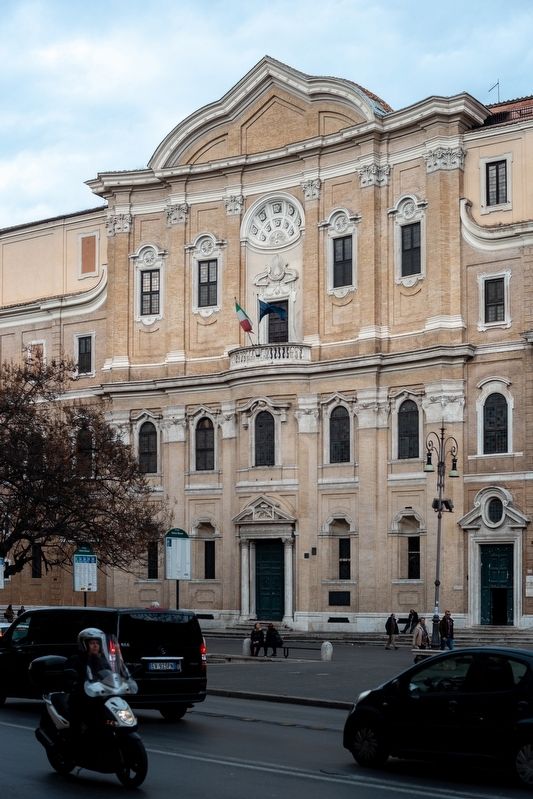
The Church of St. Maria in Vallicella, built between 1575 and 1596, and the Oratory and Cust dei Filippini, begun in 1637 by Borromini, have one common feature that is somewhat rare T in Rome: they have twin façades, though in this case it would be more accurate to speak of "sister façades" since there are a mumber of differences between the twi. On the right. St. Maria in Vallicella, is a classic example of a Counter-Reformation church; a strictly orthogonal ground plan. Imilt of travertine, spacious and extremely costly, with three doors and only one window. On the left. The Oratory represents the most brilliant affirmation of the incipient Baroque, with a façade that curves gently inwards, almost entirely built of brick which cost less but which adequately reproduced the brick architecture of ancient times, and with such a large number of windows that it is hard to tell whether it is a church or a palace. Behind the façade of the church the layout is typical of a basilica, and on entering by the central door the main altar can be seen at the far end. In the Oratory, the altar is on the left. The left half of the façade covers the Oratory, whereas the right half covers a series of smaller rooms. In this solution can be seen an example of one of Borromini's typical inventions, the "inganno dell'occhio" (a trick of the eye), which conceals the internal and architecture, this invention also appears in "Propaganda Fide". The façade of St. Maria in Vallicella is conceived of as a static image: the large wooden model of the church (still on show in the sacristy) was in fact completed before the façade was begun. The façade of the Oratory became larger as work on the building proceeded. In fact in 1638, acting on a choice made by his patroms, Borromini had to fit the Vallicelliana Library in behind the upper level of the façade; this space was problematic as it was so large. So Borromini had to change the size of the façade, enlarging the upper level, while at the same time making sure that the previously built lower level looked wider in proportion. He skilfully resolved the problem by inserting volutes and ashlarwork panels into the lower under. The Oratory was built between 1637 and 1639, and is the earliest manifestation of Borromini's concepts of space: in the colonnade above the entrance and in the one above the altar a structure is imposed by means of which vertical elements, running continuously from the floor to the roof vault, prevail over horizontal elements. The rib vault looks something like a net and the centre bears an "ocil-de-boeuf that originally contained a fresco painting of the Assumption by Romanelli. The Casa dei Filippini has hundreds of rooms that are now occupied by the Capitoline Archive, the National History Association of Rome, the Vallicelliana Library, a number of cultural associations and the Congregation of the Oratory, though it used to house only the Congregation. The Filippini mostly frequented the "salu di ricreatione" or recreation room (now the seat of the Orsini Archive), an oval room with a stately fireplace made of ancient marble dug up from the foundations. For the rest of the Casa, Borromini used simple yet effective means to give the space form, without resorting to costly decorations or materials: mouldings, curved walls, rib vaults and hidden light sources. Its most direct descendent in Rome is the magnificent residence built for the Agostiniani by Vanvitelli (1746-1761) around the Church of St. Agostino.
Erected by City
Matthias A. Peterseim (CC BY-SA 4.0), courtesy of Wikimedia Commons, January 28, 2016
3. Oratorio dei Filippini alla Vallicella
Topics. This historical marker is listed in these topic lists: Architecture • Religion & Religious Structures. A significant historical year for this entry is 1650.
Location. 41° 53.899′ N, 12° 28.096′ E. Marker is in Roma, Lazio (Latium, Rome), in Città metropolitana di Roma Capitale. It is at the intersection of Corso Vittorio Emanuele II and Via dei Filippini on Corso Vittorio Emanuele II. Touch for map. Marker is at or near this postal address: Corso Vittorio Emanuele II 245, Roma, Lazio 00186, Italy. Touch for directions.

Regionally, it is in Europe, the European Union, the Schengen Area, a coastal Mediterranean country, and the Western World. Historically, it finds itself in what was once the Roman Empire.
Other nearby markers. At least 8 other markers are within walking distance of this marker: Parione (about 90 meters away, measured in a direct line); Spirito Santo dei Napoletani / Holy Spirit of the Neapolitans (about 210 meters away); Santa Maria in Monserrato degli Spagnoli / Holy Mary in Monserrat of the Spaniards (approx. 0.3 kilometers away); Giorgio Labò and Gianfranco Mattei (approx. 0.3 kilometers away); La Venerabile Mary Ward / The Venerable Mary Ward (approx. 0.3 kilometers away); Santa Caterina da Siena / Saint Catherine of Siena (approx. 0.3 kilometers away); a different marker also named Santa Caterina da Siena / Saint Catherine of Siena (approx. 0.3 kilometers away); Pamphilj Palace on Navona Square (approx. 0.4 kilometers away). Touch for a list and map of all markers in Roma.
More about this marker. When visited in August 2025, part of the marker's title was blocked by a sticker.
Credits. This page was last revised on September 10, 2025. It was originally submitted on September 10, 2025, by Sean P. Flynn of Oak Park, Illinois. This page has been viewed 95 times since then and 24 times this year. Photos: 1, 2, 3. submitted on September 10, 2025, by Sean P. Flynn of Oak Park, Illinois.
