Guelph in Wellington County, Ontario — Central Canada (North America)
Henry Langley 1836-1907

Photographed by Tim Boyd, September 1, 2025
1. Henry Langley 1836-1907 Marker
Erected by Ontario Heritage Foundation.
Topics and series. This historical marker is listed in these topic lists: Architecture • Religion & Religious Structures. In addition, it is included in the Canada, Ontario Heritage Trust series list. A significant historical year for this entry is 1862.
Location. 43° 32.859′ N,
this page online

Regionally, this marker is in the Huron-Perth-Waterloo-Wellington Area and in Southwestern Ontario. It is also in Central Canada. Globally, it is in North America, the Western Hemisphere, the Western World, and the Anglosphere. Historically, it finds itself in what was once a British colony, the Viceroyalty of New France, the Haudenosaunee (Iroquois) Confederacy, and Rupert’s Land.
Other nearby markers. At least 8 other markers are within walking distance of this marker: Heffernan Street Footbridge (within shouting distance of this marker); Crown Attorney’s Office (within shouting distance of this marker); District of Wellington Courthouse - 1842-44 (within shouting distance of this marker); Former Residence Governor of the County Gaol (about 90 meters away, measured in a direct line); Governor’s Residence (about
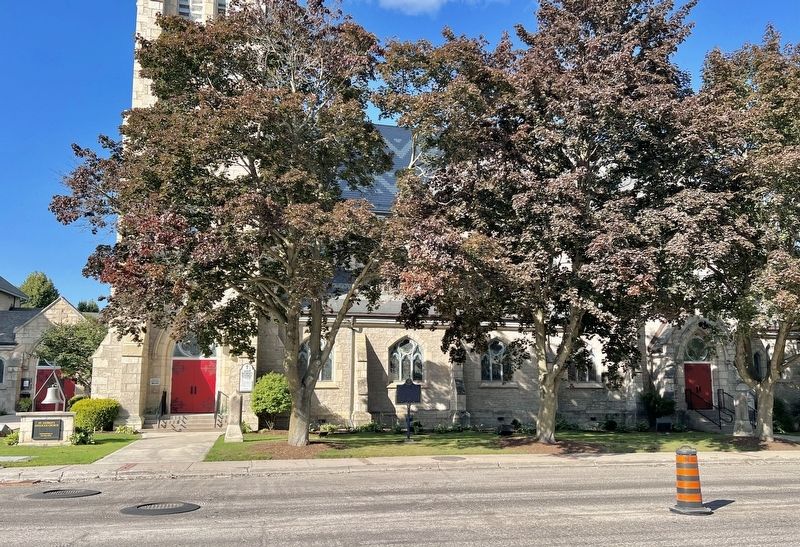
Photographed by Tim Boyd, September 1, 2025
2. Henry Langley 1836-1907 Marker
Also see . . . Langley, Henry (Dictionary of Canadian Biography).
Langley was an exceptional practitioner by virtue of the unusual size of some of his commissions, the scale of his practice, and the numbers of architects he trained. Through his churches he left his stamp on the skyline of a great many Ontario towns. At the same time his work was representative for he was rarely adventurous. That he was so conservative is not surprising considering that he was among the first generation of architects born and trained in English-speaking Canada. His career serves to link the era of the immigrant British architect and received tradition with the succeeding generation, educated in modern building technology and abreast of North American developments.(Submitted on September 11, 2025, by Tim Boyd of Hamilton, Ontario.)
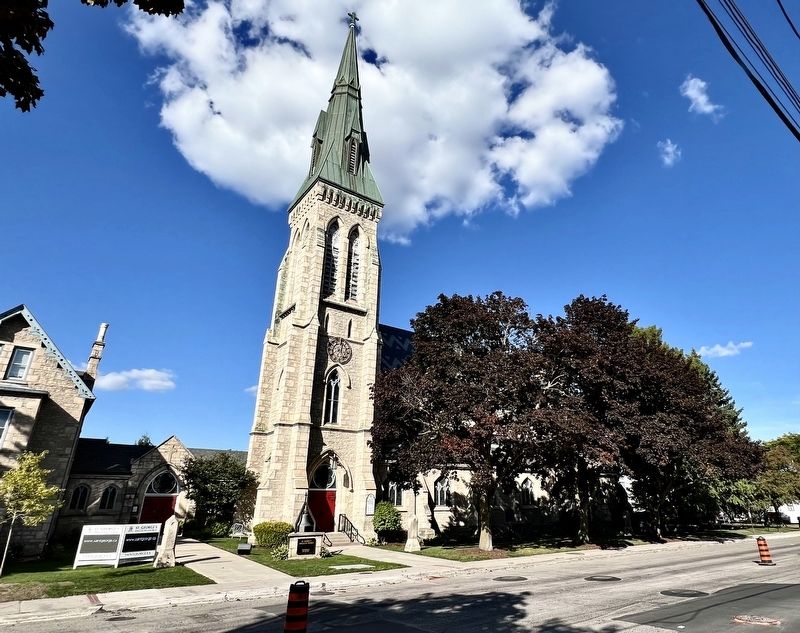
Photographed by Tim Boyd, September 1, 2025
3. St. George’s Anglican, Guelph
Designed by Langley in 1873
Credits. This page was last revised on September 11, 2025. It was originally submitted on September 11, 2025, by Tim Boyd of Hamilton, Ontario. This page has been viewed 83 times since then and 20 times this year. Photos: 1, 2, 3. submitted on September 11, 2025, by Tim Boyd of Hamilton, Ontario. • Andrew Ruppenstein was the editor who published this page.
