New Iberia in Iberia Parish, Louisiana — The American South (West South Central)
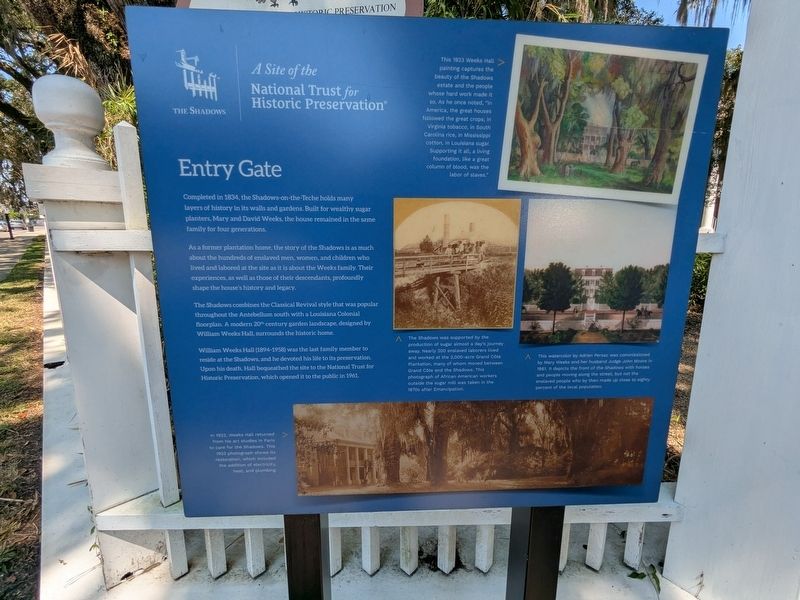
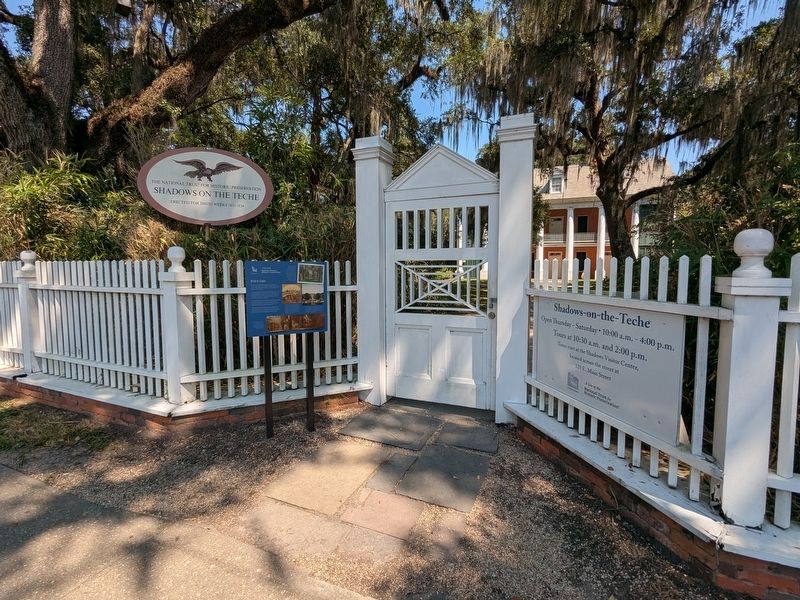
Entry Gate
The Shadows
Photographed by Cajun Scrambler, September 12, 2025
1. Entry Gate Marker
As a former plantations have the story of the Shadows is as much about the hundreds of enslaved men women, and children who lived and labored at the site as it is about the Weeks family. Their experiences, as well as those of their descendants, profoundly shape the house's history and legacy.
The Shadows combines the Classical Revival style that was popular throughout the Antebellum south with a Louisiana Colonial floorplan. A modern 20th century garden landscape designed by William Weeks Hall, surrounds the historic home.
William Weeks Hall (1894-1958) was the last family member to reside at the Shadows, and he devoted his life to its preservation. Upon his death, Hall bequeathed the site to the National Trust for Historic Preservation, which opened it to the public in 1961.
Photo Captions
This 1923 Weeks Hall painting captures the beauty of the Shadows estate and the people whose hard work made it so. As he once noted, "in America, the great houses followed the great crops; in Virginia tobacco, in South Carolina rice, in Mississippi cotton, in Louisiana sugar. Supporting it all, a living foundation, like a great column of blood, was the labor of slaves."
The Shadows was supported by the production of sugar almost a day's journey away. Nearly 200 enslaved laborers lived and worked at the 2,000-acre Grand Côte Plantation, many of whom moved between Grand Côte and the Shadows. This photograph of African American workers outside the sugar mill was taken in the 1870s after Emancipation.
This watercolor by Adrien Persac was commissioned by Mary Weeks and her husband Judge John Moore in 1861. It depicts the front of the Shadows with horses and people moving along the street, but not the enslaved people who by then made up close to eighty percent of the local population.
In 1922, Weeks Hall returned from his art studies in Paris to care for the Shadows. This 1923 photograph shows its restoration, which included the addition of electricity. heat, and plumbing.
Erected by National
this page online
Topics. This historical marker is listed in this topic list: Notable Buildings.
Location. 30° 0.246′ N, 91° 48.955′ W. Marker is in New Iberia, Louisiana, in Iberia Parish. It is on East Main Street north of Center Street, on the right when traveling north. Touch for map. Marker is in this post office area: New Iberia LA 70560, United States of America. Touch for directions.

Regionally, this marker is in Acadiana — Cajun Country and specifically in Bayou Country. It is also in the American South, specifically in the Deep South, and on the Gulf Coast. Globally, it is in North America, a Gulf of Mexico state, the Western Hemisphere, the Western World, and the Anglosphere. Historically, it finds itself in what was once New Spain, Acadia, the territory of the Mississippian Culture, the Louisiana Purchase, one of the Confederate States of America, and the Antebellum South.
Other nearby markers. At least 8 other markers are within walking distance of this marker: The Weeks' Grove (within shouting distance of this marker); Shadows-On-The Teche
Photographed by Cajun Scrambler, September 12, 2025
2. Entry Gate Marker
More about this marker. East Main Street is ONE WAY north at this location.
Credits. This page was last revised on September 14, 2025. It was originally submitted on September 14, 2025, by Cajun Scrambler of Assumption, Louisiana. This page has been viewed 82 times since then and 24 times this year. Photos: 1, 2. submitted on September 14, 2025, by Cajun Scrambler of Assumption, Louisiana.
