Fort Gibson in Muskogee County, Oklahoma — The American South (West South Central)
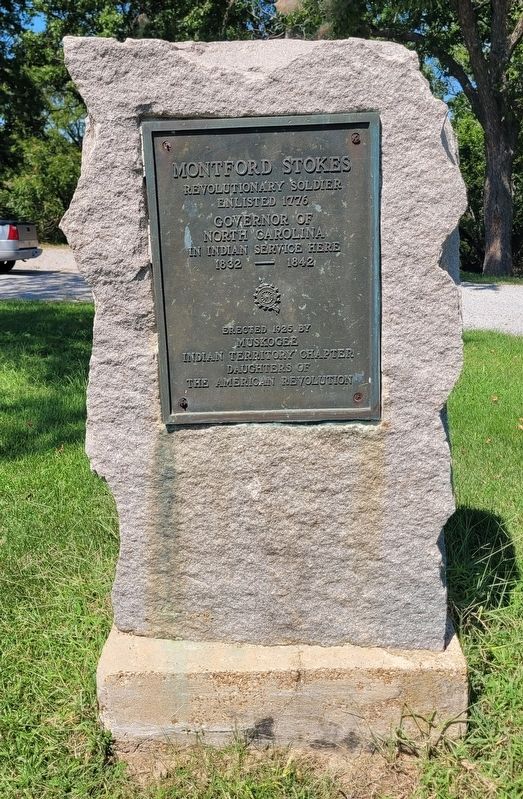
Montfort Stokes

Photographed by James Hulse, September 11, 2025
1. Montfort Stokes Marker
Enlisted 1776
Governor of
North Carolina
in Indian service here
1832 - 1842
Erected 1925 by Muskogee Indian Territory Chapter, Daughters of the American Revolution.
Topics. This historical marker is listed in these topic lists: Forts and Castles • War, US Revolutionary. A significant historical year for this entry is 1776.
Location. 35° 48.535′ N, 95° 15.244′ W. Marker is in Fort Gibson, Oklahoma, in Muskogee County. It is at the intersection of East Coppinger Avenue and N Garrison Ave (State Highway 80), on the left when traveling north on East Coppinger Avenue. The marker is located along a service road to the Fort Gibson. Touch for map. Marker is at or near this postal address: 426 E Coppinger Ave, Fort Gibson OK 74434, United States of America. Touch for directions.

Regionally, this marker is in the Muscogee Nation, specifically in the Cherokee Nation, and in Northeast Oklahoma—Green Country. It is also in the American South, specifically on the prairies, and on the Southern Plains. Globally, it is in North America, the Western Hemisphere, the Western World, and the
this page online
Other nearby markers. At least 8 other markers are within walking distance of this marker: Seventh United States Infantry (about 500 feet away, measured in a direct line); Site of Adjutant's Office (approx. 0.3 miles away); Occupied by United States Army (approx. 0.3 miles away); Telephones in 1886 (approx. 0.4 miles away); Fort Gibson (approx. 0.4 miles away); Fort Gibson Stockade Well (approx. 0.4 miles away); History of the Church Bell (approx. 0.7 miles away); a different marker also named Fort Gibson (approx. 0.8 miles away). Touch for a list and map of all markers in Fort Gibson.
Also see . . . Montfort Stokes 1762-1842. North Carolina Department of Natural and Cultural Resources
As governor, Stokes was strongly identified with the interests of western North Carolina, political and constitutional reform, internal improvements, and a sound banking system. Only secondarily did he lend his support to the tentative efforts underway to provide for public education. Responding to the(Submitted on September 15, 2025, by James Hulse of Medina, Texas.)slave rebellion led in 1831 by Nat Turner in lower southeastern Virginia, Stokes pushed back against the widespread hysteria that swept through North Carolina. His stance curbed violence against enslaved people, and Free People of Color, in North Carolina. Stokes was a strong supporter of Andrew Jackson and a vocal opponent of nullification. Repeatedly he denounced that doctrine as hostile to the Union.Photographed by James Hulse, September 11, 20252. Montfort Stokes Marker
In November of 1832 Stokes resigned his governorship to accept President Jackson’s appointment as chairman of a federal commission on Indian affairs. Relocating to Fort Gibson in present-day Oklahoma, his work there facilitated the removal and relocation of Indian people from the southeastern United States. He remained in Oklahoma doing similar work for the remainder of his life. Stokes died at Fort Gibson on November 4, 1842, and was buried near the post.
Photographed by James Hulse, September 11, 2025
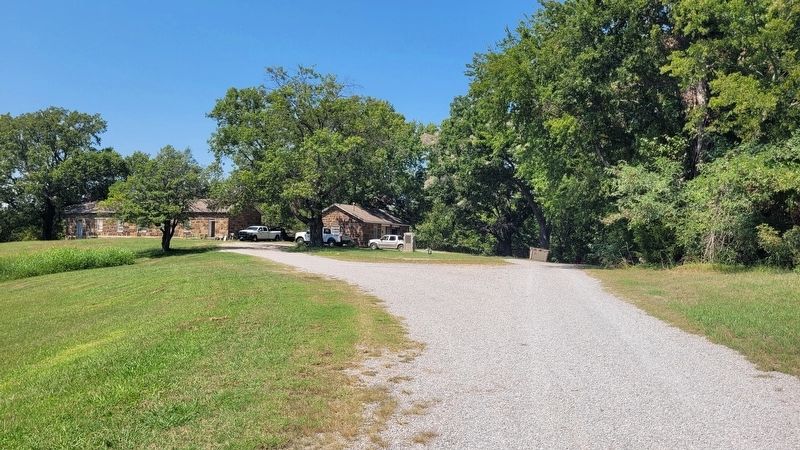
3. The view of the Montfort Stokes Marker down a park service road

Public Domain - Artist Jacob Marling - Wikipedia, circa 1830s
4. Montfort Stokes
Credits. This page was last revised on September 15, 2025. It was originally submitted on September 14, 2025, by James Hulse of Medina, Texas. This page has been viewed 103 times since then and 46 times this year. Photos: 1, 2, 3, 4. submitted on September 15, 2025, by James Hulse of Medina, Texas.
