
Welland in Niagara Region, Ontario — Central Canada (North America)
Notre histoire… [Our Story]
“Nous Avons une Histoire”
⎯⎯⎯
“We Have a History”

Photographed by Tim Boyd, November 18, 2024
1. Notre histoire… Marker

À l'âge de 34 ans, l'abbé Rosario Tanguay arrive à Welland le 2 octobre 1919 pour y célébrer le premier vendredi du mois avec les Canadiens français. En 1920, la paroisse du Sacré-Coeur de Welland est fondée et l'abbé Rosario Tanguay est désigné comme curé fondateur. Le 14 juin 1920, les paroissiens achètent, au nom de la Corporation épiscopale catholique de Toronto, le domaine Doan sur la rue Queen (Empire). Deux vieilles maisons se trouvent sur ce domaine, la plus grande est transformée en église temporaire (1e) pouvant accommoder 235 personnes; l'autre sert de presbytère. Au mois de septembre 1920, on ouvre la première classe de langue française, l'institutrice est Mille Anne-Marie Lemelin.
Dès 1933, on trouve l'église trop petite et le 28 octobre 1934 a lieu la bénédiction de la nouvelle église du Sacré-Coeur (2e). La nouvelle église de briques rouges, véritable réussite au point de vue architectural, inspire l'admiration des paroissiens et des visiteurs. Ainsi favorise-t-elle un nouvel essor de la vie paroissiale. Malheureusement, la crise économique qui sévit dans le monde,
this page online
Le père Dionis Lafrenière, dirige la paroisse de 1957 à 1963. Le 25 novembre 1958, son Excellence Monseigneur Joseph Thomas McCarthy est intronisé premier évêque de St. Catharines. Welland fait partie de ce nouveau diocèse. Le curé Lafrenière réalise deux grands projets: la nouvelle église (3°) et l'école Sacré-Coeur catholique privée.
C'est en avril 1971 qu'on ajoute à l'ambiance des offices liturgiques en achetant un magnifique orgue Casavant à vingt jeux. À l'automne 1975, la paroisse fête! L'hypothèque est payée!
1984, deux fils de la paroisse sont ordonnés prêtres: Le Père André Lemelin, le 5 mai et le Père Maurice Dionne, le 23 juin. En 1989, la Société Radio-Canada diffuse une des messes du dimanche à partir de notre église.
En 1992, la paroisse entreprend un projet

Photographed by Tim Boyd, November 18, 2024
2. Notre histoire… Marker (centre, below the arch)
En 2005 à l'occasion du 85e anniversaire de la paroisse, le conseil de ville accepte d'installer des enseignes de rue bilingues reconnaissant le quartier "French Town". En 2008, renouvellement entier d'un toit en acier.
_______________
At the age of 34, Abbé Rosario Tanguay arrives in Welland on October 2nd, 1919 to celebrate the first Friday of the Month with the French Canadians. In 1920, Sacré-Cœur parish in Welland is founded and Abbé Rosario Tanguay is named its pastor. On June 1st, 1920, the parishioners buy in the name of the Catholic Episcopal Corporation of Toronto, the domain on Queen (Empire) street. Two old houses are on the land. The biggest one is transformed into a temporary church (1st) which could accommodate two hundred ánd thirty-five people; the other house served as a rectory.

Photographed by Tim Boyd, November 18, 2024
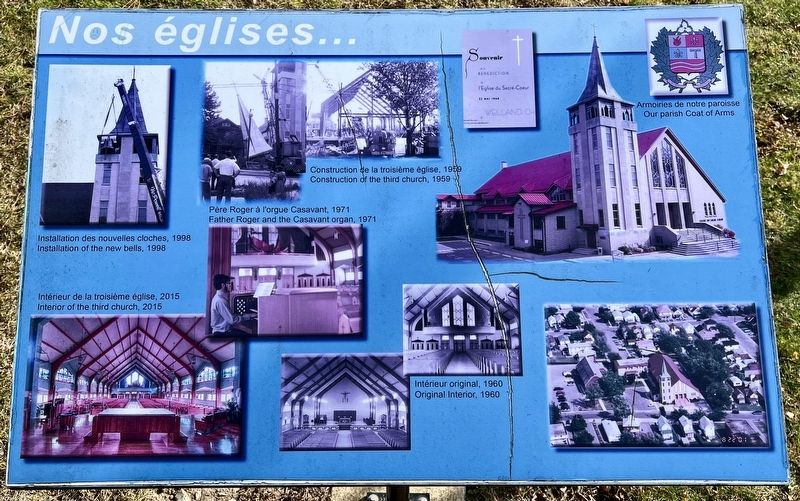
3. Nos Églises… photo panel on the left of the marker
By 1933, the church is already too small and on October 28th, 1934, the new Sacré-Cœur church (2nd) opens its doors. The new red brick church, a real architectural success inspires the admiration of the parishioners and of the visitors. Unfortunately, the financial crisis rages across the world, especially here in Welland because of its industrial base and by 1935 the situation becomes critical and many families seek better fortune elsewhere. There are now only 117 French Canadian families to support the debt of $ 50,000.
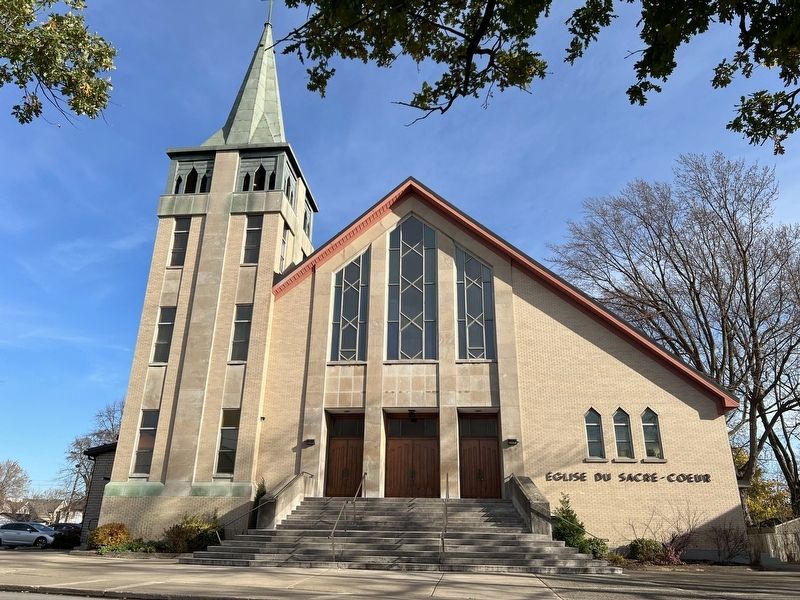
On November 25th, 1958, His Excellency, Monsignor Joseph Thomas McCarthy, becomes the first Bishop of St Catharines, and Welland is now part of this new Diocese. Father Dionis Lafrenière, in charge of the parish from 1957 to 1963, realizes two big projects; the new church (3rd) in 1960 and Sacré-Cœur catholic private school in 1957.
In April 1971, a beautiful Casavant organ is bought. The new organ adds an atmosphere to the services. In 1975, the parish celebrate another accomplishment, the mortgage
Photographed by Tim Boyd, November 18, 2024
4. Nos Églises… photo panel on the right of the marker
In 1984, two sons of the parish are ordained; abbé André Lemelin on May 5th, and abbé Maurice Dionne on June 23. In 1989, CBC (Radio-Canada) airs a Sunday celebration in our church.
In 1992, the parish takes on a major project which consists of the installation of an elevator, a ramp and a washroom for the handicapped. On July 18th, 1998, another big project took place when 5 bells arrived to our church to be installed in the bell steeple. They were christened: Albert and Marie 4,300 lbs., Roger 1,900 lbs., Louis 1,600 lbs., Isabelle 870 lbs. and Gérard 560 lbs.
In 2005, on the occasion of the parish 85th anniversary, the city council accepted to install bilingual street signs in recognition of "French Town" district. In 2008, another major project, the entire roof was refurbished with a new steel roof.
Topics. This historical marker is listed in these topic lists: Architecture • Education • Religion & Religious Structures. A significant historical year for this entry is 1919.
Location. 42° 59.474′ N, 79° 14.386′ W. Marker is in Welland, Ontario, in Niagara Region. It is on Empire Street 0.2 kilometers
Photographed by Tim Boyd, November 18, 2024
5. The third Sacred Heart Church/ Le 3e Église de Sacré-Coeur

Regionally, this marker is on Ontario’s Golden Horseshoe and in Niagara Canada. It is also in Central Canada. Globally, it is in North America, on the Great Lakes, in the Western Hemisphere, in the Western World, and in the Anglosphere. Historically, it finds itself in what was once a British colony, the Viceroyalty of New France, the Haudenosaunee (Iroquois) Confederacy, and Rupert’s Land.
Other nearby markers. At least 8 other markers are within walking distance of this marker: French Community in Welland / La Communauté Française de Welland (here, next to this marker); Gingerbread House c. 1890 (approx. half a kilometer away); Central Fire Hall 1920 (approx. 0.6 kilometers away); Gordon-Marshall House 1884 (approx. 0.6 kilometers away); Ernest Alexander Cruikshank (approx. 0.7 kilometers away); Welland County Court House (approx. 0.7 kilometers away); Artist Sarah Beattie "Ship Saudades" (approx. 0.8 kilometers away); The Town Bell / La Cloche Du Village (approx. 0.8 kilometers away). Touch for a list and map of all markers in Welland.
Credits. This page was last revised on September 18, 2025. It was originally submitted on November 20, 2024, by Tim Boyd of Hamilton, Ontario. This page has been viewed 167 times since then and 36 times this year. Last updated on September 16, 2025, by Kevin Westell of St. Catharines, Ontario. Photos: 1, 2, 3, 4, 5. submitted on November 20, 2024, by Tim Boyd of Hamilton, Ontario. • Devry Becker Jones was the editor who published this page.
