Roc de Sant Gaietà in Roda de Berà in Tarragona, Catalonia, Spain — Southwestern Europe (Iberian Peninsula)
El Roc de Sant Gaieta
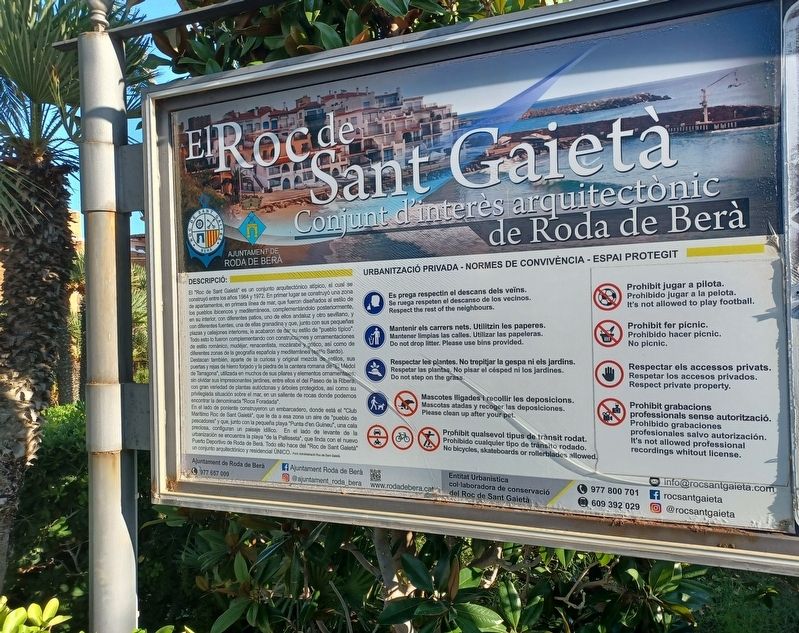
Photographed by Maggie Prats Lora, September 15, 2025
1. El Roc de Sant Gaieta Marker

Conjunt d'interès arquitectonic de Roda de Berà
Descripcio
El "Roc de Sant Gaietà" es un conjunto arquitectónico atípico, el cual se construyó entre los años 1964 y 1972. En primer lugar se construyó una zona de apartamentos, en primera línea de mar, que fueron diseñados al estilo de los pueblos ibicencos y mediterráneos, complementándolo posteriormente, en su interior, con diferentes patios, uno de ellos andaluz y otro sevillano, y con diferentes fuentes, una de ellas granadina y que, junto con sus pequeñas plazas y callejones interiores, le acabaron de dar su estilo de "pueblo típico". Todo esto lo fueron complementando con construcciones y ornamentaciones de estilo románico, mudéjar, renacentista, mozárabe y gótico, así como de diferentes zonas de la geografía española y mediterránea (estilo Sardo). Destacan también, aparte de la curiosa y original mezcla de estilos, sus puertas y rejas de hierro forjado y la piedra de la cantera romana de "El Médol de Tarragona", utilizada en muchos de sus pilares y elementos ornamentales, sin olvidar sus impresionantes jardines, entre ellos el del Paseo de la Ribera,
this page online
En el lado de poniente construyeron un embarcadero, donde está el "Club Marítimo Roc de Sant Gaietà", que le da a esa zona un aire de "pueblo de pescadores" y que, junto con la pequeña playa "Punta d'en Guineu", una cala preciosa, configuran un paisaje idílico. En el lado de levante de la urbanización se encuentra la playa "de la Pallisseta", que linda con el nuevo Puerto Deportivo de Roda de Berà. Todo ello hace del "Roc de Sant Gaietà" un conjunto arquitectónico y residencial ÚNICO.
Complex of architectural interest of Roda de Berà
Description
The "Roc de Sant Gaietà" is an atypical architectural complex, which was built between 1964 and 1972. Initially, an apartment complex was built on the seafront, designed in the style of Ibizan and Mediterranean villages. It was later complemented, inside, with different courtyards, one Andalusian and the other Sevillian, and with different fountains, one of them from Granada, which, together with its small squares and interior alleys, gave it its "typical village" style. All of this was complemented with buildings and ornamentation in Romanesque, Mudejar, Renaissance, Mozarabic and Gothic styles, as well as from different areas of Spain and the Mediterranean (Sardinian style). Also noteworthy, apart from the curious and original mix of styles, are its wrought iron gates and railings and the stone from the Roman quarry of "El Médol de Tarragona", used in many of its pillars and ornamental elements, not to mention its impressive gardens, including the Paseo de la Ribera, with a great variety of native plants and protected trees, as well as its privileged location overlooking the sea, on a rocky outcrop where we can find the so-called "Roca Foradada".
On the western side, they built a pier, where the Roc de Sant Gaietà Maritime Club is located. This gives the area a fishing village feel and, together with the small Punta d'en Guineu beach, a beautiful cove, creates an idyllic setting. On the eastern side of the development is Pallisseta beach, which borders the new Roda de Berà Marina. All of this makes Roc de Sant Gaietà a unique architectural and residential complex.
Erected by Ajuntament de Roda de Berà.
Topics. This historical marker is listed in this topic list: Architecture. A significant historical year for this entry is 1964.
Location. 41° 10.12′ N, 1° 28.83′ E. Marker is in Roda de Berà, Cataluña (Catalonia), in Tarragona. It is in Roc de Sant Gaietà. It is on Carrer de los Barques, on the right when traveling east. Touch for map. Marker is at or near this postal address: Barri Roc Sant Cayeta 17, Roda de Berà, Cataluña 43883, Spain. Touch for directions.

Regionally, it is in the North Atlantic Region, in Europe, in the European Union, in Atlantic Europe, on the Iberian Peninsula, in the Schengen Area, in a coastal Mediterranean country, and in the Western World. Historically, it finds itself in what was once the Roman Empire.
Other nearby markers. At least one other marker is within 3 kilometers of this marker, measured as the crow flies: Francesc Macià i Llussà (approx. 2.6 kilometers away).
Credits. This page was last revised on September 21, 2025. It was originally submitted on September 16, 2025, by Maggie Prats Lora of Silver Spring, Maryland. This page has been viewed 53 times since then and 21 times this year. Photo 1. submitted on September 16, 2025, by Maggie Prats Lora of Silver Spring, Maryland. • Andrew Ruppenstein was the editor who published this page.
