Hartland, New Brunswick — The Atlantic Provinces (North America)
Hartland Covered Bridge
⎯⎯⎯
Le Pont Couvert de Hartland
Photographed by Jimmy Emerson, July 8, 2022
1. Hartland Covered Bridge / Le Pont Couvert de Hartland Marker

Hartland Covered Bridge
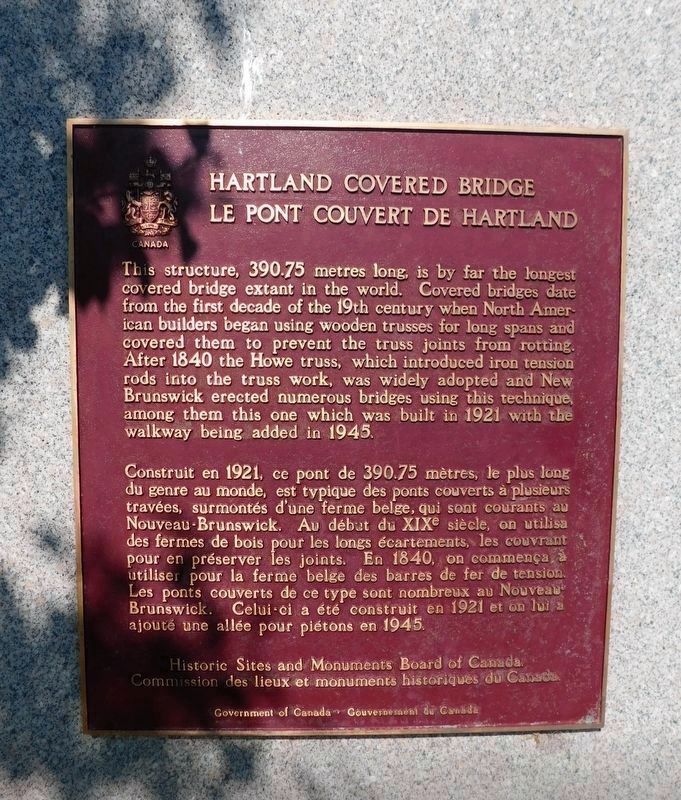
This structure, 390.75 metres long, is by far the longest covered bridge extant in the world. Covered bridges date from the first decade of the 19th century when North American builders began using wooden trusses for long spans and covered them to prevent the truss joints from rotting. After 1840 the Howe truss, which introduced iron tension rods into the truss work, was widely adopted and New Brunswick erected numerous bridges using this technique, among them this one which was built in 1921 with the walkway being added in 1945.
Le Pont Couvert de Hartland
Construit en 1921, ce pont de 390.75 mètres, le plus long du genre au monde, est typique des ponts couverts à plusieurs travées, surmontés d'une ferme belge, qui sont courants au Nouveau-Brunswick. Au début du XIXe siècle, on utilisa des fermes de bois pour les longs écartements, les couvrant pour en préserver les joints. En 1840, on commença à utiliser pour la ferme belge des barres de fer de tension. Les ponts couverts de ce type sont nombreux au Nouveau-Brunswick. Celui-ci a été construit en 1921 et on
this page online
Erected by Heritage Sites and Monuments Board Of Canada.
Topics and series. This historical marker is listed in this topic list: Bridges & Viaducts. In addition, it is included in the Canada, Historic Sites and Monuments Board, and the Covered Bridges series lists. A significant historical year for this entry is 1921.
Location. 46° 17.822′ N, 67° 31.673′ W. Marker is in Hartland, New Brunswick. It is on Hartland Hill Bridge Road near Main Street. Touch for map. Marker is at or near this postal address: 365 Main Street, Hartland NB E7P 2N1, Canada. Touch for directions.

Regionally, this marker is in Fredericton & River Valley. It is also in the Maritimes and in Atlantic Canada. Globally, it is in the North Atlantic Region, North America, the Western Hemisphere, the Western World, and the Anglosphere. Historically, it finds itself in what was once a British colony, the Viceroyalty of New France, and Acadia.
Other nearby markers. At least 8 other markers are within 18 kilometers of this marker, measured as the crow flies: St. John River (about 90 meters away, measured

Photographed by Kevin Westell, August 2007
2. View south-east from the Hartland Covered Bridge sidewalk
The red-brown triangle building (left of centre) is the visitor centre. Left of it is a gray rectangle block, on which is mounted the marker.
Also see . . . Hartland Covered Bridge (Wikipedia). Overview:
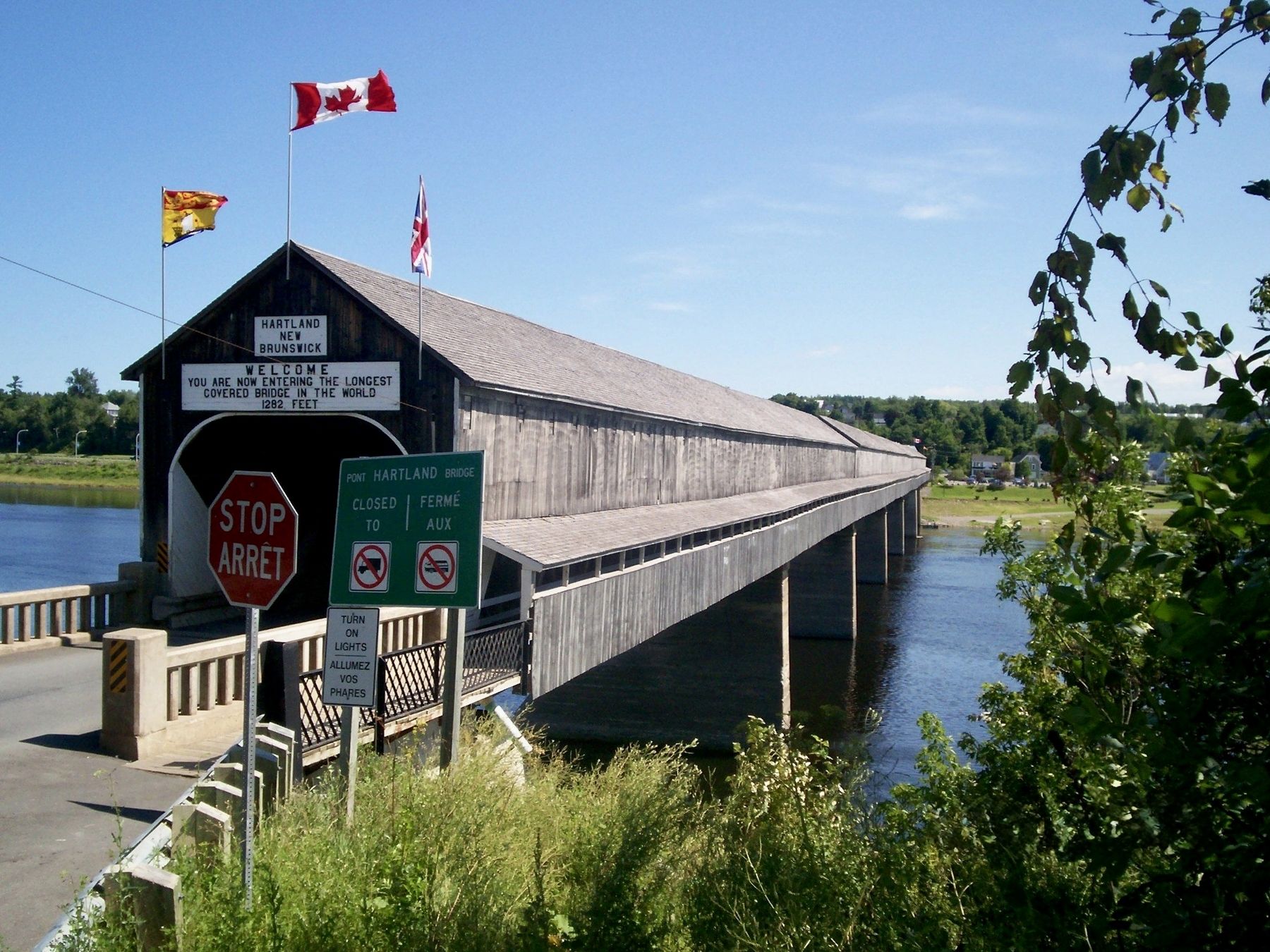
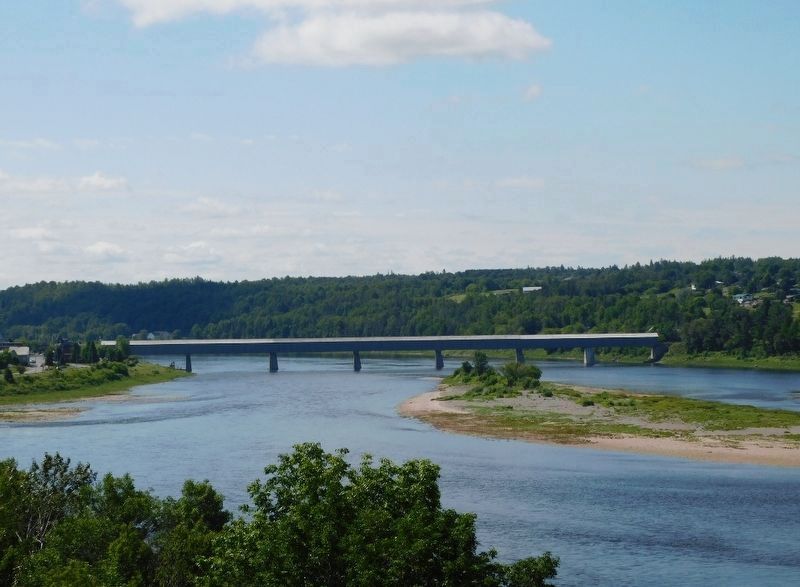
The Hartland Covered Bridge (French: Pont couvert de Hartland) or Hartland Bridge is the world's longest covered bridge at 1,282 feet (391 m) in length. Located in New Brunswick, Canada, the bridge crosses the Saint John River, joining the Carleton County communities of Hartland and Somerville. The framework consists of seven small Howe Truss bridges joined on six piers. The bridge was designated a National Historic Site of Canada in(Submitted on September 18, 2025.)1977, and a Provincial Heritage Place in New Brunswick under the Heritage Conservation Act in 1999.Photographed by Kevin Westell, August 20073. Hartland Covered BridgePhoto faces east and north-east from the west end of the bridge.
The Hartland Bridge originally opened in 1901 after planning and construction work dating back to around 1898, though its construction had been proposed and discussed earlier. It was initially uncovered and a toll bridge. The Hartland Covered Bridge became covered after it was rebuilt when it became structurally damaged by weather in early 1920. Today, it is used primarily as a tourist attraction, featuring only one lane as well as load and height limits.
Photographed by Jimmy Emerson, July 8, 2022
4. Hartland Covered Bridge
Credits. This page was last revised on July 10, 2026. It was originally submitted on September 16, 2025, by Kevin Westell of St. Catharines, Ontario. This page has been viewed 138 times since then and 75 times this year. Photos: 1. submitted on June 13, 2026, by Jimmy Emerson of Dalton, Georgia. 2, 3. submitted on September 16, 2025, by Kevin Westell of St. Catharines, Ontario. 4. submitted on June 13, 2026, by Jimmy Emerson of Dalton, Georgia. • Andrew Ruppenstein was the editor who published this page.
