Treptow-Köpenick in Berlin in Treptow-Köpenick, Germany — Northeast German Plain (The European Plain)
NS Zwangsarbeit in Adlerhof
⎯⎯⎯
Nazi Forced Labour in Adlerhof
Photographed by Andrew Ruppenstein, September 3, 2025
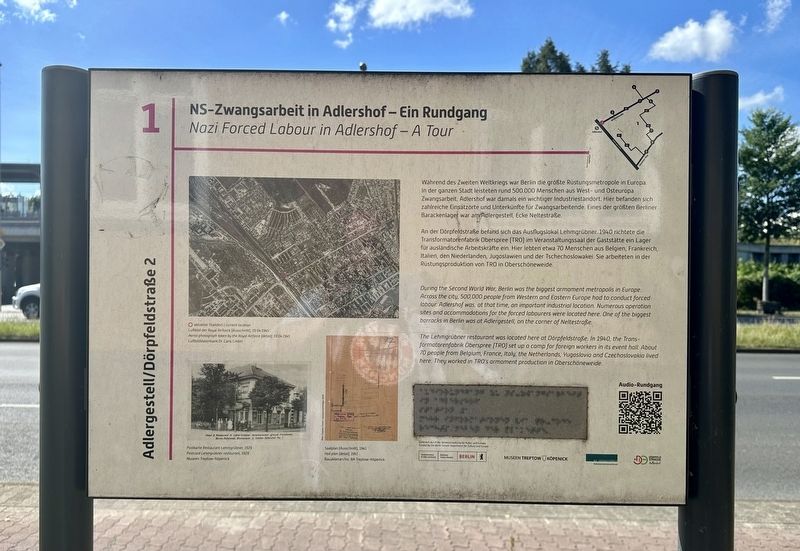
1. NS Zwangsarbeit in Adlerhof / Nazi Forced Labour in Adlerhof Marker

Während des Zweiten Weltkriegs war Berlin die größte Rüstungsmetropole in Europa. In der ganzen Stadt leisteten rund 500.000 Menschen aus West- und Osteuropa Zwangsarbeit. Adlershof war damals ein wichtiger Industriestandort. Hier befanden sich zahlreiche Einsatzorte und Unterkünfte für Zwangsarbeitende. Eines der größten Berliner Barackenlager war am Adlergestell, Ecke Neltestraße.
An der Dörpfeldstraße befand sich das Ausflugslokal Lehmgrübner. 1940 richtete die Transformatorenfabrik Oberspree (TRO) im Veranstaltungssaal der Gaststätte ein Lager für ausländische Arbeitskräfte ein. Hier lebten etwa 70 Menschen aus Belgien, Frankreich, Italien, den Niederlanden, Jugoslawien und der Tschechoslowakei. Sie arbeiteten in der Rüstungsproduktion von TRO in Oberschöneweide.
During the Second World War, Berlin was the biggest armament metropolis in Europe. Across the city, 500,000 people from Western and Eastern Europe had to conduct forced labour. Adlershof was, at that time, an important industrial location. Numerous operation
this page online
The Lehmgrübner restaurant was located here at Dörpfeldstraße. In 1940, the Transformatorenfabrik Oberspree (TRO) set up a camp for foreign workers in its event hall. About 70 people from Belgium, France, Italy, the Netherlands, Yugoslavia and Czechoslovakia lived here. They worked in TRO's armament production in Oberschöneweide. (Marker Number 1.)
Topics. This historical marker is listed in these topic lists: Industry & Commerce • War, World II. A significant historical year for this entry is 1940.
Location. 52° 26.15′ N, 13° 32.465′ E. Marker is in Berlin, in Treptow-Köpenick. It is in Treptow-Köpenick. It is at the intersection of Adlergestell and Dörpfeldstraße, on the right when traveling north on Adlergestell. Touch for map. Marker is at or near this postal address: Adlergestell 255, Berlin 12489, Germany. Touch for directions.

Regionally, it is in Europe, the European Union, Atlantic Europe, Central Europe, the Schengen Area, Western Europe, and the Western
Photographed by Andrew Ruppenstein, September 3, 2025
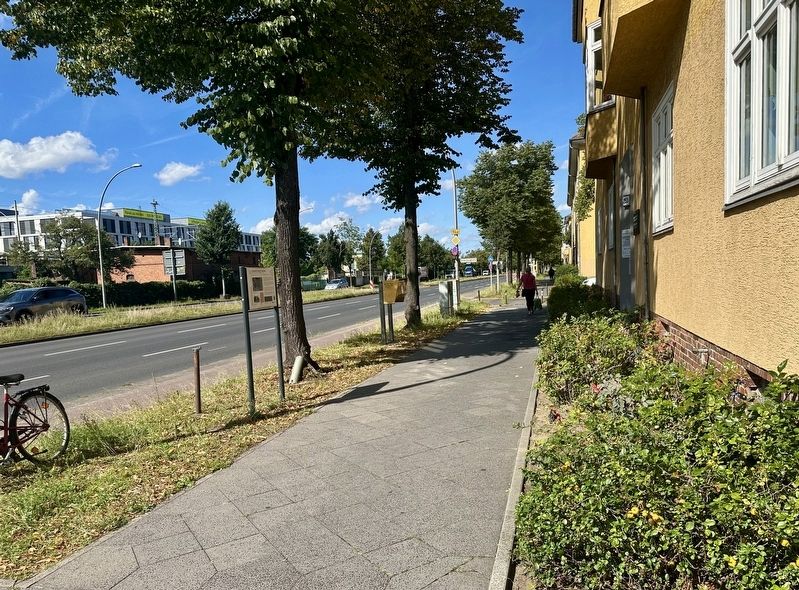
2. Nazi Forced Labour in Adlerhof Marker - wide view, looking north on Adlergestell
Other nearby markers. At least 8 other markers are within 13 kilometers of this marker, measured as the crow flies: Rudolf Wagner Régeny (a few steps from this marker); Anna Seghers (approx. 0.3 kilometers away); Berliner Mauer / Berlin Wall (approx. 4.3 kilometers away); Die Geschichte dahinter / The history behind (approx. 5.3 kilometers away in Brandenburg); Die Glocken der Dorfkirche Schönefeld / The Bells of the Schönefeld Village Church (approx. 5.9 kilometers away in Brandenburg); Tagelöhnerhaus / Day Laborers House (approx. 7.9 kilometers away in Brandenburg); Eagle Square (approx. 11.7 kilometers away); Zerstörte Synagoge / Destroyed Synagogue (approx. 12.6 kilometers away). Touch for a list and map of all markers in Berlin.
Also see . . . Forced labour under German rule during World War II (Wikipedia). Overview:
The use of slave and forced labour in Nazi Germany (German: Zwangsarbeit) and throughout German-occupied Europe during World War II took place on an unprecedented scale. It was a vital part of the German economic exploitation of conquered territories. It also contributed to the mass extermination of populations in occupied Europe. The Germans abducted approximately 12 million people from almost twenty European countries; about two thirds came from Central Europe and Eastern Europe.(Submitted on September 18, 2025.)
Many workers died as a result of their living conditions – extreme mistreatment, severe malnutrition and abuse were the main causes of death. Many more became civilian casualties from enemy (Allied) bombing and shelling of their workplaces throughout the war. At the peak of the program, the forced labourers constituted 20% of the German work force. Counting deaths and turnover, about 15 million men and women were forced labourers at one point during the war...
Credits. This page was last revised on September 18, 2025. It was originally submitted on September 18, 2025, by Andrew Ruppenstein of Lamorinda, California. This page has been viewed 72 times since then and 24 times this year. Photos: 1, 2. submitted on September 18, 2025, by Andrew Ruppenstein of Lamorinda, California.
