Fanshawe in London in Middlesex County, Ontario — Central Canada (North America)
Village Hall
Photographed by Tim Boyd, September 14, 2025
1. Village Hall Marker
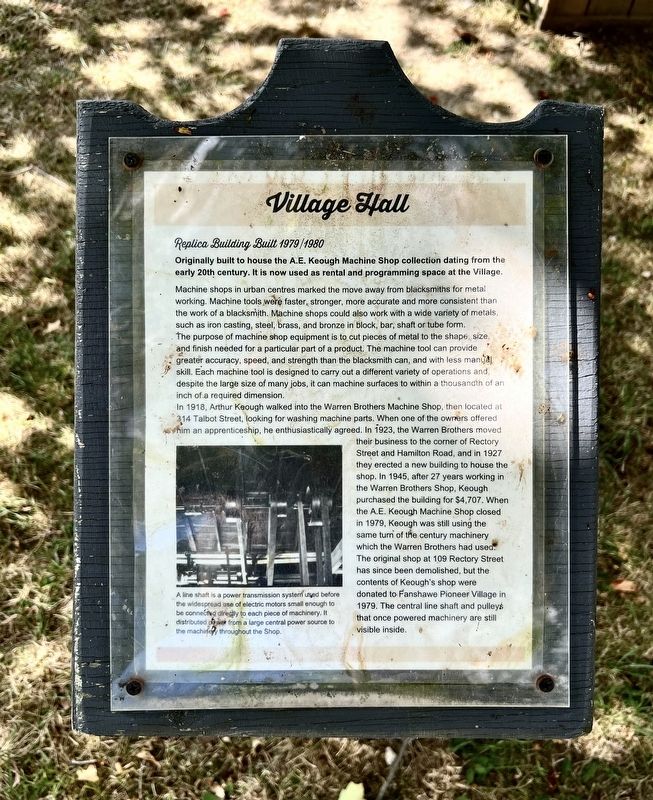
Replica Building Built 1979/1980
Originally built to house the A.E. Keough Machine Shop collection dating from the early 20th century. It is now used as rental and programming space at the Village.
Machine shops in urban centres marked the move away from blacksmiths for metal working. Machine tools were faster, stronger, more accurate and more consistent than the work of a blacksmith. Machine shops could also work with a wide variety of metals such as iron casting, steel, brass, and bronze in block, bar, shaft or tube form. The purpose of machine shop equipment is to cut pieces of metal to the shape, size and finish needed for a particular part of a product. The machine tool can provide greater accuracy, speed, and strength than the blacksmith can, and with less manua! skill. Each machine tool is designed to carry out a different variety of operations and despite the large size of many jobs, it can machine surfaces to within a thousandth of an inch of a required dimension.
In 1918, Arthur Keough walked into the Warren Brothers Machine Shop, then located at 314 Talbot Street, looking for washing machine parts. When
this page online
Topics. This historical marker is listed in this topic list: Industry & Commerce. A significant historical year for this entry is 1918.
Location. 43° 3.284′ N, 81° 10.818′ W. Marker is in London, Ontario, in Middlesex County. It is in Fanshawe. It can be reached from Fanshawe Park Road East. The marker is on the grounds of the Fanshawe Pioneer Village, accessibility subject to its operating hours and requiring paid admission.

Photographed by Tim Boyd, September 14, 2025
2. Village Hall Marker

Regionally, this marker is in the Southwest Ontario Area and in Southwestern Ontario. It is also in Central Canada. Globally, it is in North America, the Western Hemisphere, the Western World, and the Anglosphere. Historically, it finds itself in what was once a British colony, the Viceroyalty of New France, the Haudenosaunee (Iroquois) Confederacy, and Rupert’s Land.
Other nearby markers. At least 8 other markers are within walking distance of this marker: Print Shop (a few steps from this marker); Denfield General Store (within shouting distance of this marker); Trinity Church (within shouting distance of this marker); The W. Rigney Harness Shop (within shouting distance of this marker); The Cobbling Trade (within shouting distance of this marker); London Brewery (within shouting distance of this marker); Alder’s Weaving Shed (within shouting distance of this marker); Dr. Jones Frame Barn (within shouting distance of this marker). Touch for a list and map of all markers in London.
Credits. This page was last revised on September 19, 2025. It was originally submitted on September 19, 2025, by Tim Boyd of Hamilton, Ontario. This page has been viewed 49 times since then and 13 times this year. Photos: 1, 2. submitted on September 19, 2025, by Tim Boyd of Hamilton, Ontario. • Andrew Ruppenstein was the editor who published this page.
