Fanshawe in London in Middlesex County, Ontario — Central Canada (North America)
Print Shop
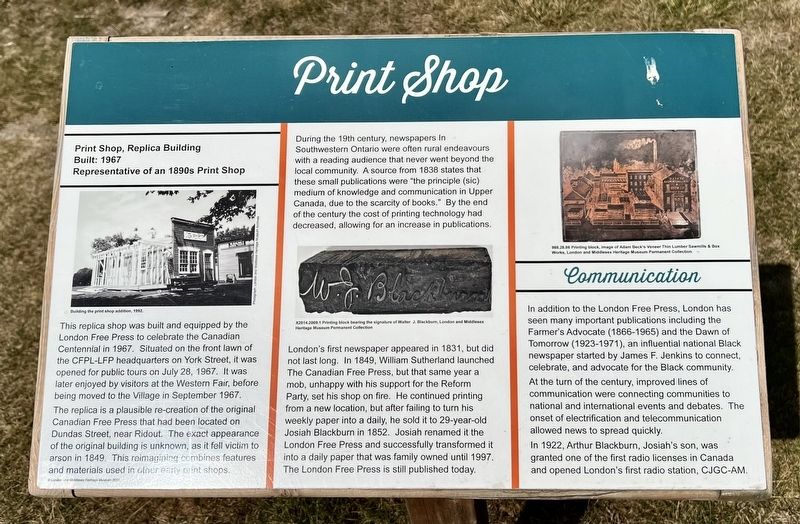
Photographed by Tim Boyd, September 14, 2025
1. Print Shop Marker
Print Shop, Replica Building
Built: 1967
Representative of an 1890s Print Shop
This replica shop was built and equipped by the London Free Press to celebrate the Canadian Centennial in 1967. Situated on the front lawn of the CFPL-LFP headquarters on York Street, it was opened for public tours on July 28, 1967. It was later enjoyed by visitors at the Western Fair, before being moved to the Village in September 1967.
The replica is a plausible re-creation of the original Canadian Free Press that had been located on Dundas Street, near Ridout. The exact appearance of the original building is unknown, as it fell victim to arson in 1849. This reimagining combines features and materials used in other early print shops.
During the 19th century, newspapers in Southwestern Ontario were often rural endeavours with a reading audience that never went beyond the local community. A source from 1838 states that these small publications were "the principle (sic) medium of knowledge and communication in Upper Canada, due to the scarcity of books." By the end of the century the cost of printing technology had decreased, allowing
this page online
London's first newspaper appeared in 1831, but did not last long. In 1849, William Sutherland launched The Canadian Free Press, but that same year a mob, unhappy with his support for the Reform Party, set his shop on fire. He continued printing from a new location, but after failing to turn his weekly paper into a daily, he sold it to 29-year-old Josiah Blackburn in 1852. Josiah renamed it the London Free Press and successfully transformed it into a daily paper that was family owned until 1997. The London Free Press is still published today.
Communication
In addition to the London Free Press, London has seen many important publications including the Farmer's Advocate (1866-1965) and the Dawn of Tomorrow (1923-1971), an influential national Black newspaper started by James F. Jenkins to connect, celebrate, and advocate for the Black community.
At the turn of the century, improved lines of communication were connecting communities to national and international events and debates. The onset of electrification and telecommunication allowed news to spread quickly. In 1922, Arthur Blackburn, Josiah's

1992
2. Print Shop marker photo and caption detail (left)
Topics. This historical marker is listed in this topic list: Communications. A significant historical date for this entry is July 28, 1967.
Location. 43° 3.28′ N, 81° 10.829′ W. Marker is in London, Ontario, in Middlesex County. It is in Fanshawe. It can be reached from Fanshawe Park Road East. The marker is on the grounds of the Fanshawe Pioneer Village, accessibility subject to its operating hours and requiring paid admission. The Village is accessed by driving east from the intersection of Clark Road and Veterans’ Parkway. Admission is paid at the entrance to the Fanshawe Conservation Area, and then follow signposts for approx. 2km to the Village. Touch for map. Marker is at or near this postal address: 2609 Fanshawe Park Road E, London ON N0M 2P0, Canada. Touch for directions.

Regionally, this marker is in the Southwest Ontario Area and in Southwestern Ontario. It is also in Central Canada. Globally, it is in North America, the Western Hemisphere, the Western World, and the Anglosphere. Historically, it finds itself in

3. Print Shop marker photo and caption detail (centre)
Other nearby markers. At least 8 other markers are within walking distance of this marker: Denfield General Store (a few steps from this marker); Village Hall (a few steps from this marker); The Cobbling Trade (a few steps from this marker); The W. Rigney Harness Shop (a few steps from this marker); London Brewery (within shouting distance of this marker); Trinity Church (within shouting distance of this marker); Harmer Sawmill (within shouting distance of this marker); Arrival of European Settlers (within shouting distance of this marker). Touch for a list and map of all markers in London.

4. Print Shop marker photo and caption detail (right)

Photographed by Tim Boyd, September 14, 2025
5. Print Shop Marker
Credits. This page was last revised on September 20, 2025. It was originally submitted on September 19, 2025, by Tim Boyd of Hamilton, Ontario. This page has been viewed 61 times since then and 16 times this year. Photos: 1, 2, 3, 4, 5. submitted on September 19, 2025, by Tim Boyd of Hamilton, Ontario. • Andrew Ruppenstein was the editor who published this page.
