Fanshawe in London in Middlesex County, Ontario — Central Canada (North America)
The Cobbling Trade
Photographed by Tim Boyd, September 14, 2025
1. The Cobbling Trade Marker
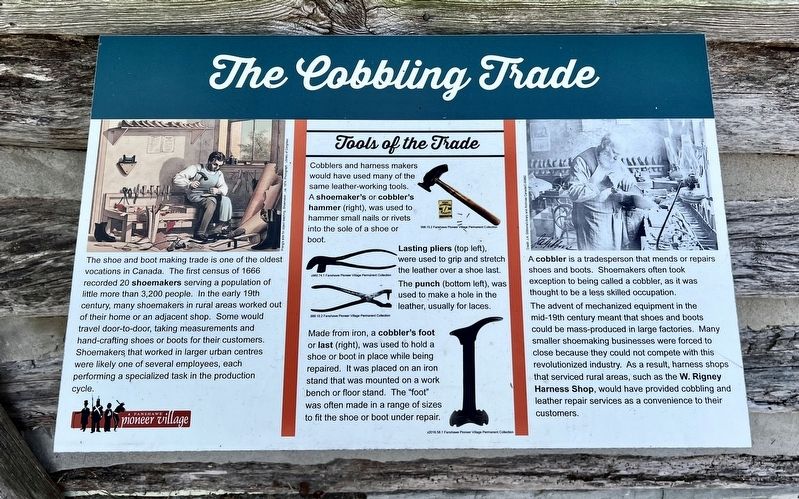
The shoe and boot making trade is one of the oldest vocations in Canada. The first census of 1666 recorded 20 shoemakers serving a population of little more than 3,200 people. In the early 19th century, many shoemakers in rural areas worked out of their home or an adjacent shop. Some would travel door-to-door, taking measurements and hand-crafting shoes or boots for their customers. Shoemakers, that worked in larger urban centres were likely one of several employees, each performing a specialized task in the production cycle.
Tools of the Trade
Cobblers and harness makers would have used many of the same leather-working tools. A shoemaker's or cobbler's hammer (right), was used to hammer small nails or rivets into the sole of a shoe or boot.
Lasting pliers (top left), were used to grip and stretch the leather over a shoe last.
The punch (bottom left), was used to make a hole in the leather, usually for laces.
Made from iron, a cobbler's foot or last (right), was used to hold a shoe or boot in place while being repaired. It was placed on an iron stand that was mounted on a work bench or floor stand. The "foot"
this page online
A cobbler is a tradesperson that mends or repairs shoes and boots. Shoemakers often took exception to being called a cobbler, as it was thought to be a less skilled occupation.
The advent of mechanized equipment in the mid-19th century meant that shoes and boots could be mass-produced in large factories. Many smaller shoemaking businesses were forced to close because they could not compete with this revolutionized industry. As a result, harness shops that serviced rural areas, such as the W. Rigney Harness Shop, would have provided cobbling and leather repair services as a convenience to their customers.
Erected by Fanshawe Pioneer Village.
Topics. This historical marker is listed in this topic list: Industry & Commerce. A significant historical year for this entry is 1666.
Location. 43° 3.27′ N, 81° 10.833′ W. Marker is in London, Ontario, in Middlesex County. It is in Fanshawe. It can be reached from Fanshawe Park Road East. The marker is on the grounds of the Fanshawe Pioneer Village, accessibility subject to its operating hours and requiring paid admission.

Photographed by Tim Boyd, September 14, 2025
2. The Cobbling Trade Marker
Below the window on the lefthand building

Regionally, this marker is in the Southwest Ontario Area and in Southwestern Ontario. It is also in Central Canada. Globally, it is in North America, the Western Hemisphere, the Western World, and the Anglosphere. Historically, it finds itself in what was once a British colony, the Viceroyalty of New France, the Haudenosaunee (Iroquois) Confederacy, and Rupert’s Land.
Other nearby markers. At least 8 other markers are within walking distance of this marker: The W. Rigney Harness Shop (here, next to this marker); Denfield General Store (a few steps from this marker); Print Shop (a few steps from this marker); London Brewery (a few steps from this marker); Village Hall (within shouting distance of this marker); Harmer Sawmill (within shouting distance of this marker); Trinity Church (within shouting distance of this marker); Arrival of European Settlers (within shouting distance of this marker). Touch for a list and map of all markers in London.
Credits. This page was last revised on September 20, 2025. It was originally submitted on September 20, 2025, by Tim Boyd of Hamilton, Ontario. This page has been viewed 56 times since then and 20 times this year. Photos: 1, 2. submitted on September 20, 2025, by Tim Boyd of Hamilton, Ontario. • Andrew Ruppenstein was the editor who published this page.
