Fanshawe in London in Middlesex County, Ontario — Central Canada (North America)
Trinity Church

Photographed by Tim Boyd, September 14, 2025
1. Trinity Church Marker
Trinity Church, Original Building
Built: c. 1887, Perth County
Sebringville, Ontario
In 1872, Trinity Anglican Church was formed by five families as a mission of Stratford's St. James Anglican Church. Land was eventually obtained to build the church, and in 1887 Trinity Church was built on Concession 1, Lot 17, Ellice Township in Sebringville. Faced with a declining congregation, Trinity's parishioners unanimously decided to close its doors in 1997. The building was moved to the Village later that year.
Trinity Church is one of the few remaining examples of "Carpenter Gothic" architecture in Ontario, and is designated under the Ontario Heritage Act. The Canadian adaptation of the European Gothic architecture style utilizes wood instead of stone, and includes elements such as fancy scroll work and board-and-batten siding. Trinity Church is also distinctive in its "Holy Trinity" theme, which dictates that all seating, banks of lights, windows and carved ornamentation are set in groups of three.
In the early 20th century churches continued to play a large role in people's lives, not only as a place of worship, but by also providing philanthropic and social opportunities. As towns grew, churches evolved to meet the needs of their
this page online
Religious Diversity
Since the arrival of explorers and missionaries, various religious beliefs have been introduced to Canada. However, this was a place already thriving with diverse Indigenous spirituality.
The role religion would play in communities and decision making would be dominated by Christian mindsets well into the 20th century, greatly affecting Indigenous peoples, religious minorities, and those seeking refuge or wishing to immigrate to Canada.
Freedom of religion in Canada is now protected by the Canadian Charter of Human Rights and Freedoms and the Canadian Human Rights Act. Government laws cannot restrict a person's religious freedom unless it infringes on other rights and values, for example, the right to equality.
Topics. This historical marker is listed in these topic lists: Architecture • Religion & Religious Structures. A significant historical year for this entry is 1887.
Location. 43° 3.274′ N, 81° 10.801′ W. Marker is in London, Ontario, in Middlesex County. It is in Fanshawe. It can be reached from Fanshawe Park Road East. The marker is on the grounds of
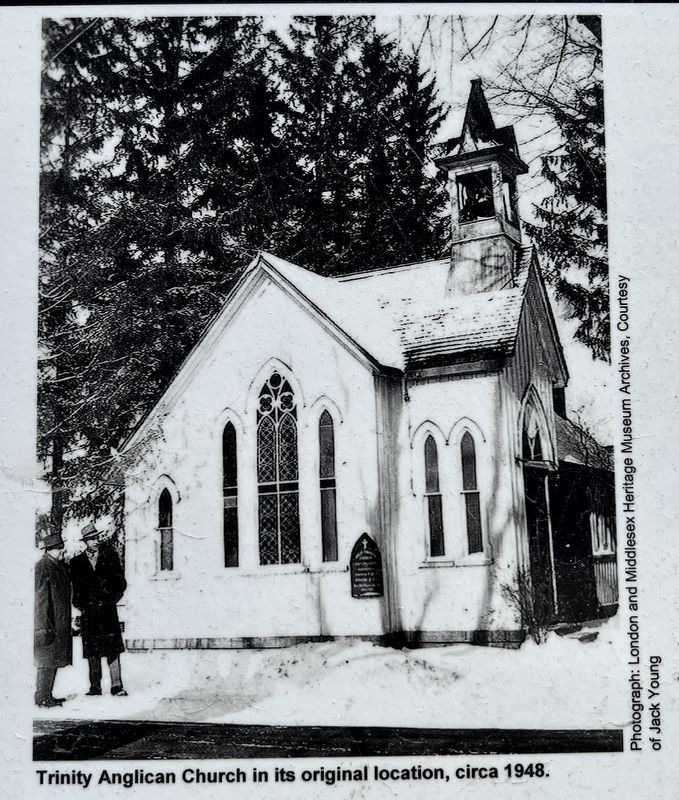
circa 1948
2. Trinity Church marker photo and caption detail, (left)

Regionally, this marker is in the Southwest Ontario Area and in Southwestern Ontario. It is also in Central Canada. Globally, it is in North America, the Western Hemisphere, the Western World, and the Anglosphere. Historically, it finds itself in what was once a British colony, the Viceroyalty of New France, the Haudenosaunee (Iroquois) Confederacy, and Rupert’s Land.
Other nearby markers. At least 8 other markers are within walking distance of this marker: Village Hall (within shouting distance of this marker); Peel House (within shouting distance of this marker); Alder’s Weaving Shed (within shouting distance of this marker); Print Shop (within shouting distance of this marker); The W. Rigney Harness Shop (within shouting distance of this marker); The Cobbling Trade (within shouting

1942
3. Trinity Church marker photo and caption detail (centre)

1997
4. Trinity Church marker photo and caption detail (right)

Photographed by Tim Boyd, September 14, 2025
5. Trinity Church interior, 2025

Photographed by Tim Boyd, September 14, 2025
6. Trinity Church Marker
Credits. This page was last revised on September 23, 2025. It was originally submitted on September 22, 2025, by Tim Boyd of Hamilton, Ontario. This page has been viewed 54 times since then and 25 times this year. Photos: 1, 2, 3, 4, 5, 6. submitted on September 22, 2025, by Tim Boyd of Hamilton, Ontario. • Andrew Ruppenstein was the editor who published this page.
