Fanshawe in London in Middlesex County, Ontario — Central Canada (North America)
Blacksmith Shop
Photographed by Tim Boyd, September 14, 2025
1. Blacksmith Shop Marker
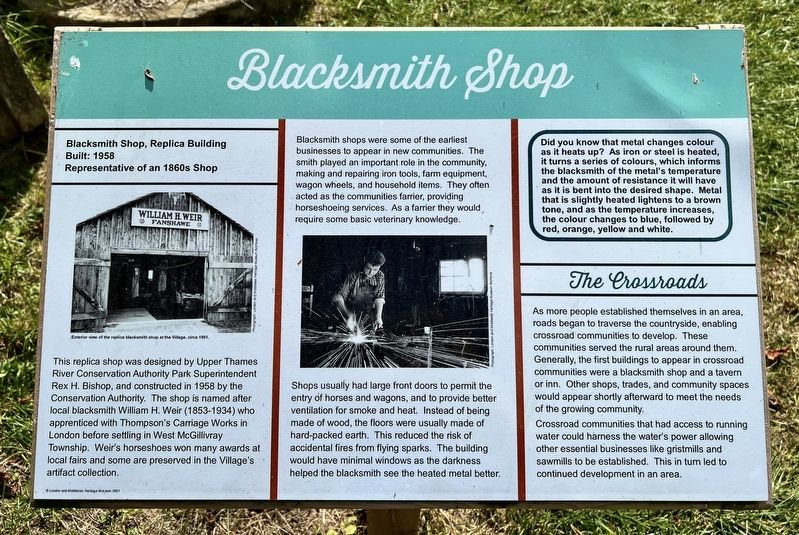
Blacksmith Shop, Replica Building
Built: 1958
Representative of an 1860s Shop
This replica shop was designed by Upper Thames River Conservation Authority Park Superintendent Rex H. Bishop, and constructed in 1958 by the Conservation Authority. The shop is named after local blacksmith William H. Weir (1853-1934) who apprenticed with Thompson's Carriage Works in London before settling in West McGillivray Township. Weir's horseshoes won many awards at local fairs and some are preserved in the Village's artifact collection.
Blacksmith shops were some of the earliest businesses to appear in new communities. The smith played an important role in the community, making and repairing iron tools, farm equipment, wagon wheels, and household items. They often acted as the communities farrier, providing horseshoeing services. As a farrier they would, require some basic veterinary knowledge.
Shops usually had large front doors to permit the entry of horses and wagons, and to provide better ventilation for smoke and heat. Instead of being made of wood, the floors were usually made of hard-packed earth. This reduced the risk
this page online
Did you know that metal changes colour as it heats up? As iron or steel is heated, it turns a series of colours, which informs the blacksmith of the metal's temperature and the amount of resistance it will have as it is bent into the desired shape. Metal that is slightly heated lightens to a brown tone, and as the temperature increases, the colour changes to blue, followed by red, orange, yellow and white.
The Crossroads
As more people established themselves in an area, roads began to traverse the countryside, enabling crossroad communities to develop. These communities served the rural areas around them. Generally, the first buildings to appear in crossroad communities were a blacksmith shop and a tavern or inn. Other shops, trades, and community spaces would appear shortly afterward to meet the needs of the growing community.
Crossroad communities that had access to running water could harness the water's power allowing other essential businesses like gristmills and sawmills to

circa 1861
2. Blacksmith Shop marker photo and caption detail
Topics. This historical marker is listed in these topic lists: Industry & Commerce • Settlements & Settlers. A significant historical year for this entry is 1958.
Location. 43° 3.318′ N, 81° 10.789′ W. Marker is in London, Ontario, in Middlesex County. It is in Fanshawe. It can be reached from Fanshawe Park Road East. The marker is on the grounds of the Fanshawe Pioneer Village, accessibility subject to its operating hours and requiring paid admission. The Village is accessed by driving east from the intersection of Clark Road and Veterans’ Parkway. Admission is paid at the entrance to the Fanshawe Conservation Area, and then follow signposts for approx. 2km to the Village. Touch for map. Marker is at or near this postal address: 2609 Fanshawe Park Road E, London ON N0M 2P0, Canada. Touch for directions.

Regionally, this marker is in the Southwest Ontario Area and in Southwestern Ontario. It is also in Central Canada. Globally, it is in North America, the Western Hemisphere, the Western World, and the Anglosphere. Historically, it finds itself in

Photographed by Tim Boyd, September 14, 2025
3. Blacksmith Shop Marker
Other nearby markers. At least 8 other markers are within walking distance of this marker: Purple Hill Loyal Orange Lodge (a few steps from this marker); African Methodist Episcopal Church (a few steps from this marker); a different marker also named African Methodist Episcopal Church (a few steps from this marker); Corbett Tavern (a few steps from this marker); Lochaber Church (within shouting distance of this marker); Dr. Jones House (within shouting distance of this marker); Dr. Jones’ House: (within shouting distance of this marker); The Resources of the Woodland (within shouting distance of this marker). Touch for a list and map of all markers in London.
Credits. This page was last revised on September 30, 2025. It was originally submitted on September 28, 2025, by Tim Boyd of Hamilton, Ontario. This page has been viewed 53 times since then and 23 times this year. Photos: 1, 2, 3. submitted on September 28, 2025, by Tim Boyd of Hamilton, Ontario. • Andrew Ruppenstein was the editor who published this page.
