Fanshawe in London in Middlesex County, Ontario — Central Canada (North America)
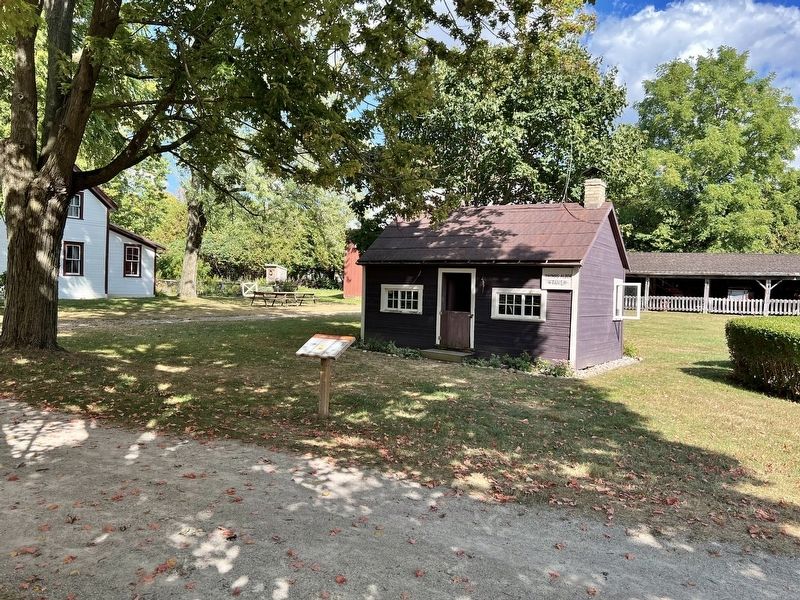
Alder’s Weaving Shed

Photographed by Tim Boyd, September 14, 2025
1. Alder’s Weaving Shed Marker
Alder's Weaving Shed, Original Building
Built: c. 1857, Middlesex County
Con. 5, Lot 32, London Township
Thomas Alder, maternal grandfather to the Village's first curator Wilfrid Jury, immigrated to Canada from England in 1857 and purchased land just north of Melrose in the former London Township. In addition his meager baggage, Thomas brought with him a steel loom harness. Although he planned to establish himself as a farmer, he knew that the long, cold winters provided little opportunity for farm income. He had apprenticed as a weaver in Gloucestershire before emigrating to Canada and planned to supplement his income during the winter months with the weaving of rugs, horse blankets and cloth.
Thomas Alder built a weaving shed, even before constructing a house, with logs cleared from his property. Inside, a work bench along one wall served as both a workspace and a bed, while a wood stove provided heat and a place to cook. He built his barn loom directly into the structure, having made the loom's framework and whittled bobbins and reels himself. Thomas bought one piece of furniture for his new dwelling, a wooden
this page online
Thomas Alder died in 1906, at which time his son John took over the farm and weaving shop. The last commercial project was taken off the loom just before 1939. Throughout the 1950s John did weave intermittently — in fact a partly woven rug was still on the loom when the shop was moved to the Village in 1962.
In the days when Thomas Alder was operating his small weaving shop, cash was not always available in rural villages, and homemade or homegrown products were often traded for store-bought goods. Thomas Alder accepted livestock for his wares and customers are known to have paid in geese, calves, pigs and chickens. Once, Thomas even received payment in the form of a colt. Imagine, trading a horse for a rug!
Business and Industry
By the turn of the century, small local businesses were competing against mass production and rapid industrialization in Canada.
Towns began to see a decline in their commercial importance as the City of London grew, but they continued to be an important support for rural communities. In many cases, small and rural businesses transitioned to

2. Alder’s Weaving Shed marker photo and caption detail (left)
Industrialization also resulted in a change to the perceived value of labour. With mechanization the "worth" of someone's time and skills, and who could complete certain jobs, began to change.
Topics. This historical marker is listed in these topic lists: Industry & Commerce • Settlements & Settlers. A significant historical year for this entry is 1857.
Location. 43° 3.285′ N, 81° 10.779′ W. Marker is in London, Ontario, in Middlesex County. It is in Fanshawe. It can be reached from Fanshawe Park Road East. The marker is on the grounds of the Fanshawe Pioneer Village, accessibility subject to its operating hours and requiring paid admission. The Village is accessed by driving east from the intersection of Clark Road and Veterans’ Parkway. Admission is paid at the entrance to the Fanshawe Conservation Area, and then follow signposts for approx. 2km to the Village. Touch for map. Marker is at or near this postal address: 2609 Fanshawe Park Road E, London ON N0M 2P0, Canada. Touch for directions.

Regionally, this marker is in the Southwest Ontario

3. Alder’s Weaving Shed marker photo and caption detail (centre)
Other nearby markers. At least 8 other markers are within walking distance of this marker: Dr. Jones Frame Barn (a few steps from this marker); Peel House (a few steps from this marker); Paul Peel (1860-1892) (within shouting distance of this marker); Dr. Jones House (within shouting distance of this marker); Dr. Jones’ House: (within shouting distance of this marker); Trinity Church (within shouting distance of this marker); Village Hall (within shouting distance of this marker); Blacksmith Shop (within shouting distance of this marker). Touch for a list and map of all markers in London.
Photographed by Tim Boyd, September 14, 2025
4. Alder’s Weaving Shed Marker
Credits. This page was last revised on September 29, 2025. It was originally submitted on September 29, 2025, by Tim Boyd of Hamilton, Ontario. This page has been viewed 37 times since then and 15 times this year. Photos: 1, 2, 3, 4. submitted on September 29, 2025, by Tim Boyd of Hamilton, Ontario. • Andrew Ruppenstein was the editor who published this page.
