Manning in Carroll County, Iowa — The American Midwest (Upper Plains)
Manning Steel Water Tower
Photographed by Cosmos Mariner, September 16, 2025
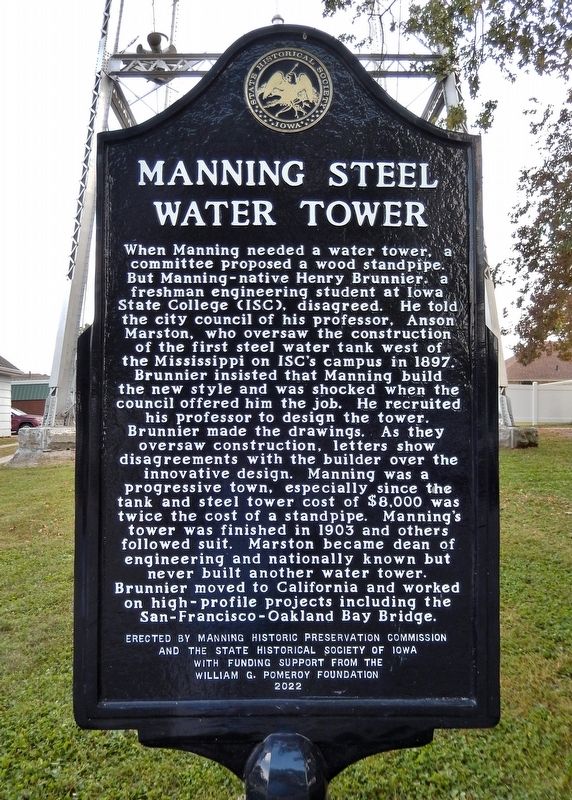
1. Manning Steel Water Tower Marker
When Manning needed a water tower, a committee proposed a wood standpipe. But Manning-native Henry Brunnier, a freshman engineering student at Iowa State College (ISC), disagreed. He told the city council of his professor, Anson Marston, who oversaw the construction of the first steel water tank west of the Mississippi on ISC’s campus in 1897. Brunnier insisted that Manning build the new style and was shocked when the council offered him the job. He recruited his professor to design the tower. Brunnier made the drawings. As they oversaw construction, letters show disagreements with the builder over the innovative design. Manning was a progressive town, especially since the tank and steel tower cost of $8,000 was twice the cost of a standpipe. Manning’s tower was finished in 1903 and others followed suit. Marston became dean of engineering and nationally known but never built another water tower. Brunnier moved to California and worked on high-profile projects including the San-Francisco-Oakland Bay Bridge.
Erected 2022 by Manning Historic Preservation Commission and the State Historical Society of Iowa with funding
this page online
Topics and series. This historical marker is listed in these topic lists: Architecture • Landmarks. In addition, it is included in the Iowa - State Historical Society of Iowa, the National Register of Historic Places (NRHP), and the William G. Pomeroy Foundation series lists. A significant historical year for this entry is 1903.
Location. 41° 54.537′ N, 95° 3.792′ W. Marker is in Manning, Iowa, in Carroll County. It is on 3rd Street just east of Center Street, on the right when traveling east. The marker is located directly in front of the subject water tower. Touch for map. Marker is at or near this postal address: 618 3rd Street, Manning IA 51455, United States of America. Touch for directions.

Regionally, this marker is in Western Iowa. It is also in the American Midwest and in the Corn Belt. Globally, it is in North America, the Western Hemisphere, the Western World, and the Anglosphere. Historically, it finds itself in what was once the territory of the Mississippian Culture and also the Louisiana Purchase.
Other nearby markers. At least 8 other markers are within 12
Photographed by Cosmos Mariner, September 16, 2025
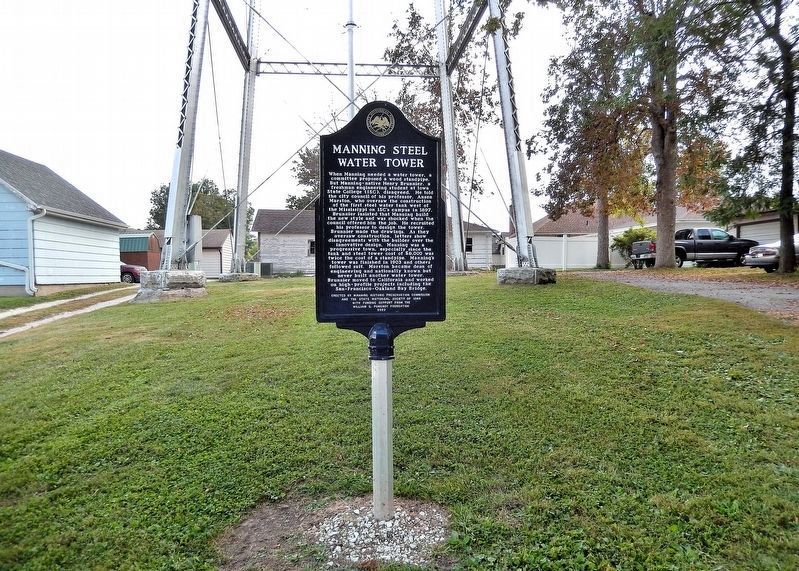
2. Manning Steel Water Tower Marker
Looking south from 3rd Street; the water tower stands in the background.
Regarding Manning Steel Water Tower. National Register of Historic Places № 16000296.
From the National Register Nomination prepared by Allan Eich and Leah D. Rogers, 10/21/2015:
The Manning Water Tower stands in the center of town on a high point overlooking the main commercial area to the west. The positioning of the water tower on the high point in Manning means that it can be seen from most views in the town and identifies the town from a distance. This tower is a community landmark.
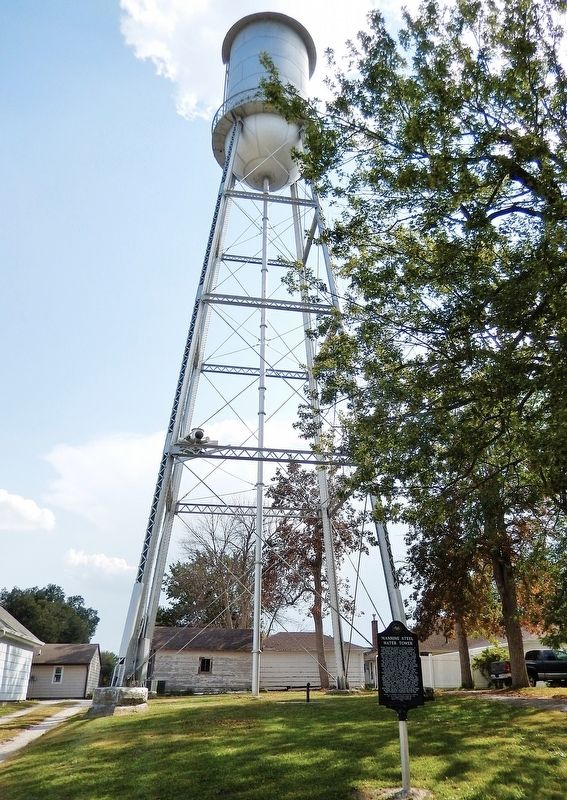
The Manning Water Tower has a riveted steel framework and tank and a cast-iron center pipe that extends into the hemisphericalbase of the tank. The large steel legs feature cross pieces that have a zig-zag pattern extending up each leg and in-between the legs up to the tank. Some of the steel sections are impressed with “CARNEGIE” the mark of the Carnegie Steel Company of Pittsburg, Pennsylvania. The tank was originally painted silver and has a pagoda-shaped steel roof. A steel latticework railing surrounds the walkway circling the base of the tank.Photographed by Cosmos Mariner, September 16, 20253. Manning Steel Water Tower & MarkerThe marker is in the right foreground.
It is also significant for its representation of an early water tower design by engineering professor Anson Marston of the Iowa State College in Ames and for its construction by the Chicago Bridge and Iron Co., also well known for their construction of innovative elevated water towers in the 1890s to early 1900s. The water tower is also associated with Henry J. Brunnier, who was born and raised in Manning and earned his degree in civil engineering at Iowa State College under the tutelage of Anson Marston.
Elevated steel water towers similar in design to that built in Manning became the common choice for communities large and small in the Midwest and the Plains from the 1890s into the first three decades of the 20th century. Superior storage capacity to other alternatives and reliability in water delivery were key factors in the popularity of this design. The fact that they were built of durable steel and were comparatively easy to erect, albeit best built by contractors skilled in their construction, defrayed the initial cost over many years. The fact that many are still standing over 100 years later is a testament to their durability.
Also see . . . Manning Water Tower (Wikipedia).
The Manning Water Tower is significant as a good example of early 20th-century steel elevated water tower design, and its association with Anson Marston and the Chicago Bridge & Iron Company. Marston, who designed the structure, was a professor of engineering at Iowa State College. Manning native Henry J. Brunnier, who studied under Marston, convinced the city council to use one of Marston's designs rather than a less expensive standpipe. He also assisted with this water tower's design, and went on to career as a civil engineer in San Francisco. Also involved in the tower's design was the Chicago Bridge & Iron Company, who built it in 1903. It replaced a pump house with a steam-powered engine and a large water tank that was built near the town's well in 1894. The water tower is 140.75 feet tall. It has a 60,000-US-gallon steel tank, with a cast-iron center pipe, and four steel legs. The superstructure rests on concrete piers with limestone capstones, and the tank is capped with a pagoda-shaped roof. The water tower was listed on the National Register of Historic Places in 2016.(Submitted on October 8, 2025, by Cosmos Mariner of Cape Canaveral, Florida.)
Credits. This page was last revised on October 8, 2025. It was originally submitted on September 30, 2025, by Cosmos Mariner of Cape Canaveral, Florida. This page has been viewed 107 times since then and 44 times this year. Photos: 1, 2, 3. submitted on October 8, 2025, by Cosmos Mariner of Cape Canaveral, Florida.
