Lafayette Park in Detroit in Wayne County, Michigan — The American Midwest (Great Lakes)
Black Bottom
Photographed by J.T. Lambrou, July 30, 2021
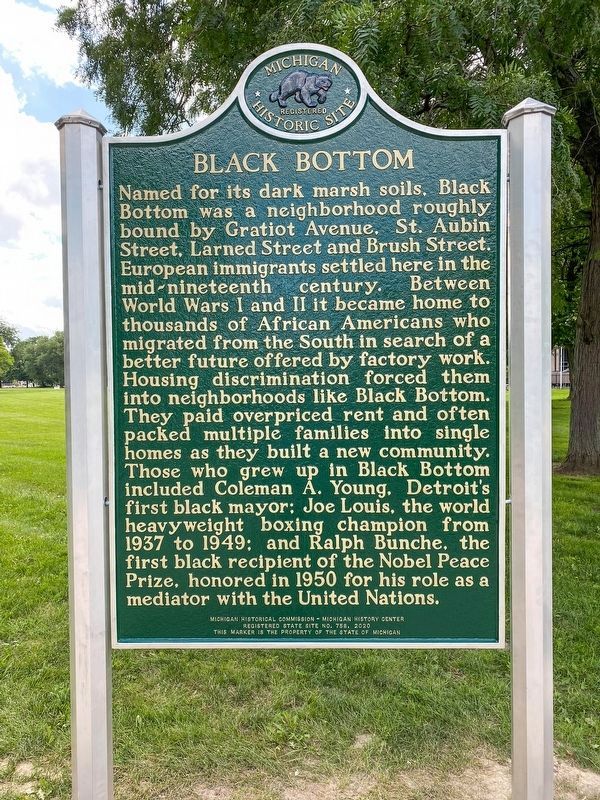
1. Black Bottom Marker
Named for its dark marsh soils, Black Bottom was a neighborhood roughly bound by Gratiot Avenue, St. Aubin Street, Larned Street and Brush Street. European immigrants settled here in the mid-nineteenth century. Between World Wars I and II it became home to thousands of African Americans who migrated from the South in search of a better future offered by factory work. Housing discrimination forced them into neighborhoods like Black Bottom. They paid overpriced rent and often packed multiple families into single homes as they built a new community. Those who grew up in Black Bottom included Coleman A. Young, Detroit's first black mayor; Joe Louis, the world heavyweight boxing champion from 1937 to 1949; and Ralph Bunche, the first black recipient of the Nobel Peace Prize, honored in 1950 for his role as a mediator with the United Nations.
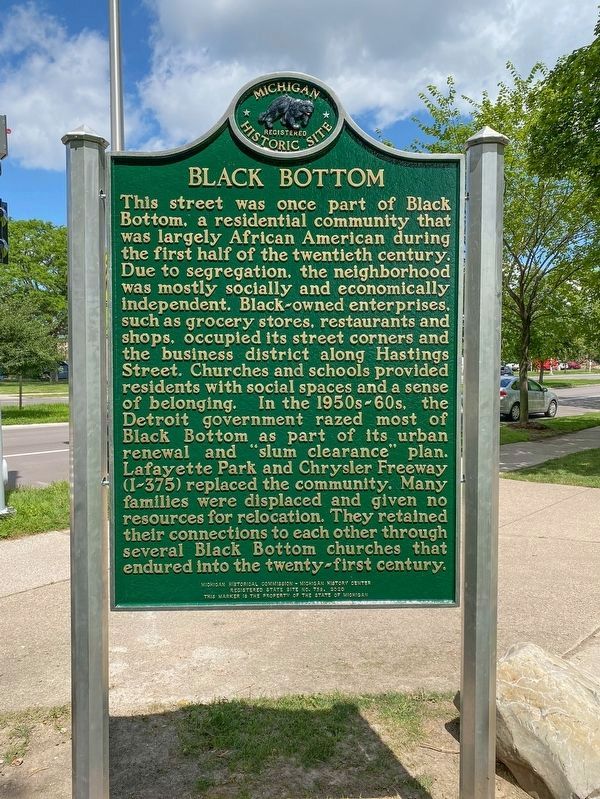
This street was once part of Black Bottom, a residential community that was largely African American during the first half of the twentieth century. Due to segregation, the neighborhood was mostly socially and economically independent, Black-owned enterprises, such as grocery stores,
this page online
Erected 2020 by Michigan Historical Commission and the Michigan History Center. (Marker Number S0758.)
Topics and series. This historical marker is listed in these topic lists: African Americans • Settlements & Settlers. In addition, it is included in the Michigan Historical Commission series list.
Location. 42° 20.26′ N, 83° 1.967′ W. Marker is in Detroit, Michigan, in Wayne County. It is in Lafayette Park. It is on East Lafayette Street 0.1 miles west of Orleans Street, on the right when traveling east. The
Photographed by J.T. Lambrou, July 30, 2021
2. Black Bottom Marker Reverse

Regionally, this marker is in Southeast Michigan. It is also in the American Midwest. Globally, it is in North America, on the Great Lakes, in the Western Hemisphere, in the Western World, and in the Anglosphere. Historically, it finds itself in what was once the Viceroyalty of New France and also the Northwest Territory.
Other nearby markers. At least 8 other markers are within walking distance of this marker: Fannie Richards Homesite (approx. ¼ mile away); Moross House (approx. ¼ mile away); St. John's Presbyterian Church (approx. ¼ mile away); Mies van der Rohe Townhouses (approx. ¼ mile away); Holy Family Church (approx. 0.3 miles away); Church of Annunciation (approx. 0.3 miles away); St. Mary's Rectory (approx. 0.4 miles away); St. Mary's Church (approx. 0.4 miles away). Touch for a list and map of all markers in Detroit.
Also see . . . Black Bottom neighborhood receives long awaited state historical marker. (Submitted on July 30, 2021, by J.T. Lambrou of New Boston, Michigan.)
Photographed by J.T. Lambrou, July 30, 2021
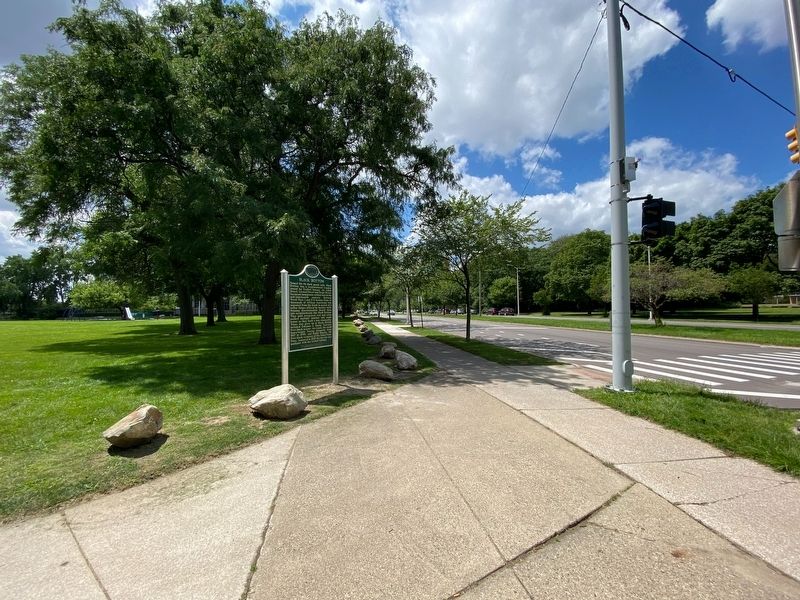
3. Black Bottom Marker
Looking west on Lafayette.
Photographed by J.T. Lambrou, July 30, 2021
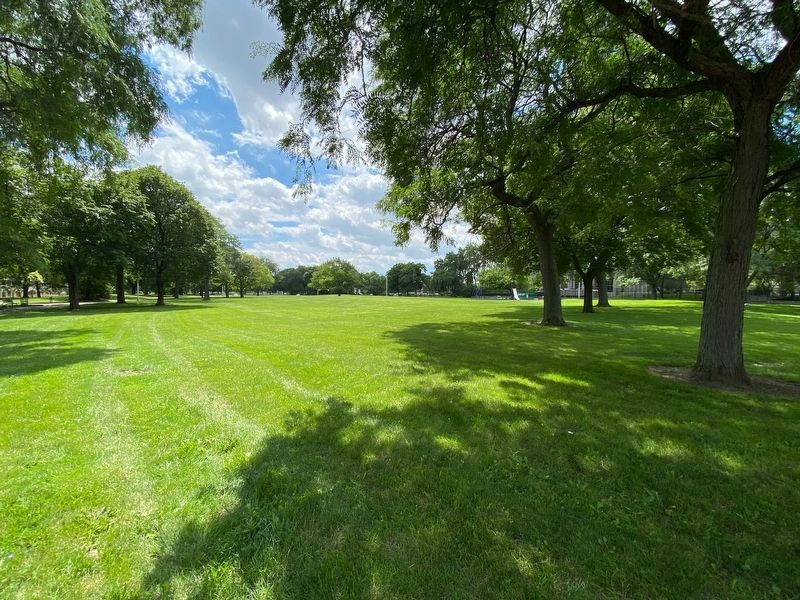
4. Black Bottom
Lafayette Central Park, located in the area of Black Bottom
Credits. This page was last revised on March 1, 2026. It was originally submitted on July 30, 2021, by J.T. Lambrou of New Boston, Michigan. This page has been viewed 2,739 times since then and 179 times this year. Last updated on September 30, 2025, by Carl Gordon Moore Jr. of North East, Maryland. Photos: 1, 2, 3, 4. submitted on July 30, 2021, by J.T. Lambrou of New Boston, Michigan. • J. Makali Bruton was the editor who published this page.
