Fairburn in Fulton County, Georgia — The American South (South Atlantic)
Old Campbell County Courthouse
Photographed by Mark Parker, September 17, 2025
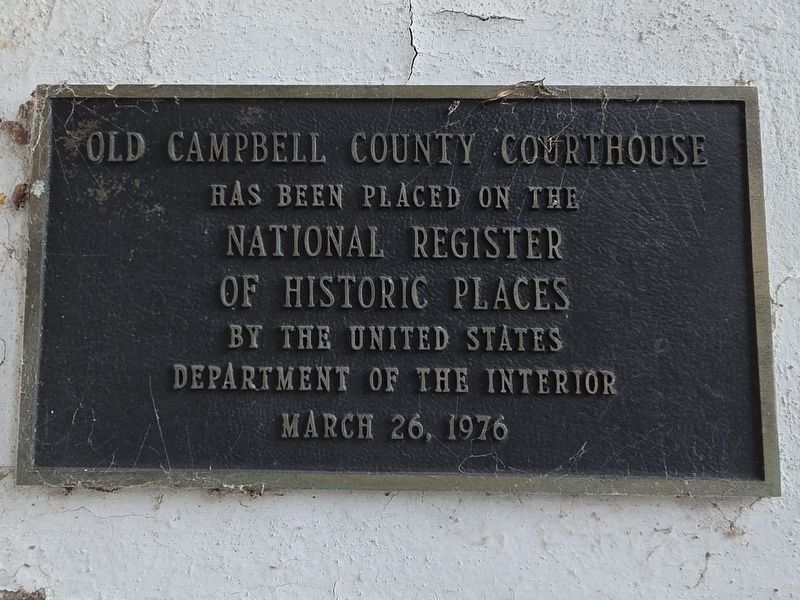
1. Old Campbell County Courthouse Marker
Has been placed on the
National Register
of Historic Places
by the United States
Department of the Interior
March 26, 1976
Erected 1976 by United States Department of the Interior.
Topics. This historical marker is listed in this topic list: Notable Buildings. A significant historical year for this entry is 1871.
Location. 33° 34.005′ N, 84° 34.769′ W. Marker is in Fairburn, Georgia, in Fulton County. It can be reached from the intersection of Northeast Broad Street and Pearl Street, on the right when traveling north. The marker is under the arch of the portico to the right of the door. Touch for map. Marker is at or near this postal address: 45 NE Broad St, Fairburn GA 30213, United States of America. Touch for directions.

Regionally, this marker is in the Piedmont and in Metro Atlanta. It is also in the American South and specifically in the Deep South. Globally, it is in North America, the Western Hemisphere, the Western World, and the Anglosphere. Historically, it finds itself in what was once the territory of the Mississippian Culture, one of the original Thirteen
this page online
Other nearby markers. At least 8 other markers are within 3 miles of this marker, measured as the crow flies: Old Campbell County (within shouting distance of this marker); Here the First Confedereate Flag Was Unfurled in Georgia (about 500 feet away, measured in a direct line); Celebrating Fairburn's History (approx. 0.2 miles away); The History of This Bell (approx. ¼ mile away); Campbell County World War Monument (approx. ¾ mile away); Union City Centennial Time Capsule (approx. 1.8 miles away); Shadnor Baptist Church (approx. 2.1 miles away); Unknown Soldiers Memorial (approx. 2.1 miles away). Touch for a list and map of all markers in Fairburn.
Regarding Old Campbell County Courthouse. Excerpts from the Old Campbell County Courthouse Nomination Form #76000634
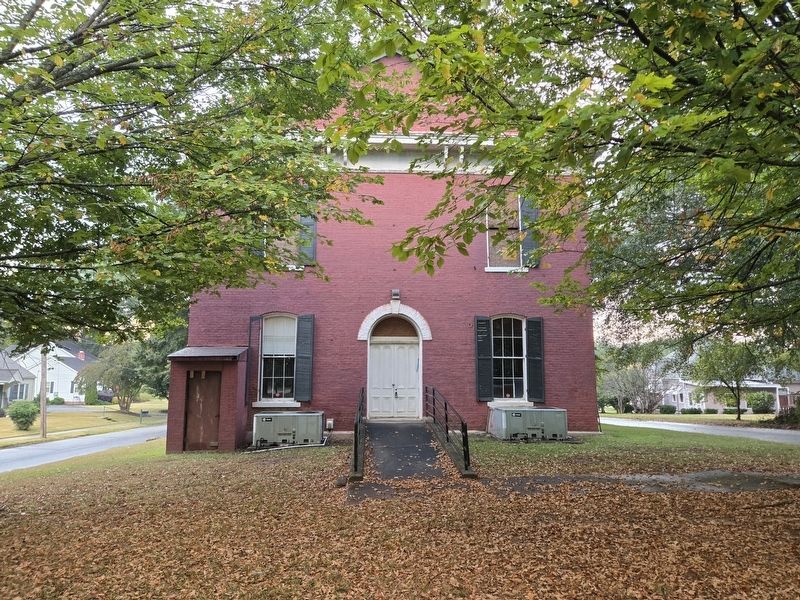
The Old Campbell County Courthouse is representative of 19th Century planning for county seat buildings. It is situated in a quiet residential area of Fairburn. Basically, its condition is still sound due to solid (sixteen inches thick) brick wall construction. Its red clay brick were moldedand burned at nearby sites more than a century ago. Bricks are laid in Common American Bond. The courthouse was built and occupied as a county seat in 1871...Photographed by Mark Parker, September 17, 20252. Old Campbell County Courthouse Marker and plaque commemorating the 1871 construction
The Old Campbell County Courthouse has been a landmark in the center of Fairburn, Georgia for 103 years. For 61 of those years it was the active county seat building of Georgia's 74th county, a typical rural Georgia county. This period was from 1871 to 1932 when Campbell County merged into Fulton County. For its entire existence, it has been an important community center and still remains as such. Its preservation as a symbol of a vanished Georgia County and as a repository for its records and relics will insure a continued respect for this important landmark...
One of a very few county mergers ever effected in the United States was made in Georgia in 1931. Campbell County's merger (along with Milton County) was approved by the state legislature and by popular vote in that year. Campbell County ceased to exist on January 1, 1932. Its courthouse became the property of Fulton County and appeared to be slated for early demolition. It fell into a state of disrepair for several years.In 1936, community leaders of Fairburn led a fight to preserve it and secured a $5,000 Federal Grant for its renovation as a community center. A community library and a recreation center were set up in the building. Such usage continued until 1970.Photographed by Mark Parker, September 17, 20253. Old Campbell County Courthouse portico. Marker is on the right of the entrance


Photographed by Mark Parker, September 17, 2025
4. Full front view of Old Campbell County Courthouse
Photographed by Mark Parker, September 17, 2025
5. Rear view Old Campbell County Courthouse Marker

Photographed by Mark Parker, September 17, 2025
6. View of the front grounds from the balcony of the Old Campbell County Courthouse
Credits. This page was last revised on October 2, 2025. It was originally submitted on October 1, 2025, by Mark Parker of Hickory, North Carolina. This page has been viewed 83 times since then and 45 times this year. Photos: 1, 2, 3, 4, 5, 6. submitted on October 1, 2025, by Mark Parker of Hickory, North Carolina. • Bernard Fisher was the editor who published this page.
