Greenville in Hunt County, Texas — The American South (West South Central)
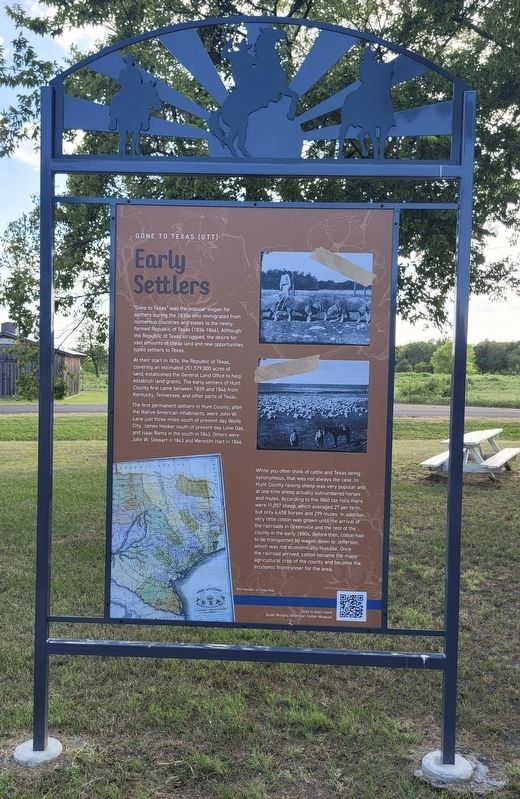
Early Settlers
Gone to Texas (GTT)
⎯⎯⎯
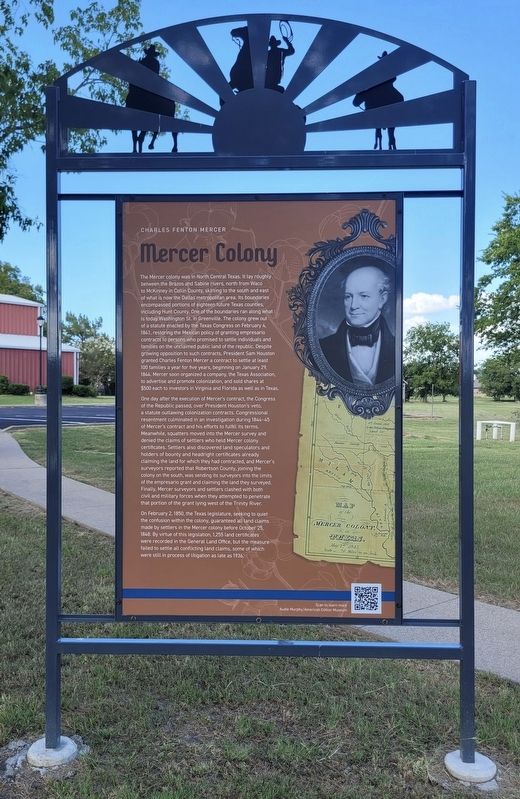
Mercer Colony
Charles Fenton Mercer
Photographed by James Hulse, July 28, 2025
1. Early Settlers / Mercer Colony Marker
At their start in 1836, the Republic of Texas, covering an estimated 251,579,800 acres of land, established the General Land Office to help establish land grants. The early settlers of Hunt County first came between 1839 and 1846 from Kentucky, Tennessee, and other parts of Texas.
The first permanent settlers in Hunt County, after the Native American inhabitants, were John W. Lane just three miles south of present-day Wolfe City, James Hooker south of present day Lone Oak, and Isaac Banta in the south in 1843. Others were John W. Stewart in 1843 and Meredith Hart in 1846.
While you often think of cattle and Texas being synonymous, that was not always the case. In Hunt County raising sheep was very popular and at one time sheep actually outnumbered horses and mules. According to the 1860 tax rolls there were 11,057 sheep, which averaged 27 per farm, but only 4,458 horses and 299 mules. In addition, very little cotton was grown until the arrival of the railroads in Greenville and the rest of the county in the early 1880s. Before then, cotton had to be transported by wagon down to Jefferson, which was not economically feasible. Once the railroad arrived, cotton became the major agricultural crop of the county and became the economic frontrunner for the area.
Captions
(Photo #1) 1844 Republic of Texas Map
Reverse Side
The Mercer colony was in North Central Texas. It lay roughly between the Brazos and Sabine rivers, north from Waco to McKinney in Collin County, skirting to the south and east of what
this page online
One day after the execution of Mercer's contract, the Congress of the Republic passed, over President Houston's veto, a statute outlawing colonization contracts. Congressional resentment culminated in an investigation during 1844-45 of Mercer's contract and his efforts to fulfill its terms. Meanwhile, squatters
Photographed by James Hulse, July 28, 2025
2. Early Settlers / Mercer Colony Marker - Reverse Side
On February 2, 1850, the Texas legislature, seeking to quiet the confusion within the colony, guaranteed all land claims made by settlers in the Mercer colony before October 25, 1848. By virtue of this legislation, 1,255 land certificates were recorded in the General Land Office, but the measure failed to settle all conflicting land claims, some of which were still in process of litigation as late as 1936.
Erected by Audie Murphy / American Cotton Museum.
Topics. This historical marker is listed in this topic list:

Photographed by James Hulse, July 28, 2025
3. Early Settlers / Mercer Colony Marker (right marker)
Location. 33° 7.527′ N, 96° 5.373′ W. Marker is in Greenville, Texas, in Hunt County. It is on Interstate 30 Frontage Road ¼ mile west of Division Street, on the right when traveling west. The marker is located on the grounds of the Audie Murphy / American Cotton Museum. Touch for map. Marker is at or near this postal address: 600 I-30 Frontage Rd, Greenville TX 75401, United States of America. Touch for directions.

Regionally, this marker is in the Prairies & Lakes Region and in the Dallas-Fort Worth Metropolitan Area. It is also in the American South. Globally, it is in North America, a Gulf of Mexico state, the Western Hemisphere, the Western World, and the Anglosphere. Historically, it finds itself in what was once New Spain, the Republic of Texas, one of the Confederate States of America, and the Antebellum South.
Other nearby markers. At least 8 other markers are within walking distance of this marker: Industry & Businesses (here, next to this marker); Transportation / Blackland Prairie (here, next to this marker); Industry & Business (a few steps from this marker); Hometown Musicians (a few steps from this marker); Ende-Gaillard House (a few steps from this marker); The Sixties (within shouting distance of this marker); Sports (within shouting distance of this marker); Early Industry & Business (within shouting distance of this marker). Touch for a list and map of all markers in Greenville.
Credits. This page was last revised on October 3, 2025. It was originally submitted on October 2, 2025, by James Hulse of Medina, Texas. This page has been viewed 83 times since then and 34 times this year. Photos: 1, 2, 3. submitted on October 3, 2025, by James Hulse of Medina, Texas.
