Roma in Città metropolitana di Roma Capitale, Latium, Rome, Italy — Central Italy (Tyrrhenian Coast)
Hotel L'Orologio
Photographed by Sean P. Flynn, August 2, 2025
1. Hotel L'Orologio Marker
this page online
Photographed by Sean P. Flynn, August 2, 2025
2. Hotel L'Orologio
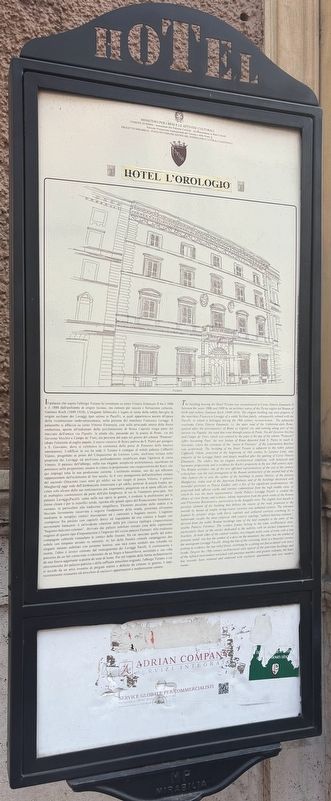
The building hosting the Hotel Tiziano was reconstructed in Corso Vittorio Emanuele II between the years 1886 and 1888 by an architect native of the Ticino region but Roman of birth and culture, Gaetano Koch (1849-1910). The elegant building was once property of the marchese Francesco Lavaggi of the noble Sicilian family, subsequently related with the Pacelli, to whom it belonged during the 19th century reconstruction. The palazzetto overlooks Corso Vittorio Emanuele, i.e. the main road
Photographed by Jensens (via Wikimedia Commons), June 2008
3. Hotel L'Orologio
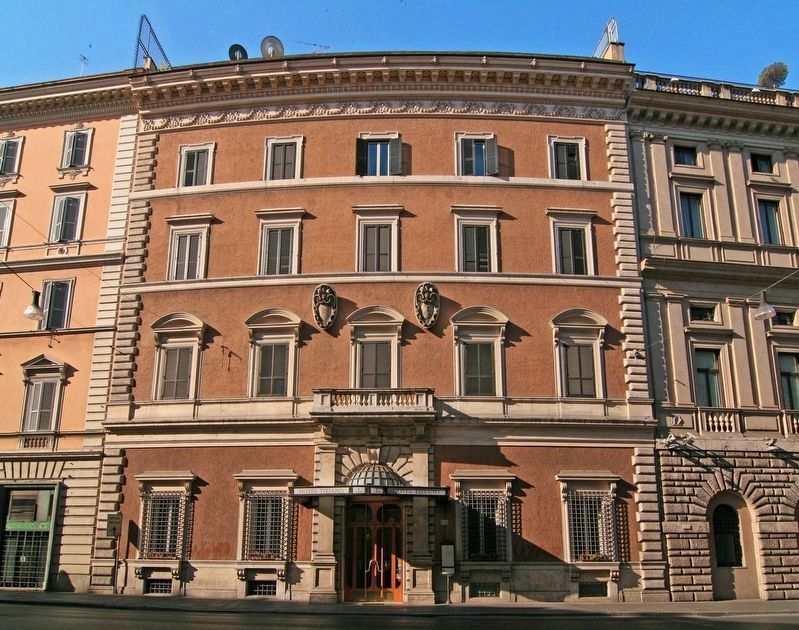
This 2008 photo was taken when the hotel was called Hotel Tiziano.
The building of the Hotel Tiziano is adjacent to the noble palace Caffarelli Vidoni, projected at the beginning of 16th century by Lorenzo Lotto, also property of the Lavaggi family and deeply modified after the opening of Corso Vittorio Emanuele. The edifice has an elegant architectural simplicity, with balanced and harmonic proportions and is evidence for Koch's propensity to the neo 16th century style. The Roman architect, one of the new affirmed representatives of the end of the century eclecticism, was the real protagonist of the Roman architecture of the second half of the 19th century (he is also the author of the buildings in piazza Vittorio; of the palazzo Margherita, today seat of the American Embassy and of the buildings decorated with beautiful porticoes in Piazza Esedra: only a few of his significant performances). He projected both official works and various commissions from the high middle class, of which he was the main representative. Inside Palazzo Lavaggi Pacelli is evident the choice of clear forms and surfaces, taking inspiration from the great works of the Roman and Florentine Renaissance, particularly to the Sangallo style.
The slightly bent façade is peculiar element of the building that follows the course of the road, projected to the outside by means of simple string-course cornices and ashlared corners. The entrance framed by pilaster strips with Doric capitals and ashlared cornices overhung by a balustrade recalls the most classical 16th century typology "ashlars-balcony-columns", derived from the noble Roman buildings (one of the best examples is the entry of the nearby Palazzo Farnese). The window frames belong to the same architectural style, particularly those of the stories dedicated to the nobility with an arched tympanum on brackets. At both sides of the central window, two elegant noble coats of arms with a lion protome stand; one has the symbol of a dove on the mountain; the other has the symbol of the monogram Lavaggi Pacelli. Along the line of the crowning, there is a beautiful cornice putting in evidence the bas-relief frieze, overhung by a jutting out fascia dotted with lion's heads. Despite the 19th century architectural style typical of the patrician buildings and of the refined environment enriched with precious marbles and granite columns, the hotel has recently been restored and endowed with exclusive apartments and very modern rooms.
Erected by Ministero Per I Beni E La Attivia Culturali, Comune di Roma.
Topics. This historical marker is listed in these topic lists: Architecture • Industry & Commerce • Notable Buildings. A significant historical year for this entry is 1886.
Location. 41° 53.777′ N, 12° 28.538′ E. Marker is in Roma, Lazio (Latium, Rome), in Città metropolitana di Roma Capitale. It is on Corso Vittorio Emanuele II east of Piazza Vidone. Touch for map. Marker is at or near this postal address: Corso Vittorio Emanuele II 110, Roma, Lazio 00186, Italy. Touch for directions.

Regionally, it is in Europe, the European Union, the Schengen Area, a coastal Mediterranean country, and the Western World. Historically, it finds itself in what was once the Roman Empire.
Other nearby markers. At least 8 other markers are within walking distance of this marker: Chile Democratico (within shouting distance of this marker); Giuseppe Gioachino Belli (within shouting distance of this marker); Adelaide Ristori Capranica del Grillo and Aldo Palazzeschi (within shouting distance of this marker); Adelaide Ristori and Aldo Palazzeschi (within shouting distance of this marker); Chiesa di Sant'Andrea della Valle / Church of Saint Andrew of the Valley (about 90 meters away, measured in a direct line); Galleria Spada / Spada Gallery (about 120 meters away); La Chiesa Di S. Nicola De' Calcarario Poi De' Cesarini (about 120 meters away); Il Tempio A / Temple A (about 120 meters away). Touch for a list and map of all markers in Roma.
Another marker is no longer nearby. Hotel Tiziano (was here, next to this marker but has been replaced with another marker now near it).
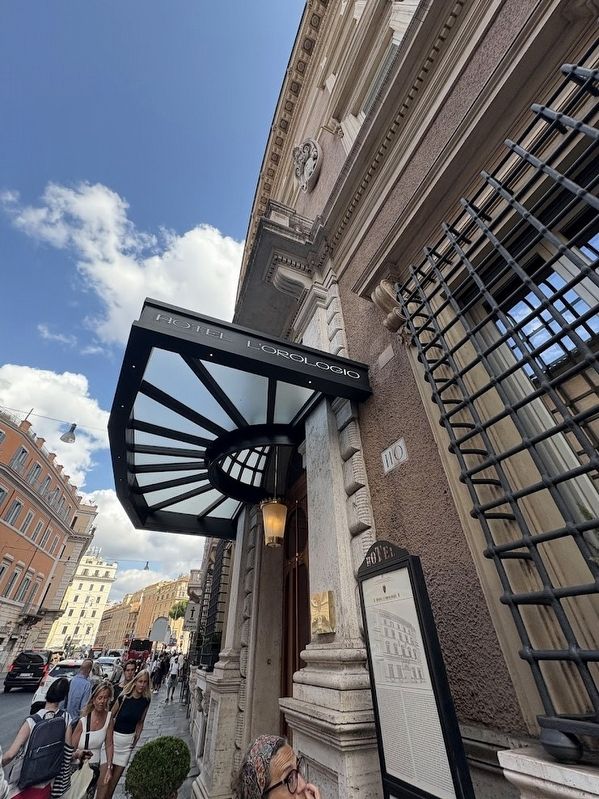
More about this marker. The Hotel Tiziano was renamed Hotel L'Orologio at some point between 2020 and 2023, and the historical marker next to its entrance was covered over with a new title reflecting the new name. However, all references to Tiziano in the text of the marker are still there.
Also see . . . Hotel L'Orologio official site. (Submitted on October 3, 2025, by Sean P. Flynn of Oak Park, Illinois.)
Credits. This page was last revised on October 3, 2025. It was originally submitted on October 3, 2025, by Sean P. Flynn of Oak Park, Illinois. This page has been viewed 52 times since then and 15 times this year. Photos: 1, 2, 3. submitted on October 3, 2025, by Sean P. Flynn of Oak Park, Illinois.
