Upper St. Clair Township in Allegheny County, Pennsylvania — The American Northeast (Mid-Atlantic)
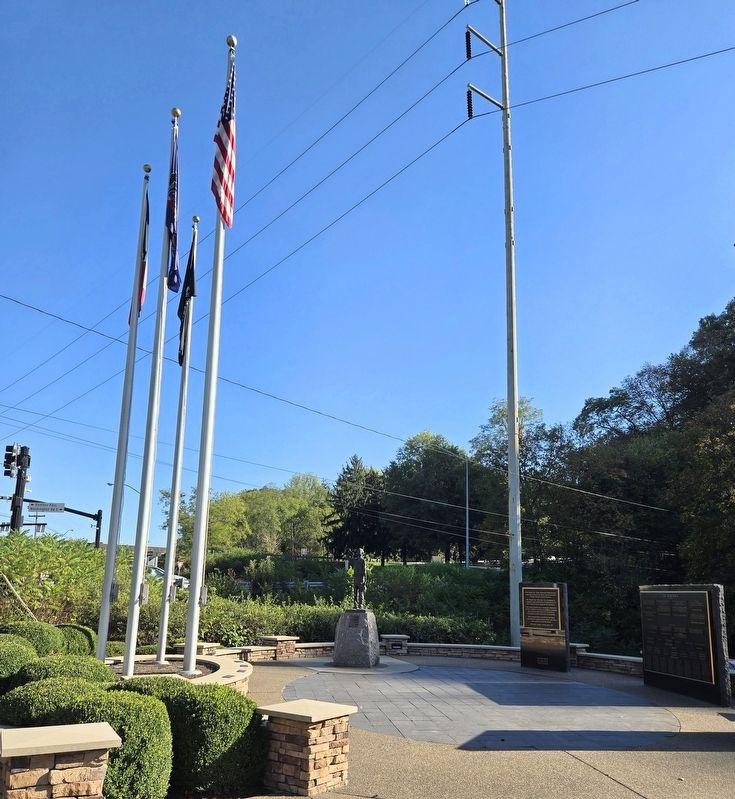
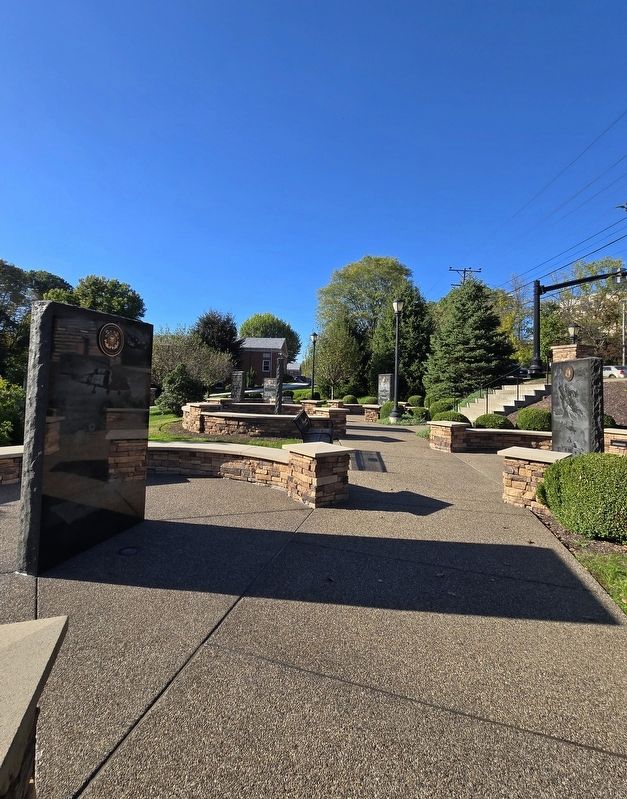
Upper St. Clair Veterans Park
Photographed by Bradley Owen, October 3, 2025
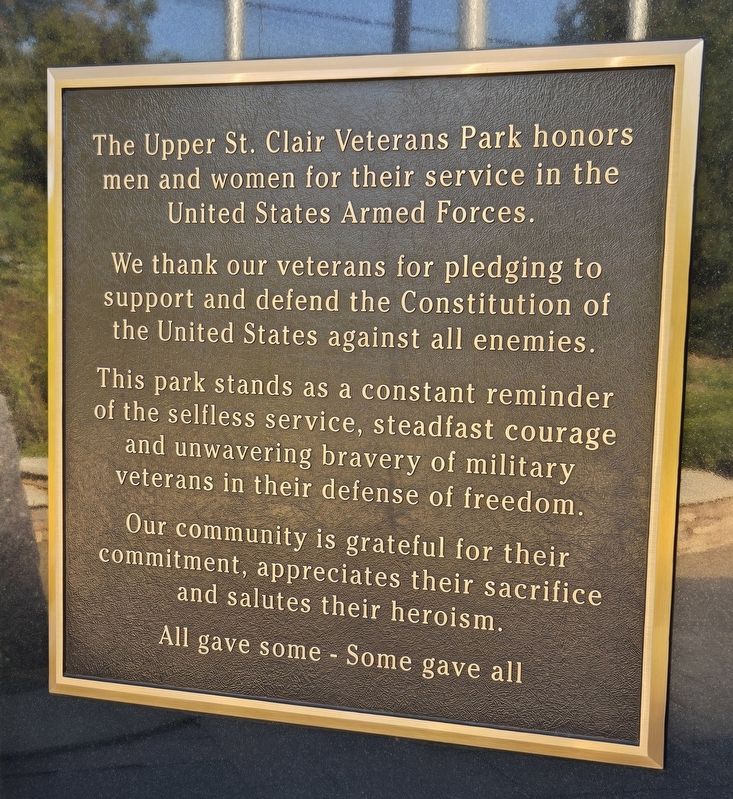
1. Upper St. Clair Veterans Park Marker
The Upper St. Clair Veterans Park honors men and women for their service in the United States Armed Forces.
We thank our veterans for pledging to support and defend the Constitution of the United States against all enemies.
This park stands as a constant reminder of the selfless service, steadfast courage and unwavering bravery of military veterans in their defense of freedom.
Our community is grateful for their commitment, appreciates their sacrifice and salutes their heroism.
All gave some - Some gave all
Erected 2011 by The Citizens of Upper St. Clair Township.
Topics. This memorial is listed in this topic list: Military.
Location. 40° 19.947′ N, 80° 4.249′ W. Memorial is in Upper St. Clair, Pennsylvania, in Allegheny County. It is in Upper St. Clair Township. It is on McLaughlin Run Road 0.1 miles north of Washington Road (U.S. 19), on the left when traveling north. Park is accessed by way of the parking lot entrance to the Upper St. Clair Township building. Touch for map. Memorial is at or near this postal address: 1822 McLaughlin Run Road, Pittsburgh
this page online

Regionally, this memorial is in Greater Pittsburgh. It is also in the American Northeast, in the Mid-Atlantic, in Appalachia, and specifically in Northern Appalachia. Globally, it is in North America, the Western Hemisphere, the Western World, and the Anglosphere. Historically, it finds itself in what was once the Viceroyalty of New France, the Haudenosaunee (Iroquois) Confederacy, and one of the original Thirteen Colonies.
Other nearby markers. At least 8 other markers are within 3 miles of this marker, measured as the crow flies: Fulton Log House (within shouting distance of this marker); Bethel Presbyterian Church (approx. 1.2 miles away); Peter S. Edwards, Jr. (approx. 2.2 miles away); Schoolhouse Arts Center (approx. 2.2 miles away); Bridgeville Public Library Founders 1962 (approx. 2.8 miles away); Bridgeville Railroad Depot (approx. 2.8 miles away); Murray House (approx. 2.9 miles away); Bridgeville District Honor Roll (approx. 2.9 miles away).
Photographed by Bradley Owen, October 3, 2025
2. Upper St. Clair Veterans Park Marker
Photographed by Bradley Owen, October 3, 2025
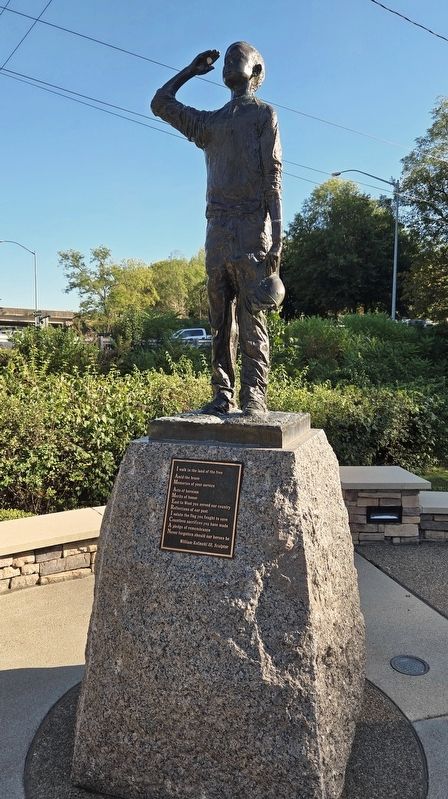
3. I Am American Statue
I walk in the land of the free
Amid the brave
Memories of your service
Acts of heroism
Merits of honor
East to west you served our country
Reflections of our past
I salute the flag you fought to save
Countless sacrifices you have made
A pledge of remembrance
Never forgotten should our heroes be
William Kofmehl III, Sculptor
Photographed by Bradley Owen, October 3, 2025
4. Upper St. Clair Veterans Park
Photographed by Mike Wintermantel, July 16, 2026
5. Upper St. Clair Veterans Park Marker
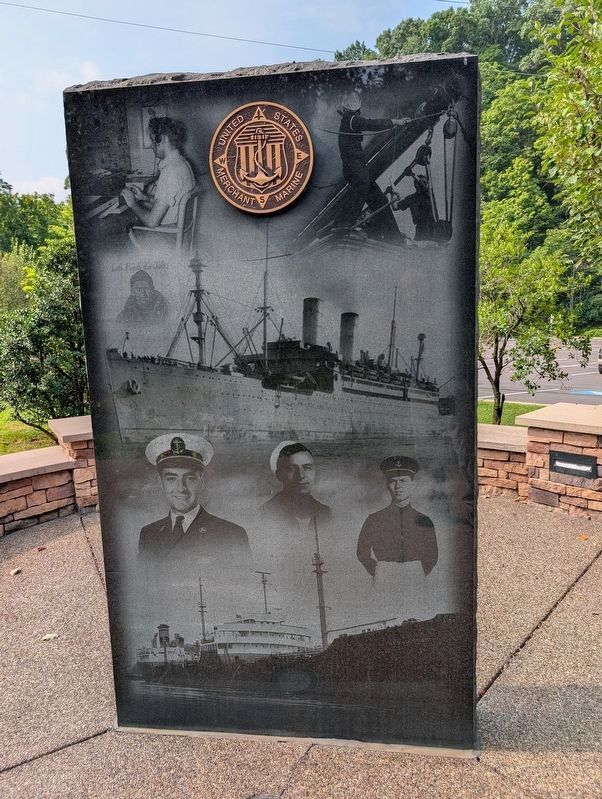
Merchant Marines
Side A
Side A
Photographed by Mike Wintermantel, July 16, 2026
6. Upper St. Clair Veterans Park Marker
Merchant Marines
Side B
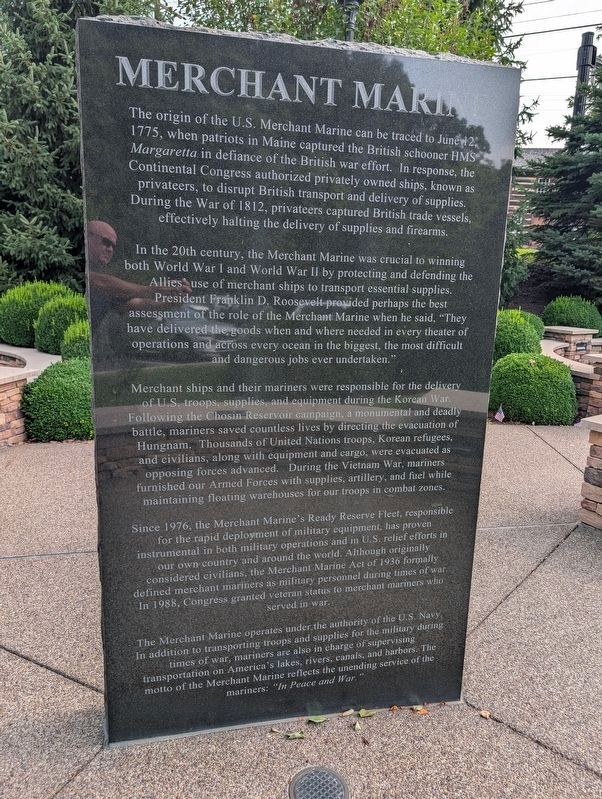
The origin of the U.S. Merchant Marine can be traced to June 12, 1775, when patriots in Maine captured the British schooner HMS Margaretta in defiance of the British war effort. In response, the Continental Congress authorized privately owned ships, known as privateers, to disrupt British transport and delivery of supplies. During the War of 1812, privateers captured British trade vessels, effectively halting the delivery of supplies and firearms.
In the 20th century, the Merchant Marine was crucial to winning both World War I and World War II by protecting and defending the Allies' use of merchant ships to transport essential supplies. President Franklin D. Roosevelt provided perhaps the best assessment of the role of the Merchant Marine when he said, "They have delivered the goods when and where needed in every theater of operations and across every ocean in the biggest, the most difficult and dangerous jobs ever undertaken."
Merchant ships and their mariners were responsible for the delivery of U.S. troops, supplies, and equipment during the Korean War. Following the Chosin Reservoir campaign, a monumental and deadly battle, mariners saved countless lives by directing the evacuation of Hungnam. Thousands of United Nations troops, Korean refugees, and civilians, along with equipment and cargo, were evacuated as opposing forces advanced. During the Vietnam War, mariners furnished our Armed Forces with supplies, artillery, and fuel while maintaining floating warehouses for our troops in combat zones.
Since 1976, the Merchant Marine's Ready Reserve Fleet, responsible for the rapid deployment of military equipment, has proven instrumental in both military operations and in U.S. relief efforts in our own country and around the world. Although originally considered civilians, the Merchant Marine Act of 1936 formally defined merchant mariners as military personnel during times of war. In 1988, Congress granted veteran status to merchant mariners who served in war.
The Merchant Marine operates under the authority of the U.S. Navy. In addition to transporting troops and supplies for the military during times of war, mariners are also in charge of supervising transportation on America's lakes, rivers, canals, and harbors. The motto of the Merchant Marine reflects the unending service of the mariners: "In Peace and War."
Side B
In the 20th century, the Merchant Marine was crucial to winning both World War I and World War II by protecting and defending the Allies' use of merchant ships to transport essential supplies. President Franklin D. Roosevelt provided perhaps the best assessment of the role of the Merchant Marine when he said, "They have delivered the goods when and where needed in every theater of operations and across every ocean in the biggest, the most difficult and dangerous jobs ever undertaken."
Merchant ships and their mariners were responsible for the delivery of U.S. troops, supplies, and equipment during the Korean War. Following the Chosin Reservoir campaign, a monumental and deadly battle, mariners saved countless lives by directing the evacuation of Hungnam. Thousands of United Nations troops, Korean refugees, and civilians, along with equipment and cargo, were evacuated as opposing forces advanced. During the Vietnam War, mariners furnished our Armed Forces with supplies, artillery, and fuel while maintaining floating warehouses for our troops in combat zones.
Since 1976, the Merchant Marine's Ready Reserve Fleet, responsible for the rapid deployment of military equipment, has proven instrumental in both military operations and in U.S. relief efforts in our own country and around the world. Although originally considered civilians, the Merchant Marine Act of 1936 formally defined merchant mariners as military personnel during times of war. In 1988, Congress granted veteran status to merchant mariners who served in war.
The Merchant Marine operates under the authority of the U.S. Navy. In addition to transporting troops and supplies for the military during times of war, mariners are also in charge of supervising transportation on America's lakes, rivers, canals, and harbors. The motto of the Merchant Marine reflects the unending service of the mariners: "In Peace and War."
Photographed by Mike Wintermantel, July 16, 2026
7. Upper St. Clair Veterans Park Marker
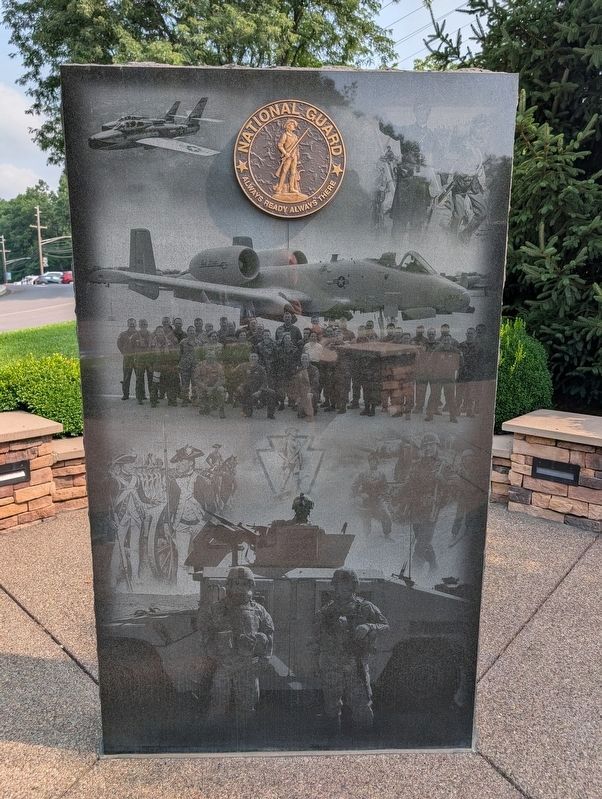
The National Guard
Side A
Side A
Photographed by Mike Wintermantel, July 16, 2026
8. Upper St. Clair Veterans Park Marker
The National Guard
Side B
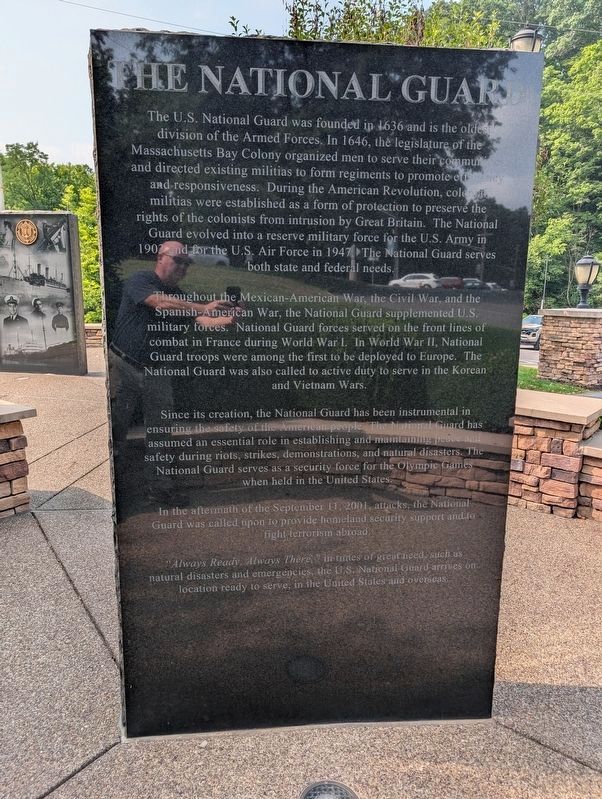
The U.S. National Guard was founded in 1636 and is the oldest division of the Armed Forces. In 1646, the legislature of the Massachusetts Bay Colony organized men to serve their community and directed existing militias to form regiments to promote efficiency and responsiveness. During the American Revolution, colonial militias were established as a form of protection to preserve the rights of the colonists from intrusion by Great Britain. The National Guard evolved into a reserve military force for the U.S. Army in 1903 and for the U.S. Air Force in 1947 The National Guard serves both state and federal needs.
Throughout the Mexican-American War, the Civil War, and the Spanish-American War, the National Guard supplemented U.S. military forces. National Guard forces served on the front lines of combat in France during World War I. In World War II, National Guard troops were among the first to be deployed to Europe. The National Guard was also called to active duty to serve in the Korean and Vietnam Wars.
Since its creation, the National Guard has been instrumental in ensuring the safety of the American people. The National Guard has assumed an essential role in establishing and maintaining peace and safety during riots, strikes, demonstrations, and natural disasters. The National Guard serves as a security force for the Olympic Games when held in the United States.
In the aftermath of the September 11, 2001, attacks, the National Guard was called upon to provide homeland security support and to fight terrorism abroad.
"Always Ready, Always There," in times of great need, such as natural disasters and emergencies, the U S. National Guard arrives on location ready to serve, in the United States and overseas.
Side B
Throughout the Mexican-American War, the Civil War, and the Spanish-American War, the National Guard supplemented U.S. military forces. National Guard forces served on the front lines of combat in France during World War I. In World War II, National Guard troops were among the first to be deployed to Europe. The National Guard was also called to active duty to serve in the Korean and Vietnam Wars.
Since its creation, the National Guard has been instrumental in ensuring the safety of the American people. The National Guard has assumed an essential role in establishing and maintaining peace and safety during riots, strikes, demonstrations, and natural disasters. The National Guard serves as a security force for the Olympic Games when held in the United States.
In the aftermath of the September 11, 2001, attacks, the National Guard was called upon to provide homeland security support and to fight terrorism abroad.
"Always Ready, Always There," in times of great need, such as natural disasters and emergencies, the U S. National Guard arrives on location ready to serve, in the United States and overseas.
Photographed by Mike Wintermantel, July 16, 2026
9. Upper St. Clair Veterans Park Marker
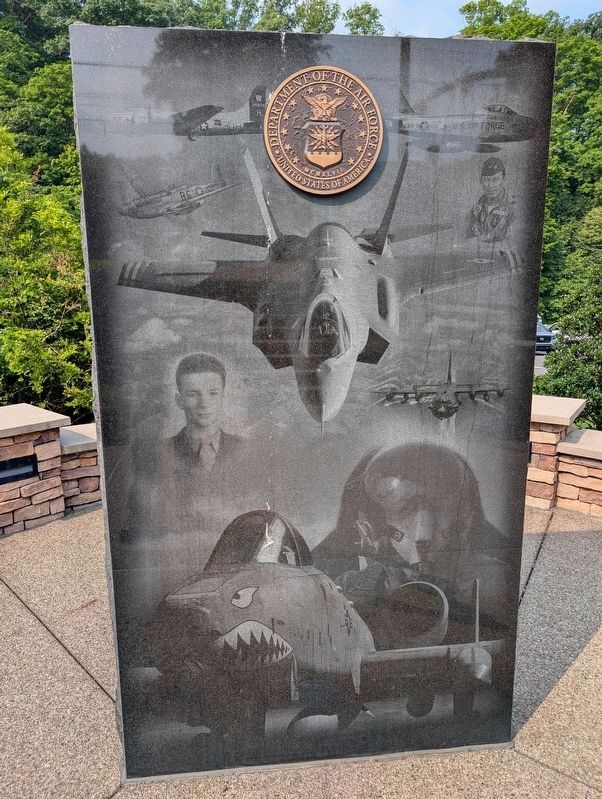
Air Force
Side A
Side A
Photographed by Mike Wintermantel, July 16, 2026
10. Upper St. Clair Veterans Park Marker
Air Force
Side B
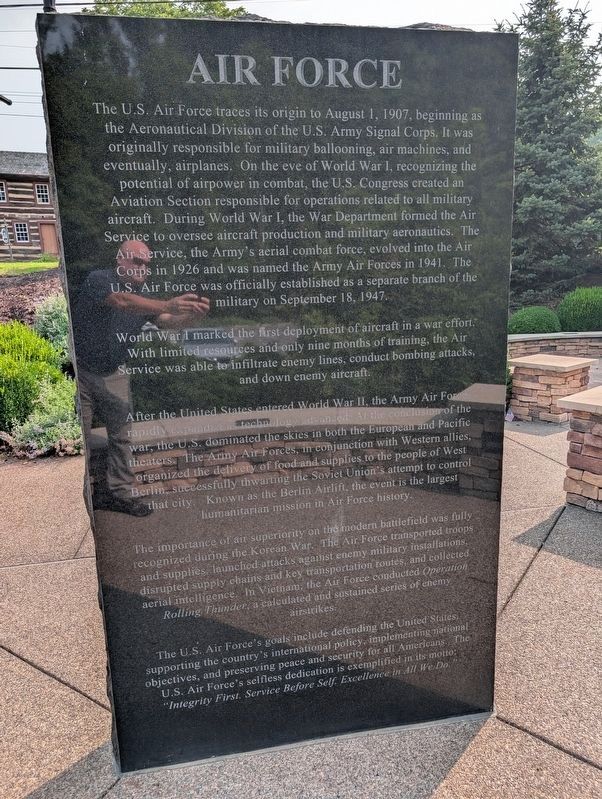
The U.S. Air Force traces its origin to August 1, 1907, beginning as the Aeronautical Division of the U.S. Army Signal Corps. It was originally responsible for military ballooning, air machines, and eventually, airplanes. On the eve of World War I, recognizing the potential of airpower in combat, the U.S. Congress created an Aviation Section responsible for operations related to all military aircraft. During World War I, the War Department formed the Air Service to oversee aircraft production and military aeronautics. The Air Service, the Army's aerial combat force, evolved into the Air Corps in 1926 and was named the Army Air Forces in 1941. The U.S. Air Force was officially established as a separate branch of the military on September 18, 1947.
World War I marked the first deployment of aircraft in a war effort. With limited resources and only nine months of training, the Air Service was able to infiltrate enemy lines, conduct bombing attacks, and down enemy aircraft.
After the United States entered World War II, the Army Air Force rapidly expanded as technology advanced. At the conclusion of the war, the U.S. dominated the skies in both the European and Pacific theaters The Army Air Forces, in conjunction with Western allies, organized the delivery of food and supplies to the people of West Berlin, successfully thwarting the Soviet Union's attempt to control that city. Known as the Berlin Airlift, the event is the largest humanitarian mission in Air Force history.
The importance of air superiority on the modern battlefield was fully recognized during the Korean War. The Air Force transported troops and supplies, launched attacks against enemy military installations, disrupted supply chains and key transportation routes, and collected aerial intelligence. In Vietnam, the Air Force conducted Operation Rolling Thunder, a calculated and sustained series of enemy airstrikes.
The U.S. Air Force's goals include defending the United States, supporting the country's international policy, implementing national objectives, and preserving peace and security for all Americans. The U.S. Air Force's selfless dedication is exemplified in its motto:
"Integrity First. Service Before Self. Excellence in All We Do."
Side B
World War I marked the first deployment of aircraft in a war effort. With limited resources and only nine months of training, the Air Service was able to infiltrate enemy lines, conduct bombing attacks, and down enemy aircraft.
After the United States entered World War II, the Army Air Force rapidly expanded as technology advanced. At the conclusion of the war, the U.S. dominated the skies in both the European and Pacific theaters The Army Air Forces, in conjunction with Western allies, organized the delivery of food and supplies to the people of West Berlin, successfully thwarting the Soviet Union's attempt to control that city. Known as the Berlin Airlift, the event is the largest humanitarian mission in Air Force history.
The importance of air superiority on the modern battlefield was fully recognized during the Korean War. The Air Force transported troops and supplies, launched attacks against enemy military installations, disrupted supply chains and key transportation routes, and collected aerial intelligence. In Vietnam, the Air Force conducted Operation Rolling Thunder, a calculated and sustained series of enemy airstrikes.
The U.S. Air Force's goals include defending the United States, supporting the country's international policy, implementing national objectives, and preserving peace and security for all Americans. The U.S. Air Force's selfless dedication is exemplified in its motto:
"Integrity First. Service Before Self. Excellence in All We Do."
Photographed by Mike Wintermantel, July 16, 2026
11. Upper St. Clair Veterans Park Marker
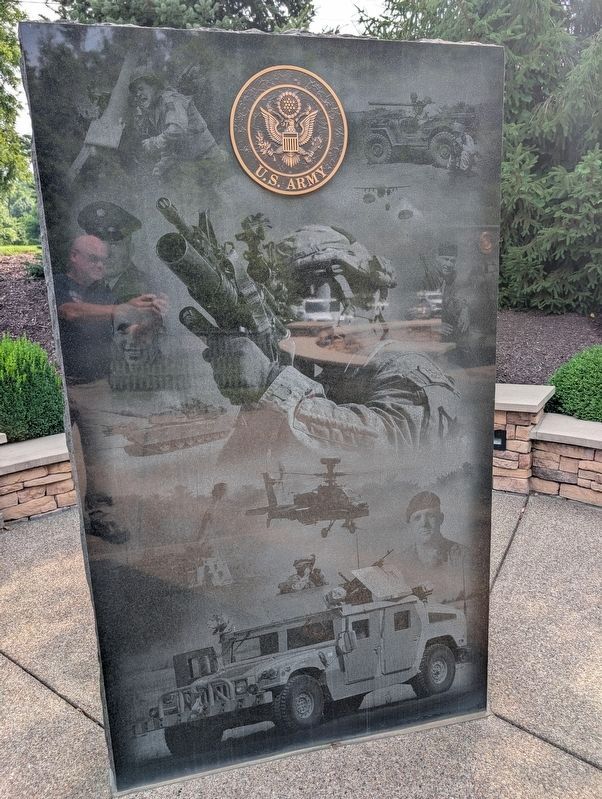
Army
Side A
Side A
Photographed by Mike Wintermantel, July 16, 2026
12. Upper St. Clair Veterans Park Marker
Army
Side B
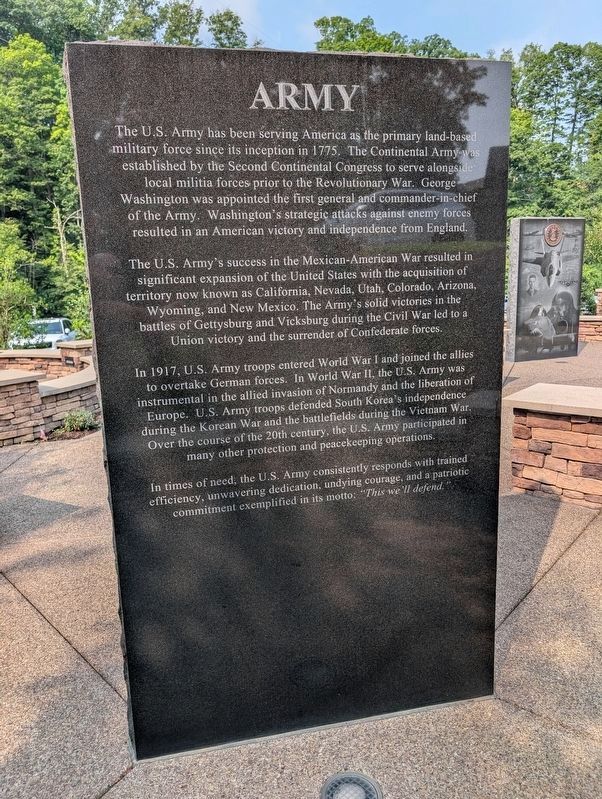
The U.S. Army has been serving America as the primary land-based military force since its inception in 1775. The Continental Army was established by the Second Continental Congress to serve alongside local militia forces prior to the Revolutionary War. George Washington was appointed the first general and commander-in-chief of the Army. Washington's strategic attacks against enemy forces resulted in an American victory and independence from England.
The U.S. Army's success in the Mexican-American War resulted in significant expansion of the United States with the acquisition of territory now known as California, Nevada, Utah, Colorado, Arizona, Wyoming, and New Mexico. The Army's solid victories in the battles of Gettysburg and Vicksburg during the Civil War led to a Union victory and the surrender of Confederate forces.
In 1917, U.S. Army troops entered World War I and joined the allies to overtake German forces. In World War II, the U.S. Army was instrumental in the allied invasion of Normandy and the liberation of Europe. U.S. Army troops defended South Korea's independence during the Korean War and the battlefields during the Vietnam War. Over the course of the 20th century, the U.S. Army participated in many other protection and peacekeeping operations.
In times of need, the U.S. Army consistently responds with trained efficiency, unwavering dedication, undying courage, and a patriotic commitment exemplified in its motto: "This we'll defend."
Side B
The U.S. Army's success in the Mexican-American War resulted in significant expansion of the United States with the acquisition of territory now known as California, Nevada, Utah, Colorado, Arizona, Wyoming, and New Mexico. The Army's solid victories in the battles of Gettysburg and Vicksburg during the Civil War led to a Union victory and the surrender of Confederate forces.
In 1917, U.S. Army troops entered World War I and joined the allies to overtake German forces. In World War II, the U.S. Army was instrumental in the allied invasion of Normandy and the liberation of Europe. U.S. Army troops defended South Korea's independence during the Korean War and the battlefields during the Vietnam War. Over the course of the 20th century, the U.S. Army participated in many other protection and peacekeeping operations.
In times of need, the U.S. Army consistently responds with trained efficiency, unwavering dedication, undying courage, and a patriotic commitment exemplified in its motto: "This we'll defend."
Photographed by Mike Wintermantel, July 16, 2026
13. Upper St. Clair Veterans Park Marker
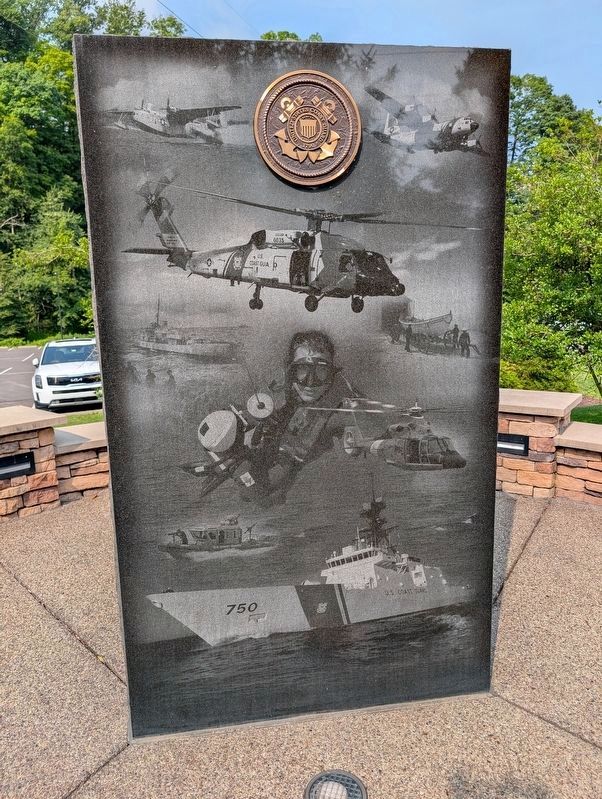
Coast Guard
Side A
Side A
Photographed by Mike Wintermantel, July 16, 2026
14. Upper St. Clair Veterans Park Marker
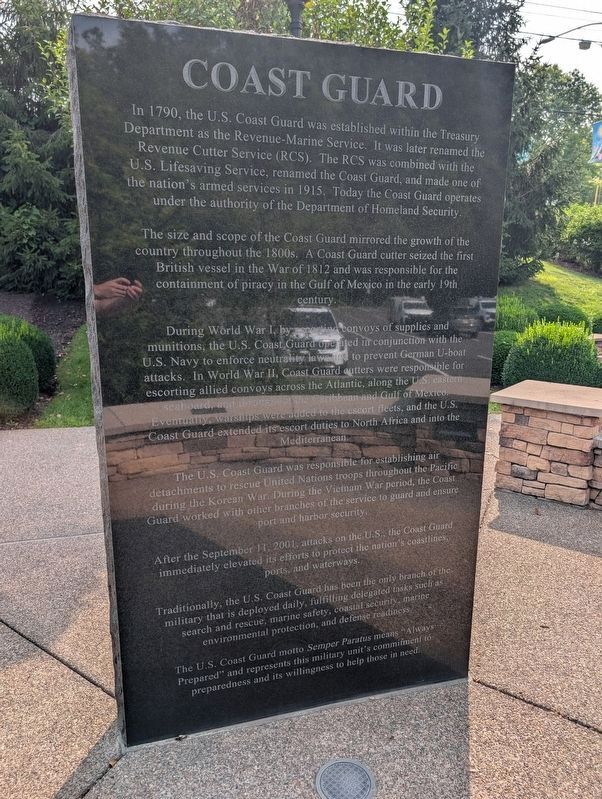
Coast Guard
Side B
In 1790, the U.S. Coast Guard was established within the Treasury Department as the Revenue-Marine Service. It was later renamed the Revenue Cutter Service (RCS). The RCS was combined with the U.S. Lifesaving Service, renamed the Coast Guard, and made one of the nation's armed services in 1915. Today the Coast Guard operates under the authority of the Department of Homeland Security.
The size and scope of the Coast Guard mirrored the growth of the country throughout the 1800s. A Coast Guard cutter seized the first British vessel in the War of 1812 and was responsible for the containment of piracy in the Gulf of Mexico in the early 19th century.
During World War I, by escorting convoys of supplies and munitions, the U.S. Coast Guard operated in conjunction with the U.S. Navy to enforce neutrality laws and to prevent German U-boat attacks. In World War II, Coast Guard cutters were responsible for escorting allied convoys across the Atlantic, along the U.S. eastern seaboard, and throughout the Caribbean and Gulf of Mexico. Eventually, warships were added to the escort fleets, and the U.S. Coast Guard extended its escort duties to North Africa and into the Mediterranean.
The U.S. Coast Guard was responsible for establishing air detachments to rescue United Nations troops throughout the Pacific during the Korean War. During the Vietnam War period, the Coast Guard worked with other branches of the service to guard and ensure port and harbor security.
After the September 11, 2001, attacks on the U.S., the Coast Guard immediately elevated its efforts to protect the nation's coastlines, ports, and waterways.
Traditionally, the U.S. Coast Guard has been the only branch of the military that is deployed daily, fulfilling delegated tasks such as search and rescue, marine safety, coastal security, marine environmental protection, and defense readiness.
The U.S. Coast Guard motto Semper Paratus means "Always Prepared" and represents this military unit's commitment to preparedness and its willingness to help those in need.
Side B
The size and scope of the Coast Guard mirrored the growth of the country throughout the 1800s. A Coast Guard cutter seized the first British vessel in the War of 1812 and was responsible for the containment of piracy in the Gulf of Mexico in the early 19th century.
During World War I, by escorting convoys of supplies and munitions, the U.S. Coast Guard operated in conjunction with the U.S. Navy to enforce neutrality laws and to prevent German U-boat attacks. In World War II, Coast Guard cutters were responsible for escorting allied convoys across the Atlantic, along the U.S. eastern seaboard, and throughout the Caribbean and Gulf of Mexico. Eventually, warships were added to the escort fleets, and the U.S. Coast Guard extended its escort duties to North Africa and into the Mediterranean.
The U.S. Coast Guard was responsible for establishing air detachments to rescue United Nations troops throughout the Pacific during the Korean War. During the Vietnam War period, the Coast Guard worked with other branches of the service to guard and ensure port and harbor security.
After the September 11, 2001, attacks on the U.S., the Coast Guard immediately elevated its efforts to protect the nation's coastlines, ports, and waterways.
Traditionally, the U.S. Coast Guard has been the only branch of the military that is deployed daily, fulfilling delegated tasks such as search and rescue, marine safety, coastal security, marine environmental protection, and defense readiness.
The U.S. Coast Guard motto Semper Paratus means "Always Prepared" and represents this military unit's commitment to preparedness and its willingness to help those in need.
Photographed by Mike Wintermantel, July 16, 2026
15. Upper St. Clair Veterans Park Marker
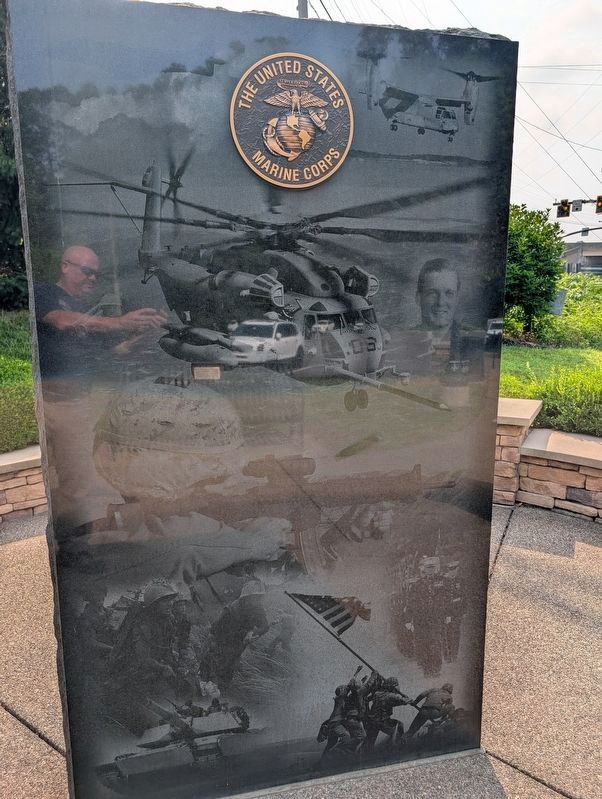
Marine Corps
Side A
Side A
Photographed by Mike Wintermantel, July 16, 2026
16. Upper St. Clair Veterans Park Marker
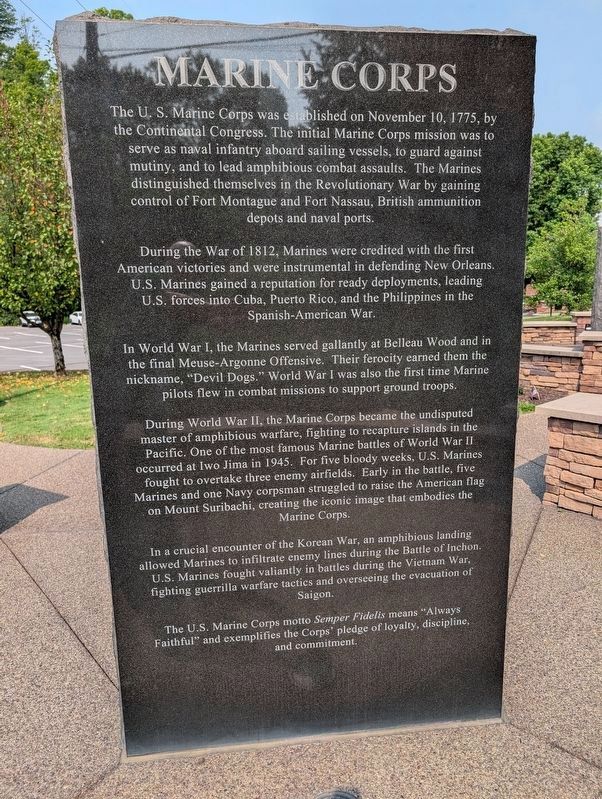
Marine Corps
Side B
The U. S. Marine Corps was established on November 10, 1775, by the Continental Congress. The initial Marine Corps mission was to serve as naval infantry aboard sailing vessels, to guard against mutiny, and to lead amphibious combat assaults. The Marines distinguished themselves in the Revolutionary War by gaining control of Fort Montague and Fort Nassau, British ammunition depots and naval ports.
During the War of 1812, Marines were credited with the first American victories and were instrumental in defending New Orleans. U.S. Marines gained a reputation for ready deployments, leading U.S. forces into Cuba, Puerto Rico, and the Philippines in the Spanish-American War.
In World War I, the Marines served gallantly at Belleau Wood and in the final Meuse-Argonne Offensive. Their ferocity earned them the nickname, "Devil Dogs." World War I was also the first time Marine pilots flew in combat missions to support ground troops. During World War II, the Marine Corps became the undisputed master of amphibious warfare, fighting to recapture islands in the Pacific. One of the most famous Marine battles of World War II occurred at Iwo Jima in 1945. For five bloody weeks, U.S. Marines fought to overtake three enemy airfields. Early in the battle, five Marines and one Navy corpsman struggled to raise the American flag on Mount Suribachi, creating the iconic image that embodies the Marine Corps.
In a crucial encounter of the Korean War, an amphibious landing allowed Marines to infiltrate enemy lines during the Battle of Inchon. U.S. Marines fought valiantly in battles during the Vietnam War, fighting guerrilla warfare tactics and overseeing the evacuation of Saigon.
The U.S. Marine Corps motto Semper Fidelis means "Always Faithful" and exemplifies the Corps' pledge of loyalty, discipline, and commitment.
Side B
During the War of 1812, Marines were credited with the first American victories and were instrumental in defending New Orleans. U.S. Marines gained a reputation for ready deployments, leading U.S. forces into Cuba, Puerto Rico, and the Philippines in the Spanish-American War.
In World War I, the Marines served gallantly at Belleau Wood and in the final Meuse-Argonne Offensive. Their ferocity earned them the nickname, "Devil Dogs." World War I was also the first time Marine pilots flew in combat missions to support ground troops. During World War II, the Marine Corps became the undisputed master of amphibious warfare, fighting to recapture islands in the Pacific. One of the most famous Marine battles of World War II occurred at Iwo Jima in 1945. For five bloody weeks, U.S. Marines fought to overtake three enemy airfields. Early in the battle, five Marines and one Navy corpsman struggled to raise the American flag on Mount Suribachi, creating the iconic image that embodies the Marine Corps.
In a crucial encounter of the Korean War, an amphibious landing allowed Marines to infiltrate enemy lines during the Battle of Inchon. U.S. Marines fought valiantly in battles during the Vietnam War, fighting guerrilla warfare tactics and overseeing the evacuation of Saigon.
The U.S. Marine Corps motto Semper Fidelis means "Always Faithful" and exemplifies the Corps' pledge of loyalty, discipline, and commitment.
Photographed by Mike Wintermantel, July 16, 2026
17. Upper St. Clair Veterans Park Marker
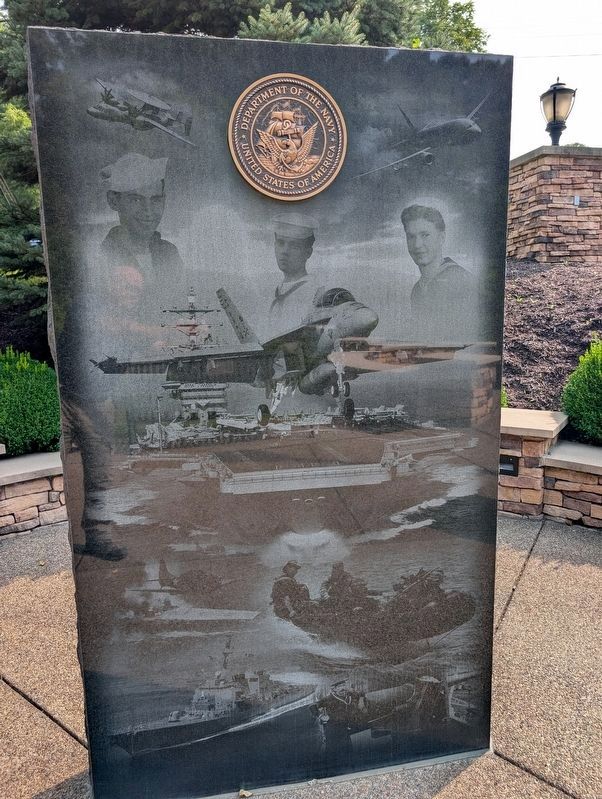
Navy
Side A
Side A
Photographed by Mike Wintermantel, July 16, 2026
18. Upper St. Clair Veterans Park Marker
Navy
Side B
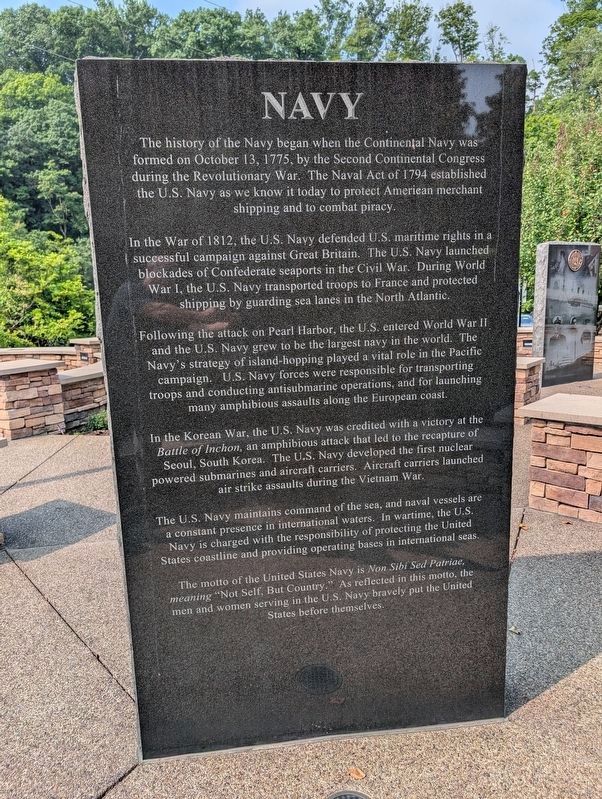
The history of the Navy began when the Continental Navy was formed on October 13, 1775, by the Second Continental Congress during the Revolutionary War. The Naval Act of 1794 established the U.S. Navy as we know it today to protect American merchant shipping and to combat piracy.
In the War of 1812, the U.S. Navy defended U.S. maritime rights in a successful campaign against Great Britain. The U.S. Navy launched blockades of Confederate seaports in the Civil War. During World War I, the U.S. Navy transported troops to France and protected shipping by guarding sea lanes in the North Atlantic.
Following the attack on Pearl Harbor, the U.S. entered World War II and the U.S. Navy grew to be the largest navy in the world. The Navy's strategy of island-hopping played a vital role in the Pacific campaign. U.S. Navy forces were responsible for transporting troops and conducting antisubmarine operations, and for launching many amphibious assaults along the European coast.
In the Korean War, the U.S. Navy was credited with a victory at the Battle of Inchon, an amphibious attack that led to the recapture of Seoul, South Korea. The U.S. Navy developed the first nuclear powered submarines and aircraft carriers. Aircraft carriers launched air strike assaults during the Vietnam War.
The U.S. Navy maintains command of the sea, and naval vessels are a constant presence in international waters. In wartime, the U.S. Navy is charged with the responsibility of protecting the United States coastline and providing operating bases in international seas.
The motto of the United States Navy is Non Sibi Sed Patriae, meaning "Not Self, But Country." As reflected in this motto, the men and women serving in the U.S. Navy bravely put the United States before themselves.
Side B
In the War of 1812, the U.S. Navy defended U.S. maritime rights in a successful campaign against Great Britain. The U.S. Navy launched blockades of Confederate seaports in the Civil War. During World War I, the U.S. Navy transported troops to France and protected shipping by guarding sea lanes in the North Atlantic.
Following the attack on Pearl Harbor, the U.S. entered World War II and the U.S. Navy grew to be the largest navy in the world. The Navy's strategy of island-hopping played a vital role in the Pacific campaign. U.S. Navy forces were responsible for transporting troops and conducting antisubmarine operations, and for launching many amphibious assaults along the European coast.
In the Korean War, the U.S. Navy was credited with a victory at the Battle of Inchon, an amphibious attack that led to the recapture of Seoul, South Korea. The U.S. Navy developed the first nuclear powered submarines and aircraft carriers. Aircraft carriers launched air strike assaults during the Vietnam War.
The U.S. Navy maintains command of the sea, and naval vessels are a constant presence in international waters. In wartime, the U.S. Navy is charged with the responsibility of protecting the United States coastline and providing operating bases in international seas.
The motto of the United States Navy is Non Sibi Sed Patriae, meaning "Not Self, But Country." As reflected in this motto, the men and women serving in the U.S. Navy bravely put the United States before themselves.
Credits. This page was last revised on July 28, 2026. It was originally submitted on October 4, 2025, by Bradley Owen of Morgantown, West Virginia. This page has been viewed 64 times since then and 32 times this year. Photos: 1, 2, 3, 4. submitted on October 4, 2025, by Bradley Owen of Morgantown, West Virginia. 5, 6, 7, 8, 9, 10, 11, 12, 13, 14, 15, 16, 17, 18. submitted on July 28, 2026, by Mike Wintermantel of Pittsburgh, Pennsylvania.
