
Altstadt in Würzburg, Bavaria, Germany — Central Europe
Vom Judenplatz zum Marktplatz
Jüdisches Leben in Würzburg
⎯⎯⎯
From Jewish Quarter to Market Square
Würzburg's Jewish Life in the Middle Ages
Photographed by James Hulse, July 14, 2025
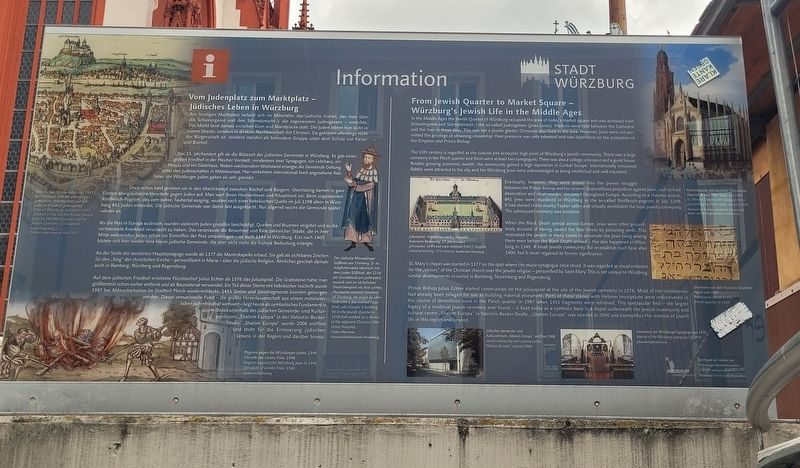
1. Vom Judenplatz zum Marktplatz / From Jewish Quarter to Market Square Marker

Am heutigen Marktplatz befand sich im Mittelalter das jüdische Viertel, das man über die Schustergasse und den Schmalzmarkt die sogenannten Judengassen erreichte. Der Markt fand damals zwischen Dom und Mainbrücke statt. Die Juden lebten hier nicht in einem Ghetto, sondern in direkter Nachbarschaft mit Christen. Sie gehörten allerdings nicht der Bürgerschaft an, sondern standen als besondere Gruppe unter dem Schutz von Kaiser und Bischof.
Das 13. Jahrhundert gilt als die Blütezeit der jüdischen Gemeinde in Würzburg. Es gab einen großen Friedhof in der Pleicher Vorstadt, mindestens zwei Synagogen, ein Lehrhaus, ein Hospiz und ein Gästehaus. Neben wachsendem Wohlstand erlangte die Gemeinde Geltung unter den Judenschaften in Mitteleuropa. Hier verkehrten international hoch angesehene Rabbiner, die Würzburger Juden galten als sehr gebildet.
Doch schon bald gerieten sie in den Machtkampf zwischen Bischof und Bürgern. Gleichzeitig kamen in ganz Europa abergläubische Vorurteile gegen Juden auf. Man warf ihnen Hostienfrevel und Ritualmord vor. Beim sogenannten Rintfleisch-Pogrom, das vom nahen Taubertal ausging,
this page online
Als die Pest in Europa ausbrach, wurden vielerorts Juden grundlos beschuldigt, Quellen und Brunnen vergiftet und so die verheerende Krankheit verursacht zu haben. Das veranlasste die Bewohner und Räte zahlreicher Städte, die in ihrer Mitte wohnenden Juden schon vor Eintreffen der Pest umzubringen - so auch 1349 in Würzburg. Erst nach 1400 bildete sich hier wieder eine kleine jüdische Gemeinde, die aber nicht mehr die frühere Bedeutung erlangte.
An der Stelle der zerstörten Hauptsynagoge wurde ab 1377 die Marienkapelle erbaut. Sie galt als sichtbares Zeichen für den „Sieg“ der christlichen Kirche - personifiziert in Maria - über die jüdische Religion. Ähnliches geschah damals auch in Bamberg, Nürnberg und Regensburg.
Auf dem jüdischen Friedhof errichtete Fürstbischof Julius Echter ab 1576 das Juliusspital. Die Grabsteine hatte man größtenteils schon vorher entfernt und als Baumaterial verwendet. Ein Teil dieser Steine mit hebräischer Inschrift
Photographed by James Hulse, July 14, 2025
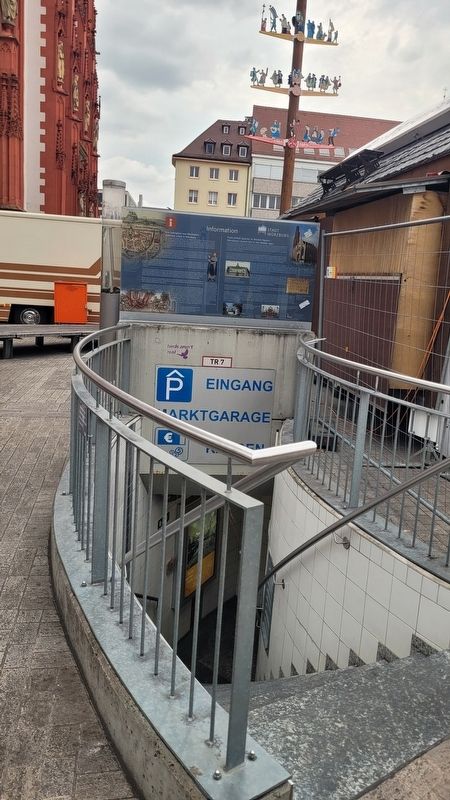
2. The marker is located at the entrance to an underground parking garage
Bildunterschriften
(Foto #1) Würzburger Stadtansicht von 1572. Rot markiert sind der ehemalige Judenplatz (Marktplatz) und der jüdische Friedhof (Juliusspital). Braun/Hogenberg, Civitates orbis terrarum, Köln 1572
(Foto #2) Der jüdische Minnesänger Süßkind von Trimberg. Er ist möglicherweise identisch mit dem Juden Süßkind, der 1218 ein Grundstück am Judenplatz erwarb und im christlichen Dietricherspital als Arzt wirkte. Codex Manesse, Universitätsbibliothek Heidelberg
(Foto #3) Pogrom gegen die Würzburger Juden, 1349, Chronik des Lorenz Fries, 1546. Stadtarchiv, Würzburg
(Foto #4) Juliusspital, Vogelschau nach J. Leypold, Kolorierte Radierung, 17. Jahrhundert. Stadtarchiv Würzburg
(Foto #5) Jüdisches Gemeinde- und Kulturzentrum. „Shalom Europa“, eröffnet 2006
(Foto #6) Marienkapelle mit barocker Turmhaube, Ölgemälde von Peter Geist, um 1845. Museum für Franken, Staatliches Museum für Kunst- und Kulturgeschichte in Würzburg
(Foto #7) Grabstein aus dem Fund im Stadtteil Pleich von 1987.
(Foto #8) Innenraum der Würzburger Synagoge von 1970. Johanna-Stahl-Zentrum
In
Photographed by James Hulse, July 14, 2025
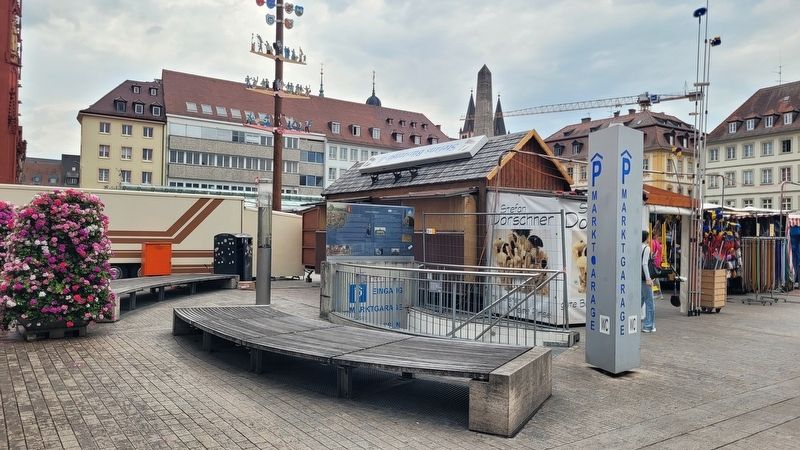
3. The view of the marker along the Market Square
The 13th century is regarded as the cultural and economic high point of Würzburg's Jewish community. There was a large cemetery in the Pleich quarter and there were at least two synagogues. There was also a college, a hospice and a guest house. Besides growing economic wealth, the community gained a high reputation in Central Europe. Internationally renowned Rabbis were attracted to the city and the Würzburg Jews were acknowledged as being intellectual and well educated.
Eventually, however, they were drawn into the power struggle between the Prince Bishop and his citizens. Superstitious prejudices against Jews, such as host desecration and
Photographed by James Hulse, July 14, 2025
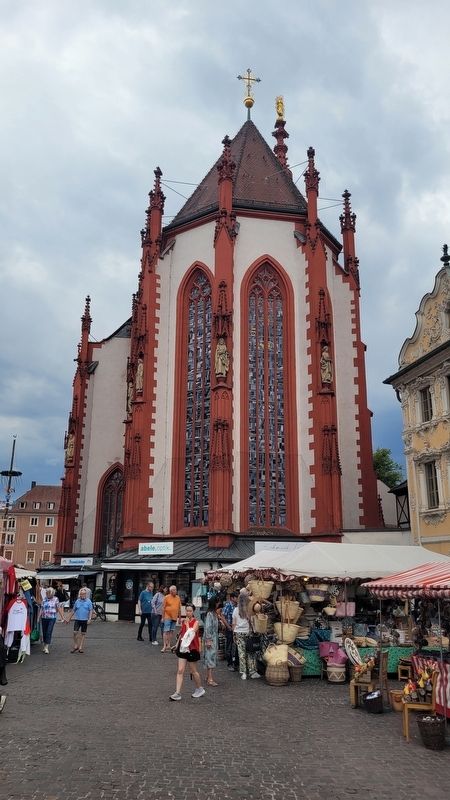
4. The view of St. Mary’s Chapel in the Market Square
When the Black Death spread across Europe, Jews were often groundlessly accused of having caused the fatal illness by poisoning wells. This motivated the people in many towns to persecute the Jews living among them even before the Black Death arrived - this also happened in Würzburg in 1349. A small Jewish community did re-establish itself here after 1400, but it never regained its former significance.
St. Mary's chapel was started in 1377 on the spot where the major synagogue once stood. It was regarded as visual evidence for the victory of the Christian church over the Jewish religion - personified by Saint Mary. This is not unique to Würzburg, similar developments occurred in Bamber, Nuremberg and Regensburg.
Prince Bishop Julius Echter started construction on the Juliusspital at the site of the Jewish cemetery in 1576. Most of the tombstones had already been pillaged for use as building material elsewhere. Parts of these stones with Hebrew inscriptions were rediscovered in the course of demolition work in the Pleich quarter in 1987 when 1455 fragments were retrieved. This spectacular find - the largest legacy of a medieval Jewish cemetery ever found - is kept today as a symbolic base in a depot underneath the Jewish community and cultural centre „Shalom Europa“ in Valentin-Becker-Straße. „Shalom Europa“ was opened in 2006 and exemplifies the renewal of Jewish life in this region and beyond.
Captions
(Photo #1) Jewish Cemetery (Juliusspital) Braun/Hogenberg. Civitates orbis terrarum, Cologne 1572
(Photo #2) The Jewish minstrel Süsskind of Trimberg. He might be identical to Süsskind, who bought a building lot in the Jewish Quarter in 1218 and worked as a doctor in the adjacent Christian Dietricher Hospital. Codex Manesse, Heidelberg University Library
(Photo #3) Pogrom against the Würzburg Jews in 1349, Chronicle of Lorenz Fries, 1546. Stadtarchiv, Würzburg
(Photo #4) Juliusspital, bird's-eye view adapted from J. Leypold, coloured etching, 17th century. Stadtarchiv Würzburg
(Photo #5) Jewish community and cultural centre. "Shalom Europa", opened 2006
(Photo #6) St. Mary's Chapel with baroque dome, oil painting by Peter Geist, around 1845. Museum für Franken, Staatliches Museum fur Kumt- und Kulturgeschichte in Würzburg
(Photo #7) Tombstone found in the Pleich quarter in 1987.
(Photo #8) Interior of the Würzburg synagogue of 1970. Johanna-Stahl-Zentrum
Erected by Stadt Würzburg.
Topics. This historical marker is listed in these topic lists: Disasters • Religion & Religious Structures • Settlements & Settlers. A significant historical year for this entry is 1298.
Location. 49° 47.68′ N, 9° 55.74′ E. Marker is in Würzburg, Bayern (Bavaria). It is in Altstadt. It is at the intersection of Marktgasse and Marktplatz on Marktgasse. The marker is located at the pedestrian entrance to the underground parking garage. Touch for map. Marker is at or near this postal address: Marktgasse 2, Würzburg BY 97070, Germany. Touch for directions.

Regionally, it is in Europe, the European Union, Atlantic Europe, Central Europe, the Schengen Area, Western Europe, and the Western World. Historically, it finds itself in what was once the Holy Roman Empire.
Other nearby markers. At least 8 other markers are within walking distance of this marker: Marienkapelle / St. Mary's Chapel (a few steps from this marker); Hof Castell (within shouting distance of this marker); Hof "Zum Stachel" / The Mace Inn (within shouting distance of this marker); Emy Roeder (within shouting distance of this marker); Kaufhaus am Markt / Department Store at the Market (about 90 meters away, measured in a direct line); Haus zum Falken (about 90 meters away); Haus zum Falken / House of the Falcon (about 120 meters away); Neumünster (about 180 meters away). Touch for a list and map of all markers in Würzburg.
Credits. This page was last revised on October 5, 2025. It was originally submitted on October 4, 2025, by James Hulse of Medina, Texas. This page has been viewed 44 times since then and 8 times this year. Photos: 1, 2, 3, 4. submitted on October 5, 2025, by James Hulse of Medina, Texas.
