New Iberia in Iberia Parish, Louisiana — The American South (West South Central)
Old City Hall
Circa 1898 and 1939
Photographed by Cajun Scrambler, September 12, 2025
1. Old City Hall Marker
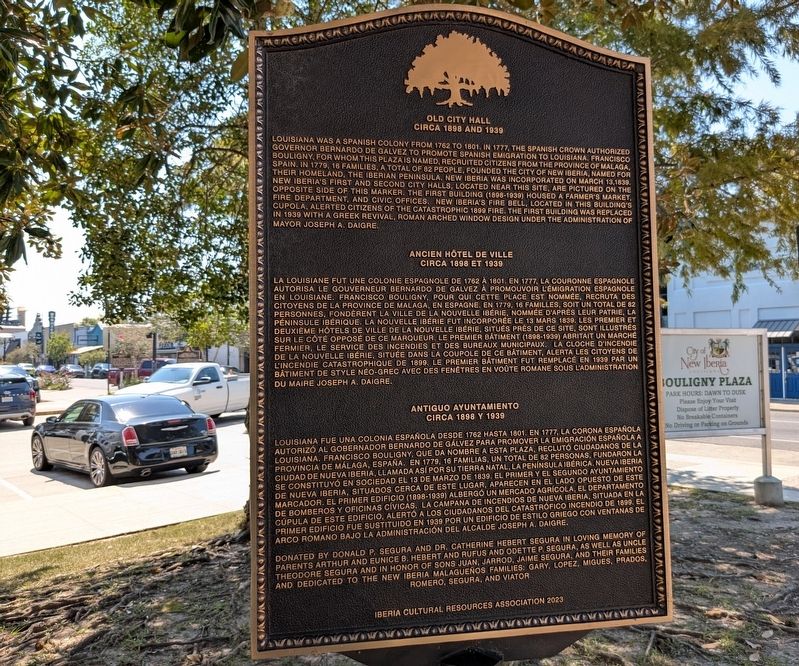
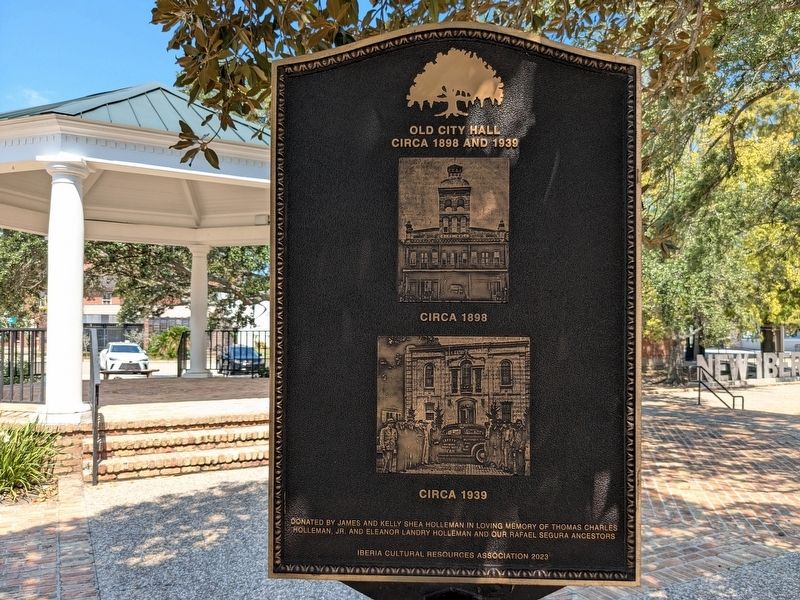
Louisiana was a Spanish colony from 1762 to 1801. in 1777, the Spanish crown authorized governor Bernardo de Galvez to promote Spanish emigration to Louisiana, Francisco Bouligny, for whom this plaza is named, recruited citizens from the province of Malaga Spain. In 1779, 16 families, a total of 82 people, founded the city of New Iberia, named for their homeland, the Iberian Peninsula. New Iberia was incorporated on March 13, 1839. New Iberia's first and second city halls, located near this site, are pictured on the opposite side of this marker. The first building (1898-1939) housed a farmer's market, fire department, and civic offices. New Iberia's fire bell, located in this building's cupola, alerted citizens of the catastrophic 1899 fire. The first building was replaced in 1939 with a Greek Revival, Roman arched window design under the administration of Mayor Joseph A. Daigre
Ancien Hotel de Ville
Circa 1898 et 1939
La Louisiane fut une colonie Espagnole de 1762 a 1801, en 1777, la couronne Espagnole autorisa le Gouverneur Bernardo de Galvez a promouvoir l'emigration Espagnole en Louisiane. Francisco Bouligny,
this page online
Antiguo Ayuntamiento
Circa 1898 y 1939
Louisiana fue una colonia Española desde 1762 hasta 1801. En 1777, la corona Española autorizó al Gobernador Bernardo de Galvez para promover la emigración Española a Louisiana. Francisco Bouligny, que da nombre a esta plaza, reclutó ciudadanos de la provincia
Photographed by Cajun Scrambler, September 12, 2025
2. Old City Hall Marker
Donated by Donald P. Segura and Dr. Catherine Hebert Segura in loving memory of parents Arthur and Eunice B. Hebert and Rufus and Odette P. Segura, as well as Uncle Theodore Segura and in honor of sons Juan, Jarrod, Jaime Segura, and their families and dedicated to the New Iberia Malagueños families: Gary, Lopez, Migues, Prados, Romero, Segura, and Viator.
Erected 2023 by Iberia Cultural
Photographed by Cajun Scrambler, September 12, 2025
3. Old City Hall Marker
Topics. This historical marker is listed in these topic lists: Government & Politics • Notable Buildings • Settlements & Settlers.
Location. 30° 0.389′ N, 91° 49.118′ W. Marker is in New Iberia, Louisiana, in Iberia Parish. It is on West Main Street near Fishers Alley. Touch for map. Marker is at or near this postal address: 104 W Main St, New Iberia LA 70560, United States of America. Touch for directions.

Regionally, this marker is in Acadiana — Cajun Country and specifically in Bayou Country. It is also in the American South, specifically in the Deep South, and on the Gulf Coast. Globally, it is in North America, a Gulf of Mexico state, the Western Hemisphere, the Western World, and the Anglosphere. Historically, it finds itself in what was once New Spain, Acadia, the territory of the Mississippian Culture, the Louisiana Purchase, one of the Confederate States of America, and the Antebellum South.
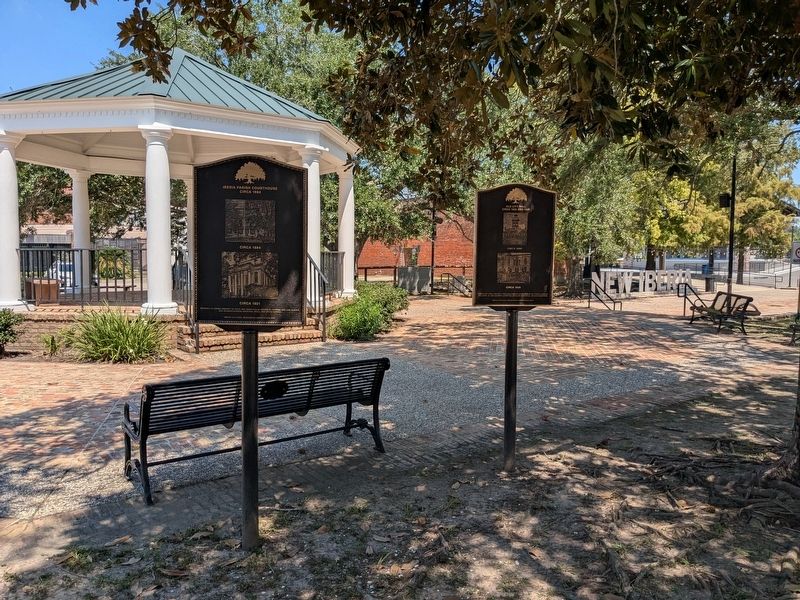
Other nearby markers. At least 8 other markers are within walking distance of this marker: Iberia Parish Courthouse (here, next to this
Photographed by Cajun Scrambler, September 12, 2025
4. Old City Hall Marker
Credits. This page was last revised on October 5, 2025. It was originally submitted on October 5, 2025, by Cajun Scrambler of Assumption, Louisiana. This page has been viewed 69 times since then and 33 times this year. Photos: 1, 2, 3, 4. submitted on October 5, 2025, by Cajun Scrambler of Assumption, Louisiana.
