Midtown - Downtown in Columbia in Richland County, South Carolina — The American South (South Atlantic)
Washington Street Methodist Church
| — | United Methodist Church Registered Historic Site No. 139 | — |
Photographed by Mike Stroud, 2010
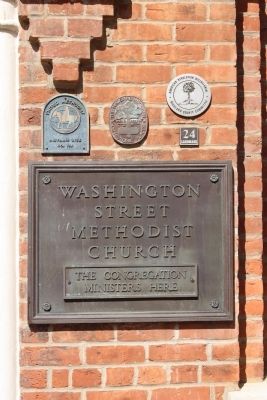
1. Washington Street Methodist Church Marker
Street
Methodist
Church
The Congregation
Ministers Here
Left Medallion
United Methodist
Historic Site
No. 139
Center Medallion
National Register of
Historic Places
Washington Street
United Methodist Church
(Building - #70000599)
Right Medallion
American Revolution Bicentennial
Richland County Committee
Landmark 24
Topics and series. This historical marker is listed in this topic list: Religion & Religious Structures. In addition, it is included in the United Methodist Church Historic Sites series list.
Location. 34° 0.318′ N, 81° 1.9′ W. Marker is in Columbia, South Carolina, in Richland County. It is in Midtown - Downtown. It is on Marion Street near Washington Street, on the left when traveling south. Touch for map. Marker is in this post office area: Columbia SC 29201, United States of America. Touch for directions.

Regionally, this marker is in the Midlands. It is also in the American South and specifically in the Deep South. Globally, it is in North America, the Western Hemisphere, the Western World, and the Anglosphere. Historically, it finds itself in what was once the territory of the Mississippian Culture, one of the original Thirteen Colonies, one of the Confederate States of America, and the Antebellum South.
Other nearby markers. At least 8 other markers are within walking distance of this marker: A different marker also named Washington Street Methodist Church (here, next to this marker); Site of Columbia Female Academy (within shouting distance of this marker); Site of Columbia High School (within shouting distance of this marker); First Presbyterian Church Confederate Veterans Monument (about 400 feet away, measured in a direct line); Cecil Herbert Land D.D. (about 500 feet away); Ordinance of Secession
this page online
Regarding Washington Street Methodist Church. A church was built here between 1803 and 1805; another church, erected 1832, was burned by Union troops in 1865 and reconstructed in 1866 of salvaged brick and clay mortar. Present church dedicated 1875. Bishop Wm. Capers (1790-1855), founder of missions to slaves in S. C., was pastor and is buried here.(The Columbia Sesquicentennial Commission)
National Register of Historic Places:
Washington Street United Methodist Church (added 1970 - - #70000599)
♦ 1401 Washington St. , Columbia
♦ Historic Significance: Event, Architecture/Engineering
♦ Architect, builder, or engineer: Unknown
♦ Architectural Style: Gothic
♦ Area of Significance: Architecture, Religion
♦ Period of Significance: 1850-1874
♦ Owner: Private
♦ Historic Function: Religion
♦ Historic Sub-function: Religious Structure
♦ Current Function: Religion
♦ Current Sub-function: Religious Structure
Photographed by Mike Stroud, 2012
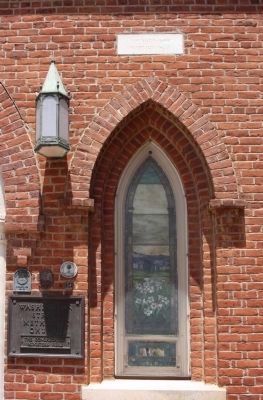
2. Washington Street Methodist Church Marker
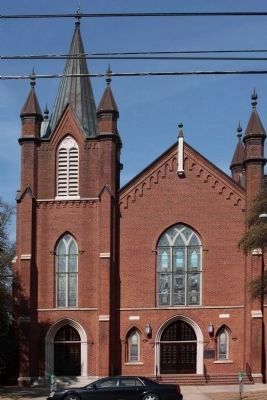
Washington Street United Methodist Church is one of Columbia’s four most historic churches. Organized in 1803, the congregation built a frame church that was the first house of worship in Columbia. A brick structure built in 1830s burned in 1865. According to legend, the church was destroyed by Union soldiers looking for First Baptist Church, site of the first meeting of South Carolina secession convention, and were directed here by a Baptist sexton. A small chapel built of brick salvaged from ruins was replaced by the present church that was erected with funds collected throughout the nation. Completed in 1872, the Washington Street Church is a red brick Victorian Gothic church with double-shouldered buttresses and a large arched center entrance with double doors flanked by similar arched entrances. The church features a fully developed tower with a steeple on the left side of the front façade with matching lines extending to the roofline on the right. Both towers are topped with four pinnacles with unusual crown-shaped ornaments, giving the appearance of Islamic influence. Stained glass windows depict life of Christ without using human figures. Listed in the National Register December 18, 1970.(South Carolina Department of Archives and History)
Photographed by Mike Stroud, 2012
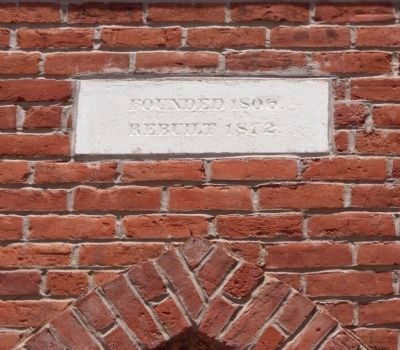
3. Washington Street Methodist Church above the window text
Rebuilt 1872
Photographed by Mike Stroud, February 21, 2010
4. Washington Street Methodist Church
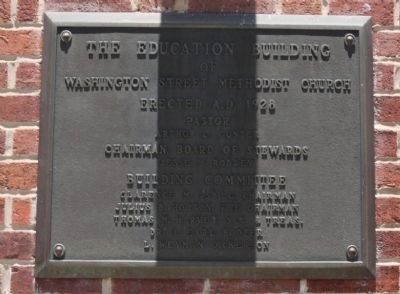
Photographed by Mike Stroud, 2012
5. The Education Building of
Erected A.D. 1928
Pastor Arthur L. Gunter
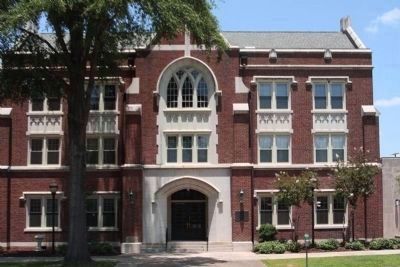
Photographed by Mike Stroud, 2012
6. Washington Street Methodist -The Education Building adjacent
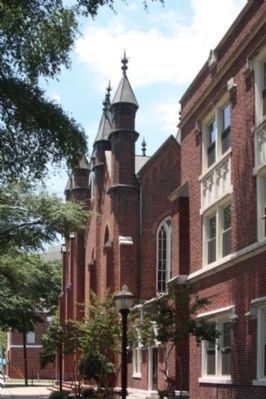
Photographed by Mike Stroud, 2012
7. Washington Street Methodist Church Spires
Credits. This page was last revised on August 20, 2023. It was originally submitted on March 9, 2010, by Mike Stroud of Bluffton, South Carolina. This page has been viewed 899 times since then and 29 times this year. Last updated on March 13, 2010, by Mike Stroud of Bluffton, South Carolina. Photos: 1. submitted on March 9, 2010, by Mike Stroud of Bluffton, South Carolina. 2, 3. submitted on June 17, 2012, by Mike Stroud of Bluffton, South Carolina. 4. submitted on March 13, 2010, by Mike Stroud of Bluffton, South Carolina. 5, 6. submitted on June 17, 2012, by Mike Stroud of Bluffton, South Carolina. 7. submitted on August 17, 2012, by Mike Stroud of Bluffton, South Carolina. • Syd Whittle was the editor who published this page.
