Corinth in Alcorn County, Mississippi — The American South (East South Central)
Bobby Gene Emmons
| — | Mississippi Country Music Trail | — |
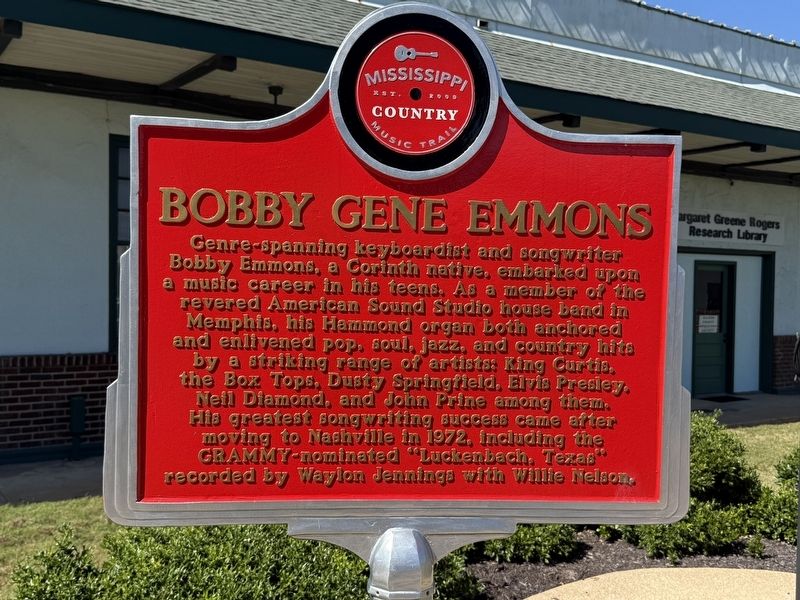
Photographed by Deborah Spencer, October 4, 2025
1. Bobby Gene Emmons Marker
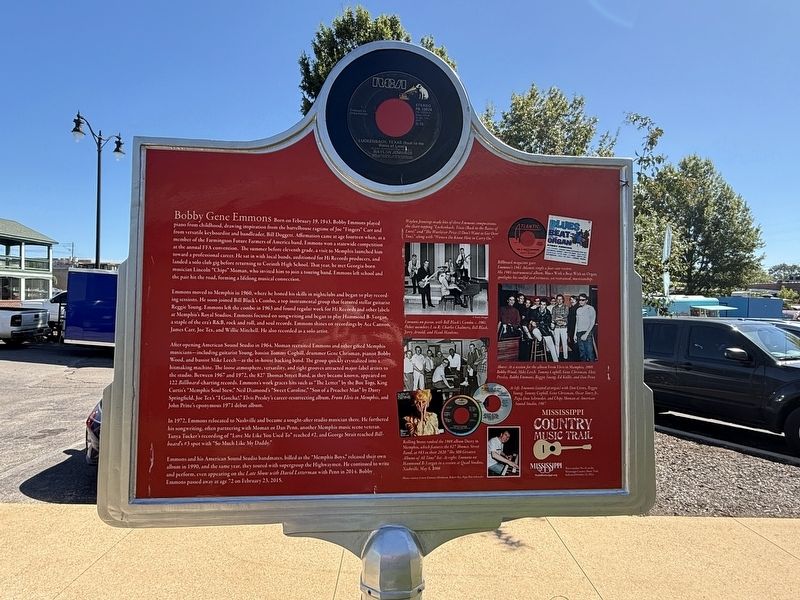
Reverse Side
Bobby Gene Emmons Born on February 18, 1943, Bobby Emmons played piano from childhood, drawing inspiration from the barrelhouse ragtime of Joe "Fingers" Carr and from versatile keyboardist and bandleader, Bill Doggett. Affirmation came at age fourteen when, as a member of the Farmington Future Farmers of America band, Emmons won a statewide competition at the anual FFA convention. The summer before eleventh grade, a visit to Memphis launched him toward a professional career. He sat in with local bands, auditioned for Hi
this page online
Emmons moved to Memphis in 1960, where he honed his skills in nightclubs and began to play recording sessions. He soon joined Bill Black's Combo, a top instrumental group that featured stellar guitarist Reggie Young. Emmons left the combo in 1963 and found regular work for Hi Records and other labels at Memphis's Royal Studios. Emmons focused on songwriting and began to play Hammon B-3 organ, a staple of the era's R&B, rock and roll, and soul records. Emmons shines on recordings by Ace Cannon, James Carr, Joe Tex, and Willie Mitchell. He also recorded as a solo artist.
After opening American Sound Studio in 1964, Moman recruited Emmons and other gifted Memphis musicians - including guitarist Young, bassist Tommy Gogbill, drummer Gene Chrisman, pianist Bobby Wood, and bassist Mike Leech - as the in-house backing band. The group quickly crystalized into
Photographed by Deborah Spencer, October 4, 2025
2. Bobby Gene Emmons Marker
In 1972 Emmons relocated to Nashville and became a sought-after studio musician there. He furthered his songwriting, often partnering with Moman or Dan Penn, another Memphis music scene veteran. Tanya Tucker's recording of "Love Me Like You Used To" reached #2, and George Strait reached Billboard's #3 spot with "So Much Like My Daddy."
Emmons and his American Sound Studio bandmates, billed as the "Memphis Boys," released their own album in 1990, and the same year, they toured with supergroup the Highwaymen. He continued to write and perform, even appearing on the Late Show with David Letterman
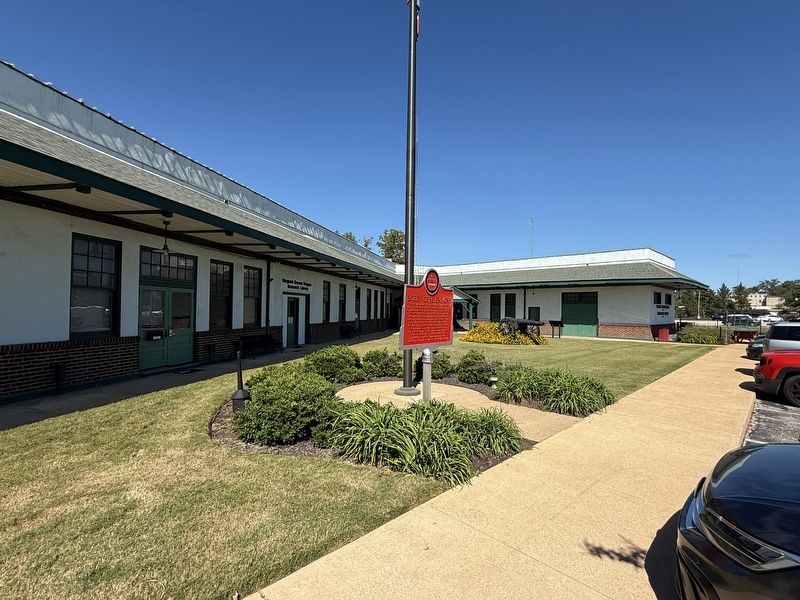
Photographed by Deborah Spencer, October 4, 2025
3. Bobby Gene Emmons Marker
Captions
(Photo #1) Waylon Jennings made hits of three Emmons compositions, the chart-topping "Luckenbach, Texas (Back to the Basics of Love)" and "The Wurlitzer Prize (I Don't Want to Get Over You)," along with "Women Do Know How to Carry On."
(Photo #2) Emmons on piano, with Bill Black's Combo, c. 1961. Other members L to R: Charles Chalmers, Bill Black, Jerry Arnold, and Hank Hankins.
(Photo #3) Rolling Stone ranked the 1969 album Dusty in Memphis, which features the 827 Thomas Street Band, at #83 in their 2020 "The 500 Greatest Albums of All Time" list. At right: Emmons on Hammond B-3 organ in a session at Quad Studios, Nashville, May 8, 2006.
(Photo #4) Billboard magazine gave Emmon's 1961 Atlantic single a four-star review. His 1965 instrumental album, Blues With a Beat With an Organ, spotlights his soulful and virtuosic, yet restrained, musicianship.
(Photo #5) Above: At a session for the album From Elvis in Memphis, 1969. Bobby Wood, Mike Leech, Tommy Cogbill, Gene Chrisman, Elvis Presley, Bobby Emmons, Reggie Young, Ed Kollis, and Dan Penn.
(Photo #6) At left: Emmons (seated at organ) with Don Crews, Reggie Young, Tommy Cogbill, Gene Chrisman, Oscar Toney Jr., Papa Don Schroeder, and Chips Moman at American Sound Studio, 1967.
Erected 2024 by Mississippi Country Music Trail. (Marker Number 42.)
Topics and series. This historical marker is listed in these topic lists: Arts, Letters, Music • Entertainment. In addition, it is included in the Mississippi Country Music Trail series list.
Location. 34° 56.018′ N, 88° 31.325′ W. Marker is in Corinth, Mississippi, in Alcorn County. It is at the intersection of Wick Street and North Fillmore Street, on the right when traveling west on Wick Street. Marker is located in front of the Crossroads Museum (old Corinth railroad depot). Touch for map. Marker is in this post office area: Corinth MS 38834, United States of America. Touch for directions.

Regionally, this marker is in andspecifically ast Mississippi in the North Mississippi Hills. It is also in the American South, specifically in the Deep South, in Appalachia, and specifically in Southern Appalachia. Globally, it is in North America, a Gulf of Mexico state, the Western Hemisphere, the Western World, and the Anglosphere. Historically, it finds itself in what was once the territory of the Mississippian Culture, one of the Confederate States of America, and the Antebellum South.
Other nearby markers. At least 8 other markers are within walking distance of this marker: Caboose #2994 (a few steps from this marker); The Big Guns (a few steps from this marker); 1924 American LaFrance Fire Engine (within shouting distance of this marker); "A beehive of activity..." (within shouting distance of this marker); Union Troops at Corinth (within shouting distance of this marker); The Old Tishomingo Hotel (within shouting distance of this marker); View Toward Batteries Robinett and Williams (within shouting distance of this marker); Corinth (about 300 feet away, measured in a direct line). Touch for a list and map of all markers in Corinth.
Credits. This page was last revised on September 28, 2026. It was originally submitted on October 6, 2025, by Deborah Spencer of Huntsville, Alabama. This page has been viewed 116 times since then and 59 times this year. Photos: 1, 2, 3. submitted on October 6, 2025, by Deborah Spencer of Huntsville, Alabama. • James Hulse was the editor who published this page.
