
Cheb, Karlovy Vary, Czechia — Central Europe (Bohemia)
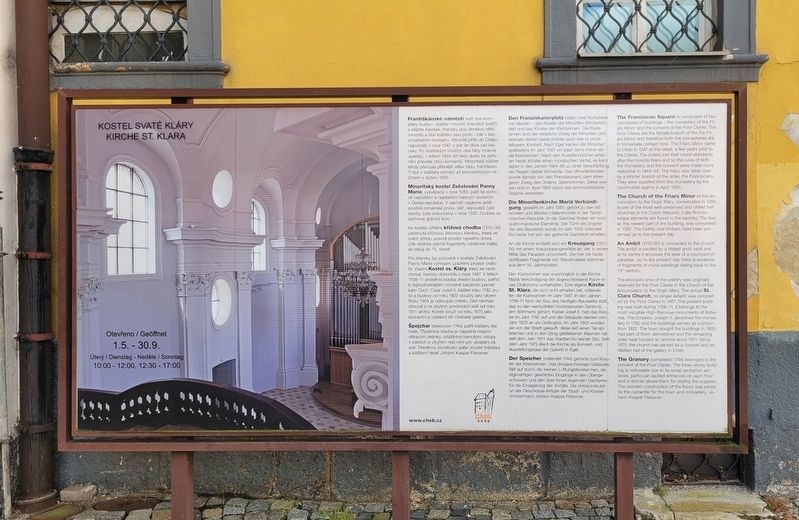
Kostel Svaté Kláry
⎯⎯⎯
Church of St. Clare
Photographed by James Hulse, June 17, 2025
1. Kostel Svaté Kláry / Church of St. Clare Marker

Františkánské náměstí tvoří dva komplexy budov - klášter minoritů (menších bratří) a klášter klarisek. Klarisky jsou ženskou větví minoritů a oba kláštery jsou proto i zde v bezprostředním kontaktu. Minorité přišli do Chebu nejpozději v roce 1247, o pár let dříve než klarisky. Po husitských bouřích oba řády mravně upadaly, v letech 1464-65 tedy došlo ke zpřísnění pravidel obou konventů. Minoritský klášter tehdy převzala přísnější větev řádu, františkáni. Ti byli z kláštera vyhnáni až komunistickým režimem v dubnu 1950.
Minoritský kostel Zvěstování Panny Marie, vysvěcený v roce 1285, patří ke slohově nejčistším a nejstarším halovým kostelům v České republice. V sakristii najdeme ještě pozdně románské prvky. Věž, nejnovější část stavby, byla dokončena v roce 1330. Dodnes se zachoval gotický krov.
Ke kostelu přiléhá křížová chodba (1310-30) zaklenutá křížovou žebrovou klenbou, která ve svém středu uzavírá prostor rajského dvora. Zde dodnes patrné fragmenty nástěnné malby se datují do 15. století.
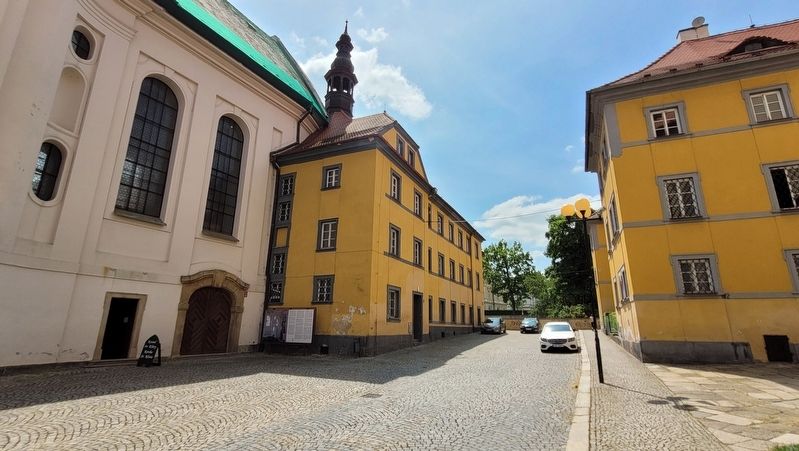
Pro klarisky byl původně v kostele Zvěstování Panny Marie vyhrazen uzavřený prostor oratoře. Vlastní Kostel sv. Kláry, který se nedochoval, klarisky dokončily v roce 1467. V letech 1708-11 proběhla stavba dnešní budovy, patřící k nejhodnotnějším vrcholně barokním památkám Čech. Císař Josef II. klášter roku 1782 zrušil a budovy od roku 1822 sloužily jako vězení. Roku 1905 je odkoupilo město, část nechalo zbourat a ve zbylých prostorách sídlí od roku 1911 archiv. Kostel slouží od roku 1975 jako koncertní a výstavní síň chebské galerie.
Špejchar (dokončen 1744) patřil klášteru klarisek. Třípatrová stavba je nápadná malými větracími okénky, zvláštními klenutými vstupy v patrech a vikýřem nad nimi pro ukládání zásob. Dřevěnou konstrukci pater zroubil městský a klášterní tesař Johann Kaspar Fleissner.
Den Franziskanerplatz bilden zwei Komplexe von Bauten - das Kloster der Minoriten (Minderbrüder) und das Kloster der Klarissinnen. Die Klarissinnen sind der weibliche Zweig der Minoriten und deshalb stehen beide Klöster auch hier in unmittelbarem Kontakt. Nach Eger kamen die Minoriten spätestens im Jahr 1247, ein paar Jahre früher als die Klarissinnen. Nach den Hussitenunruhen erlebten beide Klöster einen moralischen Verfall, es kam daher in den Jahren 1464-65 zu einer Verschärfung der Regeln beider Konvente. Das Minoritenkloster wurde damals von den Franziskanern, dem strengeren Zweig des Ordens, übernommen. Diese wurden erst im April 1950 durch das kommunistische Regime vertrieben.
Die Minoritenkirche Mariä Verkündigung, geweiht im Jahr 1285, gehört zu den stilreinsten und ältesten Hallenkirchen in der Tschechischen Republik. In der Sakristei finden wir noch spätromanische Elemente. Der Turm als jüngster Teil des Bauwerks wurde im Jahr 1330 vollendet. Bis heute hat sich der gotische Dachstuhl erhalten.
An die Kirche schließt sich ein Kreuzgang (1310-30) mit einem Kreuzrippengewölbe an, der in seiner Mitte das Paradies umschließt. Die hier bis heute sichtbaren Fragmente von Wandmalerei stammen aus dem 15. Jahrhundert.
Den Klarissinnen war ursprünglich in der Kirche Mariä Verkündigung der abgeschlossene Raum eines Oratoriums vorbehalten. Eine eigene Kirche St. Klara, die sich nicht erhalten hat, vollendeten die Klarissinnen im Jahr 1467. In den Jahren 1708-11 fand der Bau des heutigen Bauwerks statt, das zu den wertvollsten hochbarocken Denkmälern Böhmens gehört. Kaiser Josef II. hob das Kloster im Jahr 1782 auf und die Gebäude dienten vom Jahr 1822 an als Gefängnis. Im Jahr 1905 wurden sie von der Stadt gekauft, diese ließ einen Teil abbrechen und in den übrig gebliebenen Räumen hat seit dem Jahr 1911 das Stadtarchiv seinen Sitz. Seit dem Jahr 1975 dient die Kirche als Konzert- und Ausstellungssaal der Galerie in Eger.
Der Speicher (vollendet 1744) gehörte zum Kloster der Klarissinnen. Das dreigeschossige Gebäude fällt auf durch die kleinen Lüftungsfensterchen, die eigenartigen gewölbten Eingänge in den Obergeschossen und den über ihnen liegenden Dacherker für die Einlagerung der Vorräte. Die Holzkonstruktion der Geschosse fertigte der Stadt- und Klosterzimmermann Johann Kaspar Fleissner.
The Franciscan Square is composed of two complexes of buildings - the monastery of the Friars Minor and the convent of the Poor Clares. The Poor Clares are the female branch of the the Friars Minor and therefore both the monasteries are in immediate contact here. The Friars Minor came to Cheb in 1247 at the latest, a few years prior to the Clares. The orders lost their moral standards after the Hussite Wars and so the rules of both the monastery and the convent were made more restrictive in 1464-65. The friary was taken over by a stricter branch of the order, the Franciscans. They were expelled from the monastery by the Communist regime in April 1950.
The Church of the Friars Minor of the Annunciation to the Virgin Mary, consecrated in 1285, is one of the most well-preserved and oldest hall churches in the Czech Republic. Late-Romanesque elements are found in the sacristy. The tower, the newest part of the building, was completed in 1330. The Gothic roof timbers have been preserved up to the present day.
An Ambit (1310-30) is connected to the church. The ambit is vaulted by a ribbed groin vault and at its centre it encloses the area of a courtyard of paradise. Up to the present day there is evidence of fragments of mural paintings dating back to the 15th century.
The enclosed area of the oratory was originally reserved for the Poor Clares in the Church of the Annunciation to the Virgin Mary. The actual St. Clara Church, no longer extant, was completed by the Poor Clares in 1467. The present building was built during 1708-11, it belongs to the most valuable High-Baroque monuments of Bohemia. The Emperor Joseph II. abolished the monastery in 1782 and the buildings served as a prison from 1822. The town bought the buildings in 1905, had part of them demolished and the remaining ones have housed an archive since 1911. Since 1975, the church has served as a concert and exhibition hall of the gallery in Cheb.
The Granary (completed 1744) belonged to the convent of the Poor Clares. The three-storey building is noticeable due to its small ventilation windows, particular vaulted entrances on each floor and a dormer above them for storing the supplies. The wooden construction of the floors was joined by the carpenter for the town and monastery, Johann Kaspar Fleissner.
Erected by Cheb
this page online
Topics. This historical marker is listed in this topic list: Religion & Religious Structures. A significant historical year for this entry is 1247.
Location. 50° 4.655′ N, 12° 22.105′ E. Marker is in Cheb, Karlovarský kraj ( Karlovy Vary). It is on Františkánské námestí just south of Dlouhá, on the left when traveling south. The marker is located at a west entrance to one of the buildings. Touch for map. Marker is at or near this postal address: Františkánské nám 5, Cheb, Karlovarský kraj 350 02, Czechia. Touch for directions.

Regionally, it is in Europe, the European Union, the Carpathian States, Central Europe, Eastern Europe, the Schengen Area, and the Western World. Historically, it finds itself in what was once the Holy Roman Empire.
Other nearby markers. At least 8 other markers are within walking distance of this marker: Městský dům č. p. 36 / Town house no. 36 (within shouting distance of this marker); Městský dům č. p. 27 / Town house no. 27 (within shouting distance of this marker); Městský dům č. p. 447 / Town house no. 447 (within shouting distance of this
Photographed by James Hulse, June 17, 2025
2. The Church of St. Clare and Marker

Photographed by James Hulse, June 17, 2025
3. Church of St. Clare
Credits. This page was last revised on October 6, 2025. It was originally submitted on October 6, 2025, by James Hulse of Medina, Texas. This page has been viewed 37 times since then and 9 times this year. Photos: 1, 2, 3. submitted on October 6, 2025, by James Hulse of Medina, Texas.
