Near Ivanpah in San Bernardino County, California — The American West (Pacific Coastal)
Ivanpah Solar Electric Generating System
Looking to The Sun

Photographed by Craig Baker, September 20, 2025
1. Ivanpah Solar Electric Generating System Marker
Upon completion in early 2014, this system became the world's largest concentrated solar power (CSP) facility, earning it POWER Magazine's "Plant of the Year" in 2014. In the years since, it has contributed to California's ever-growing renewable energy output.
The Power of Ivanpah
• Has 392 megawatts of commercial solar thermal energy capacity.
• Supports a yearly average of 140,000 California homes.
• Dry cooling system uses 95% less water than wet-cooled approach.
• Is produced from 374,000 mirrors mounted on heliostat pylons using 25% less land than traditional ground mounts.
• Reduces air pollutants by 85% compared to traditional power plants. This avoids 450,000 tons of carbon emissions annually-the equivalent of taking more than 95,000 cars off California roads.
· Electricity is sold to Southern California Edison and Pacific Gas and Electric.
· Supports California's goal to reach 50% renewable power by 2030.
· Upon completion, became the first large-scale solar thermal plant built in California in 20 years.
· Created approximately 2,600 construction jobs
this page online
· 2014 POWER Magazine "Plant of the Year."
Welcome to Ivanpah Valley
California Desert Conservation Area
Ivanpah Lake lies within the 25-million-acre California Desert Conservation Area (CDCA), which makes up nearly one-quarter of the state. This is a land of contrasts: from the relatively high Mojave Desert of Joshua trees and creosote to the lower Colorado Desert of native fan palms, smoke trees and ocotillo, the CDCA offers a multitude of recreational opportunities. Whether you have come to hike, backpack, camp, take photos, tour by auto, explore on an OHV, horseback ride, or go on a mountain bike, please "Tread Lightly!” and "Leave No Trace” of your visit so that others can enjoy this area for generations to come.
Land of Many Uses
The public lands in Ivanpah Valley are used for a variety of purposes. One of these uses is providing renewable energy. Large fields of mirrors and solar panels capture the sun's energy and converts it to electricity that is transmitted to cities for use in homes and businesses.
While much needed energy is being

Photographed by Craig Baker, September 20, 2025
2. Welcome to Ivanpah Valley
Wilderness to Wander
If you are interested in a more primitive experience, you may find it in the mountains adjacent to Ivanpah Valley. The Stateline and Mesquite wildernesses are to the north, the Mojave National Preserve is to the west, and the Lucy Gray Mountains are to the east. Wilderness areas are designated by Congress to be preserved and protected in their natural condition. They can only be explored on foot or horseback. Hunting is allowed under state regulations; however, no motorized or mechanized equipment is allowed. Be prepared to explore and find your own way through the desert terrain.
Ivanpah Dry Lakebed
Sailing without a Sea
A traveler journeying from California to Las Vegas always knew when they were nearing the end of their journey as they dropped down from Mountain Pass and saw the expansive Ivanpah Dry Lakebed.

Photographed by Craig Baker, September 20, 2025
3. Ivanpah Dry Lakebed
Today, three collector towers at the solar farm rise tall above the lakebed, glowing like giant candles guiding you through the brilliance of the area. Then, something to the east catches your eye: is it a mirage? Are there actual sailboats gliding over the lakebed?
Wind sailors come from all over the world to cruise across this playa in their land boats. They come for the winds of the Mojave Desert and to compete in international competitions.
Enthusiasts bring a wide range of non-motorized equipment to the lakebed to harness the wind: experimental fixed wing land planes, sail carts, blow karts, kite buggies, and human powered airplanes. If you thought you were too old for skateboarding, come join the hundreds of kite buggy riders and practice your airborne tricks.
Other lakebed activities include model rocketry, marathons, film events, long-distance archery competitions, and scientific studies. The lakebed offers something for everyone!
Erected by Bureau of Land
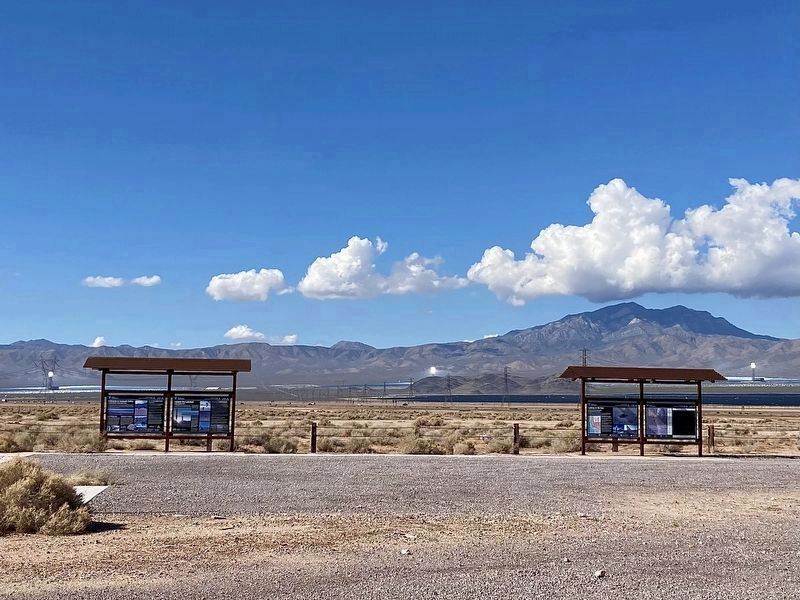
Photographed by Craig Baker, September 20, 2025
4. Ivanpah Markers
Three glowing solar towers are visible in the distance.
Topics. This historical marker is listed in these topic lists: Industry & Commerce • Natural Resources. A significant historical year for this entry is 2014.
Location. 35° 36.193′ N, 115° 23.221′ W. Marker is near Ivanpah, California, in San Bernardino County. It can be reached from Primm Boulevard south of Interstate 15. Located on a rough dirt road just south of the stateline casinos in Primm, Nevada. Touch for map. Marker is at or near this postal address: 32250 Fashion Outlet Way, Searchlight NV 89046, United States of America. Touch for directions.

Regionally, this marker is in Greater Los Angeles, in the Peninsular Ranges, and specifically in the Transverse Ranges. It is also in the American Southwest. Globally, it is in North America, on the Ring of Fire, on the Pacific Rim, in the Western Hemisphere, in the Western World, and in the Anglosphere. Historically, it finds itself in what was once New Spain and also Mexico’s Alta California.
Other nearby markers. At least 4 other markers are within 13 miles of this marker, measured as the crow flies: Nipton (approx. 11.4 miles away); Jean, Nevada (approx.
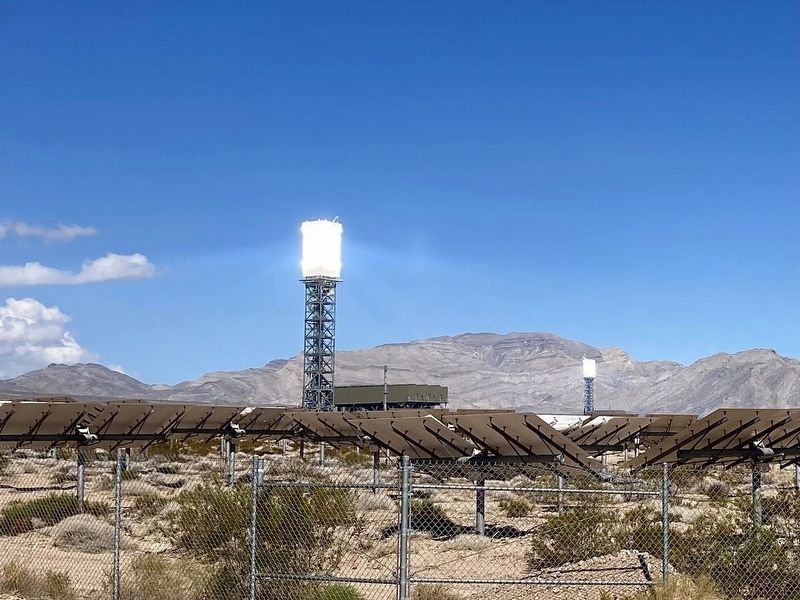
Photographed by Craig Baker, September 20, 2025
5. Ivanpah Solar Electric Generating System
Mirrors that track the sun are in the foreground.
Another marker is no longer nearby. Old Elko Fire Bell (was approx. 12½ miles away in Nevada but has been confirmed missing).
Regarding Ivanpah Solar Electric Generating System. The solar plant has proposed shutting down because its concentrated solar thermal (CST) technology is outmoded and less cost-effective than the cheaper and more efficient photovoltaic (PV) solar panels that are now the industry standard. Declining costs for PV technology, coupled with high operating costs and technical challenges for Ivanpah, led California utilities to terminate power purchase agreements. The plant failed to meet energy production targets, had high operational costs, relied on natural gas, and had high electricity prices, compounded by the unexpected rapid decline in the cost of photovoltaic (PV) solar technology.
If the site shuts down, it may be repurposed with PV technology in the future.
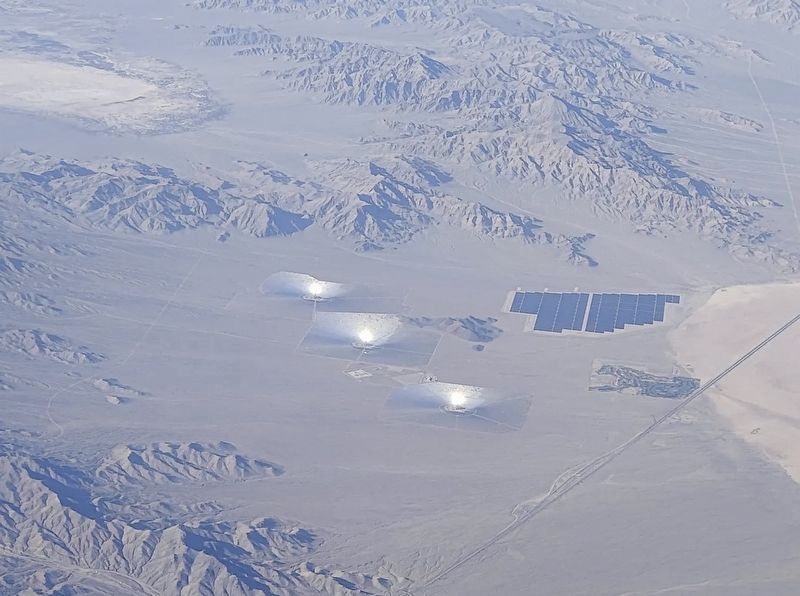
Photographed by Craig Baker
6. Viewed From 35,000 Feet
A familiar sight for airline passengers.
Credits. This page was last revised on April 6, 2026. It was originally submitted on October 7, 2025, by Craig Baker of Sylmar, California. This page has been viewed 74 times since then and 32 times this year. Photos: 1, 2, 3, 4, 5, 6. submitted on October 7, 2025, by Craig Baker of Sylmar, California.
