
Glidden in Carroll County, Iowa — The American Midwest (Upper Plains)
Glidden Liberty Rock Veterans Memorial
Honoring Carroll County Veterans
| — | Ray “Bubba” Sorensen II | — |

Photographed by Cosmos Mariner, September 16, 2025
1. Glidden Liberty Rock Veterans Memorial (south side)
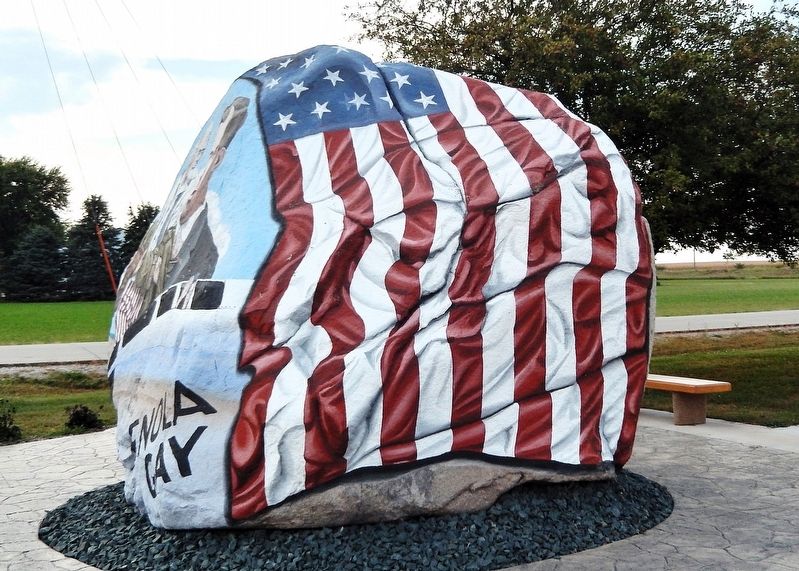
From “Sorensen tackles Liberty Rock project” by Larry Devine: Re-creation of the drawing by the Des Moines Register’s Ding Darling of Uncle Sam carrying the lifeless body of a soldier, along with a drawing of Merle Hay of Glidden, the first Iowan and one of the first three Americans killed in World War I in November 1917. Also pictured is the nose of the B-29 Superfortress Enola Gay, which dropped an atomic bomb on Hiroshima leading to Japan’s surrender ending World War II. Paul Tibbets, the bomber’s pilot, named the plane for his mother, Enola Gay Tibbets, who was from Glidden.
[south side]
[north side]
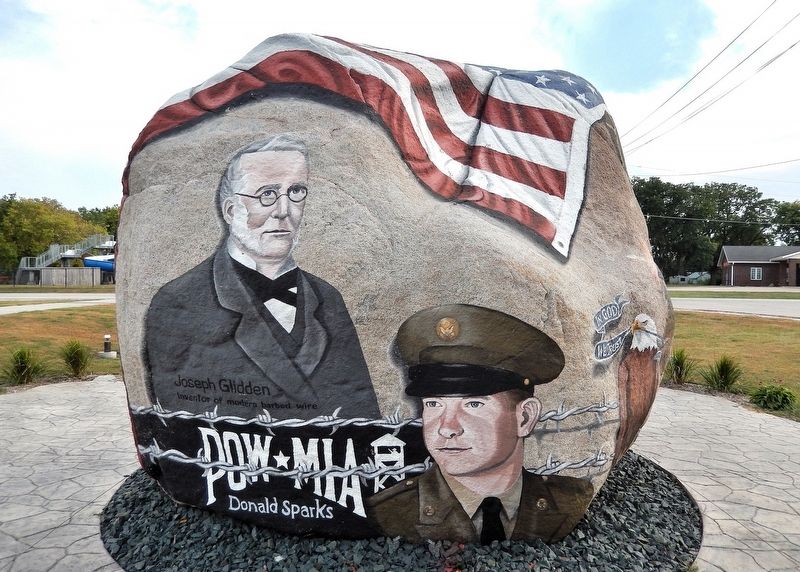
Inventor of modern barbed wire
Donald Sparks • POW☆MIA
[west side]
Erected 2021.
Topics and series. This historical marker and memorial is listed in these topic lists: Patriots & Patriotism • War, Vietnam • War, World I • War, World II. In addition, it is included in the Freedom Rock Memorials, and the Medal of Honor Recipients series lists.
Location. 42° 3.855′ N, 94° 43.999′ W. Marker is in Glidden, Iowa, in Carroll County. It is at the intersection of Lincoln Highway (U.S. 30) and Sherwood Avenue (Arizona Street), on the right when traveling west on Lincoln Highway. The marker is located near the northeast corner of the intersection, on the south side of Northland Park. Touch for map. Marker is at or near this postal address: 705 Arizona Street, Glidden IA 51443, United States of America. Touch for directions.

Regionally, this marker and memorial is in Western Iowa. It is also in the American Midwest and in the
this page online
Other nearby markers. At least 3 other markers are within 7 miles of this marker, measured as the crow flies: Private Merle D. Hay (approx. 0.4 miles away); Merle D. Hay Memorial (approx. 0.4 miles away); The Miracle Cornfield Landing of 1960 (approx. 6½ miles away).
Related markers. Click here for a list of markers that are related to this marker.
Also see . . .
1. Merle David Hay (1896-1917) (Wikipedia).
Excerpt: Hay was the first Iowa serviceman, and perhaps the first American serviceman to die in combat while assigned to an American unit, in World War I, along with Corporal James Bethel Gresham of Evansville, Indiana and Thomas Enright of Pittsburgh, Pennsylvania. When the United States entered the First World War, Hay was young enough to avoid being drafted. With his father's blessing, he voluntarily enlisted on May 9, 1917. He was among eight men from Glidden who enlisted(Submitted on October 8, 2025, by Cosmos Mariner of Cape Canaveral, Florida.)that day. By November 1917, he was assigned to Company F along with Corporal James Bethel Gresham and Private Thomas Enright. They were posted in the trenches of position 'Artois' near the French village of Bathelémont in Lorraine. In the early morning of 3 November 1917, the Imperial German Army attacked. After an hour of fighting, Hay, Corporal Gresham, and Private Enright were the first three casualties of the American Expeditionary Force.Photographed by Cosmos Mariner, September 16, 20252. Glidden Liberty Rock Veterans Memorial (north side)From “Sorensen tackles Liberty Rock project” by Larry Devine: Depictions of Joseph Glidden and Donald Sparks. The town’s namesake, Joseph Glidden, was from DeKalb, Illinois, and was an inventor of a type of barbed wire that dramatically changed the settlement of the U.S. plains. Sparks was a casualty of the Vietnam War who for years was listed as missing in action after an ambush by the enemy on June 17, 1969. Sparks grew up on a farm southwest of Glidden. “I thought barbed wire and prisoner of war matched up pretty well,” Sorensen said.
2. Enola Gay (Wikipedia).
Excerpt: The Enola Gay is a Boeing B-29 Superfortress bomber, named after Enola Gay Tibbets, the mother of the pilot, Colonel Paul Tibbets. On 6 August 1945, during the final stages of World War II, it became the first aircraft to drop an atomic bomb in warfare. The bomb, code-named "Little Boy", was targeted at the city of Hiroshima, Japan, and destroyed about three-quarters of the city.(Submitted on October 8, 2025, by Cosmos Mariner of Cape Canaveral, Florida.)
After the war, the Enola Gay was transferred to the Smithsonian Institution and spent many years parked at air bases exposed to the weather and souvenir hunters, before its 1961 disassemblyand storage at a Smithsonian facility in Suitland, Maryland. The cockpit and nose section of the aircraft were exhibited at the National Air and Space Museum (NASM) on the National Mall, for the bombing's 50th anniversary in 1995, amid controversy. Since 2003, the entire restored B-29 has been on display at NASM's Steven F. Udvar-Hazy Center.Photographed by Cosmos Mariner, September 16, 20253. Glidden Liberty Rock Veterans Memorial (west side)From “Sorensen tackles Liberty Rock project” by Larry Devine: Scenes that are a tribute to Ralph Neppel, who received the Congressional Medal of Honor from President Harry Truman for his bravery in World War II. Neppel was a Willey native who died in 1987 and is buried at Holy Family Cemetery south of Lidderdale.

3. Joseph Farwell Glidden (Wikipedia).
Excerpt: American businessman and farmer. Glidden began work on ways to make a useful barbed wire to fence cattle in 1873. He made his best design of barbed wire by using a coffee mill to create the barbs. Glidden placed the barbs along a wire and then twisted another wire around it to keep the barbs in place, in a design that he called "The Winner", being his best design. He received the patent for that barbed wire design on November 24, 1874, when he was 61 years old. He and local hardware dealer Isaac L. Ellwood began manufacturing and selling the barbed wire with his patent, as the Barb Fence Company in DeKalb, Illinois. In 1876, Glidden exited the manufacturing(Submitted on October 8, 2025, by Cosmos Mariner of Cape Canaveral, Florida.)aspect, though retaining royalties, by selling his half of the manufacturing business to Washburn and Moen, who had a wire manufacturing plant in Worcester, Massachusetts and from whom Glidden and Ellwood had been purchasing steel wire. Ellwood stayed in DeKalb and renamed the company I. L. Ellwood & Company of DeKalb. That company evolved into American Steel and Wire, and eventually was bought by U. S. Steel Manufacturing Company.Photographed by Cosmos Mariner, September 16, 20254. Glidden Liberty Rock Veterans Memorial (east side)The American flag drapes the top and east side of the rock.
4. Private First Class (PFC) Donald Lee Sparks (Defense POW/MIA Accounting Agency).
Excerpt: Donald Lee Sparks entered the U.S. Army from Iowa and was a member of Company C, 3rd Battalion, 21st Infantry Regiment, 196th Light Infantry Brigade, Americal (23rd) Division. On June 17, 1969, PFC Sparks was acting as a point man on a patrol when his unit was ambushed by the enemy in the vicinity of (GC) BT 098 232, South Vietnam. Witnesses to the incident indicated that PFC Sparks was hit and fell to the ground. He was believed to be dead. The next day, a US patrol returned to the area but could not locate PFC Sparks'(Submitted on October 8, 2025, by Cosmos Mariner of Cape Canaveral, Florida.)body. In May 1970, it was learned that PFC Sparks had been captured. His last known location in captivity was a field medical facility in Tien Lanh Village, Tien Phuoc District, Quang Nam Province. He was subsequently moved west across the river that forms the western boundary of Tien Lanh Village to an unknown location. In 2012, it was determined that PFC Sparks did not survive captivity. After the incident, the U.S. Army promoted PFC Sparks to the rank of Sergeant First Class. Today, Sergeant First Class Sparks is memorialized on the Courts of the Missing at the National Memorial Cemetery of the Pacific. His name is also inscribed along with all his fallen comrades on the Vietnam Veterans Memorial Wall in Washington, DC.Photographed by Cosmos Mariner, September 16, 20255. Glidden Liberty Rock Artist
Ray “Bubba” Sorensen IIThe Bald Eagle and Ray “Bubba” Sorensen II signature are painted on the bottom left corner of the west side of the rock.

5. Ralph George Neppel (Congressional Medal of Honor Society).
Excerpt: Rank: Sergeant(Submitted on October 8, 2025, by Cosmos Mariner of Cape Canaveral, Florida.)
Conflict/Era: World War II
Unit/Command: Company M, 329th Infantry,83d Infantry Division
Military Service Branch: U.S. Army
Medal of Honor Action Date: December 14, 1944
Medal of Honor Action Place: Birgel, Germany
Citation: He was a leaderof a machine-gun squad defending an approach to the village of Birgel, Germany, on 14 December 1944, when an enemy tank, supported by 20 infantrymen, counterattacked. He held his fire until the Germans were within 100 yards and then raked the foot soldiers beside the tank, killing several of them. The enemy armor continued to press forward, and, at the point-blank range of 30 yards, fired a high-velocity shell into the American emplacement, wounding the entire squad. Sgt. Neppel, blown 10 yards from his gun, had one leg severed below the knee and suffered other wounds. Despite his injuries and the danger from the onrushing tank and infantry, he dragged himself back to his position on his elbows, remounted his gun, and killed the remaining enemy riflemen. Stripped of its infantry protection, the tank was forced to withdraw. By his superb courage and indomitable fighting spirit, Sgt. Neppel inflicted heavy casualties on the enemy and broke a determined counterattack.Photographed by Cosmos Mariner, September 16, 20256. Glidden Liberty Rock Veterans Memorial (north side)Looking south; US Highway 30 (the Lincoln Highway) crosses in the background.

6. Sorensen tackles Liberty Rock project (Carroll Times Herald).
(By Larry Devine,(Submitted on October 8, 2025, by Cosmos Mariner of Cape Canaveral, Florida.)10/21/2021) Excerpt: While there will be only one Freedom Rock in each county — Sorensen painted Carroll County’s Freedom Rock at the Hausban Heritage Park on the east side of Manning in 2014 — Glidden officials are hoping their Liberty Rock will have similar drawing power as the Freedom Rock Tour. Just weeks after completing the last Freedom Rock, Sorensen turned his attention to the Glidden Liberty Rock. His canvas is an 11-foot-tall, 100-ton monster that was trucked to Glidden last year from a field near Bayard. His homework on what he’d illustrate on the Liberty Rock, Sorensen said, was an eye-opener. “This one has so much neat history on it, not just U.S. military history, but Iowa history,” he said. I think it’s very interesting that this random town in the middle of Iowa has connections to the bookends of both world wars.”Photographed by Cosmos Mariner, September 16, 20257. Glidden Liberty Rock Veterans Memorial (west side)

7. The Freedom Rock. Thanking our Veterans, one painting at a time. (Submitted on October 8, 2025, by Cosmos Mariner of Cape Canaveral, Florida.)

Photographed by Cosmos Mariner, September 16, 2025
8. Glidden Liberty Rock Veterans Memorial (south side)
Looking north from US Highway 30 (the Lincoln Highway).
Credits. This page was last revised on October 9, 2025. It was originally submitted on October 8, 2025, by Cosmos Mariner of Cape Canaveral, Florida. This page has been viewed 76 times since then and 28 times this year. Photos: 1, 2, 3, 4, 5, 6, 7, 8. submitted on October 8, 2025, by Cosmos Mariner of Cape Canaveral, Florida.
