Boron in Kern County, California — The American West (Pacific Coastal)
Twenty-Mule Teams
Photographed by Denise Boose, October 10, 2025
1. Twenty-Mule Teams Marker
Inscription.
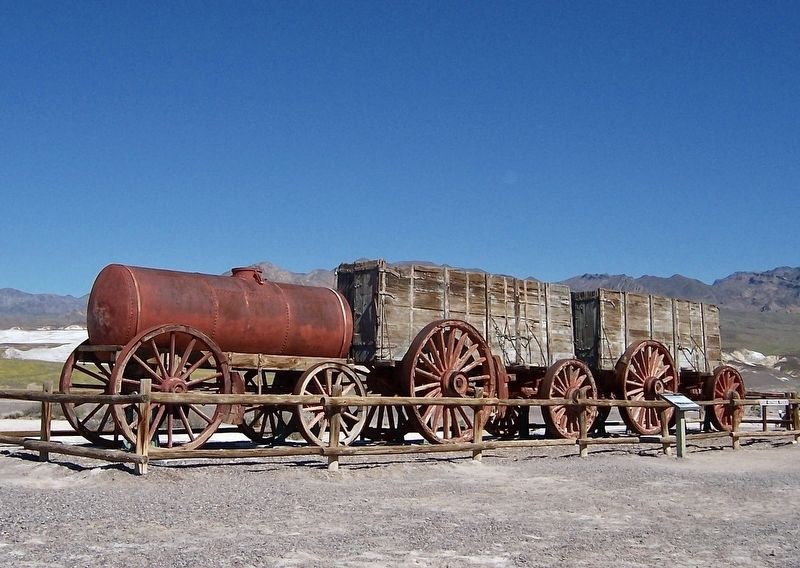
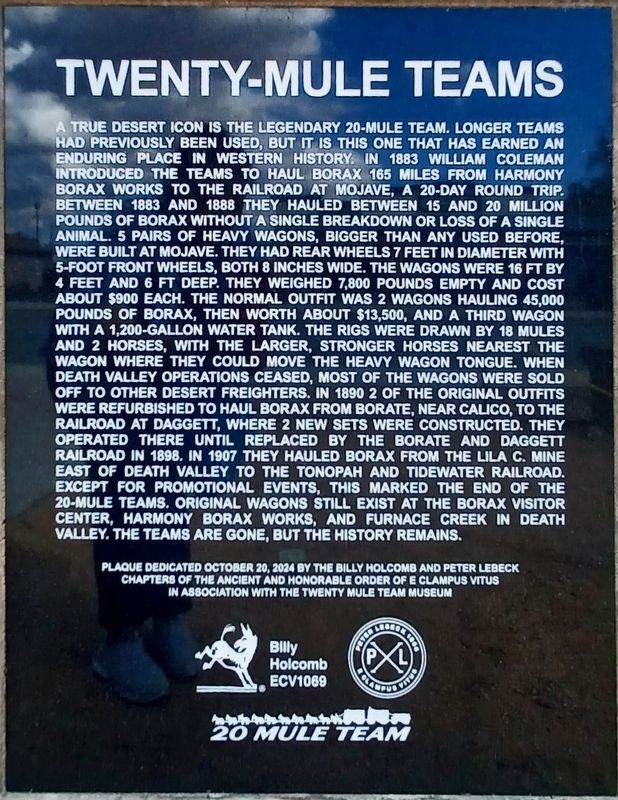
Twenty-Mule Teams. . A true desert icon is the legendary 20-mule team. Longer teams had previously been used, but it is this one that has earned an enduring place in western history. In 1883 William Coleman introduced the teams to haul borax 165 miles from Harmony Borax works to the railroad at Mojave, a 20-day round trip. Between 1883 and 1888 they hauled between 15 and 20 million pounds of Borax without a single breakdown or loss of a single animal. 5 pairs of heavy wagons, bigger than any used before, were built at Mojave. They had rear wheels 7 feet in diameter with 5-foot front wheels, both 8 inches wide. The wagons were 16 ft by 4 feet and 6 ft deep. They weighed 7,800 pounds empty and cost about $900 each. The normal outfit was 2 wagons hauling 45,000 pounds of borax, then worth about $13,500, and a third wagon with a 1,200-gallon water tank. The rigs were drawn by 18 mules and 2 horses, with the larger, stronger horses nearest the wagon where they could move the heavy wagon tongue. When Death Valley operations ceased, most of the wagons were sold off to other desert freighters. In 1890 2 of the original outfits were refurbished to haul Borax from Borate, near Calico, to the railroad at Daggett, where 2 new sets were constructed. They operated there until replaced by The Borate and Daggett Railroad in 1898. In 1907 they hauled Borax from the Lila C. Mine east of Death Valley to the Tonopah and Tidewater Railroad. Except for promotional events, this marked the end of the 20-Mule teams. Original wagons still exist at the Borax Visitor Center, Harmony Borax Works, and Furnace Creek in Death Valley. The teams are gone, but the history remains. ,
A true desert icon is the legendary 20-mule team. Longer teams had previously been used, but it is this one that has earned an enduring place in western history. In 1883 William Coleman introduced the teams to haul borax 165 miles from Harmony Borax works to the railroad at Mojave, a 20-day round trip. Between 1883 and 1888 they hauled between 15 and 20 million pounds of Borax without a single breakdown or loss of a single animal. 5 pairs of heavy wagons, bigger than any used before, were built at Mojave. They had rear wheels 7 feet in diameter with 5-foot front wheels, both 8 inches wide. The wagons were 16 ft by 4 feet and 6 ft deep. They weighed 7,800 pounds empty and cost about $900 each. The normal outfit was 2 wagons hauling 45,000 pounds of borax, then worth about $13,500, and a third wagon with a 1,200-gallon water tank. The rigs were drawn by 18 mules and 2 horses, with the larger, stronger horses nearest the wagon where they could move the heavy wagon tongue. When Death Valley operations ceased, most of the wagons were sold off to other desert freighters. In 1890 2 of the original outfits were refurbished to haul
Click or scan to see this page online
Borax from Borate, near Calico, to the railroad at Daggett, where 2 new sets were constructed. They operated there until replaced by The Borate and Daggett Railroad in 1898. In 1907 they hauled Borax from the Lila C. Mine east of Death Valley to the Tonopah and Tidewater Railroad. Except for promotional events, this marked the end of the 20-Mule teams. Original wagons still exist at the Borax Visitor Center, Harmony Borax Works, and Furnace Creek in Death Valley. The teams are gone, but the history remains.
Erected 2024 by The Billy Holcomb and Peter Lebeck Chapters of the Ancient and Honorable Order of E Clampus Vitus in Association with the Twenty Mule Team Museum.
Topics and series. This historical marker is listed in these topic lists: Animals • Industry & Commerce. In addition, it is included in the E Clampus Vitus series list. A significant historical year for this entry is 1883.
Location. 34° 59.965′ N, 117° 39.042′ W. Marker is in Boron, California, in Kern County. It is at the intersection of Twenty Mule Team Road and Boron Avenue, on the left when traveling west on Twenty Mule Team Road. Touch for map. Marker is
Photographed by Denise Boose, October 10, 2025
2. Twenty-Mule Teams Marker

at or near this postal address: 26962 Twenty Mule Team Road, Boron CA 93516, United States of America. Touch for directions.
Regionally, this marker is in California’s San Joaquin Valley, specifically in the Central Valley, and in the Sierra Nevada. It is also on the American Pacific Coast. Globally, it is in North America, on the Ring of Fire, in the Pacific Rim, in the Western Hemisphere, in the Western World, and in the Anglosphere. Historically, it finds itself in what was once New Spain and also Mexicos Alta California.
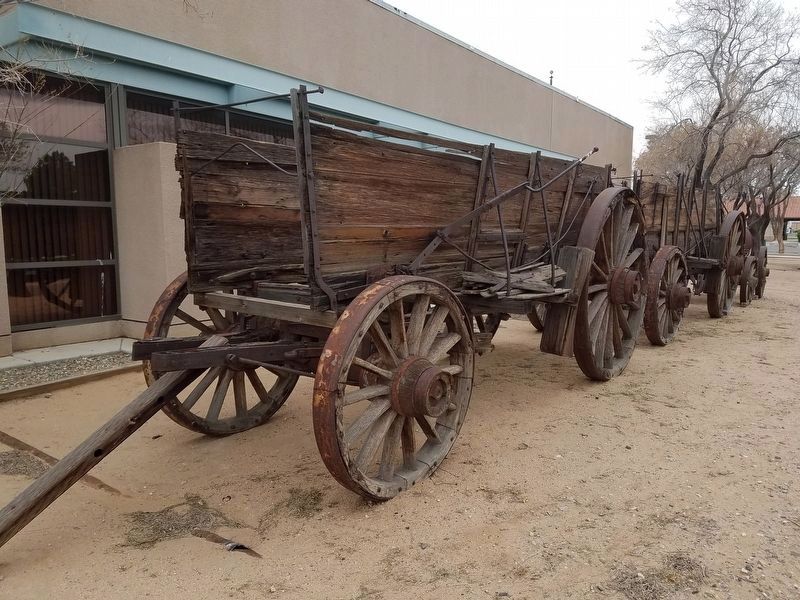
largest set of original Twenty Mule Team Wagons is on display at Harmony Borax Works in Death Valley. It is the only existing set of wagons that made the trip from Death Valley to Mojave, and it was built in Mojave. The other two sets of wagons are smaller and they made shorter trips from a mine near Daggett. They were built at Alfs Blacksmith Shop in Daggett. One set is on display at the Borax mine visitor center near here, and the other set is on display in Death Valley at the ranch museum in Furnace Creek.
Photographed by Denise Boose, April 11, 2019
4. Twenty-Mule Teams Wagons
They were on display by 20-Mule Team Trail Marker located outside of California City, but were moved to the Cal City Police station due to vandalism.
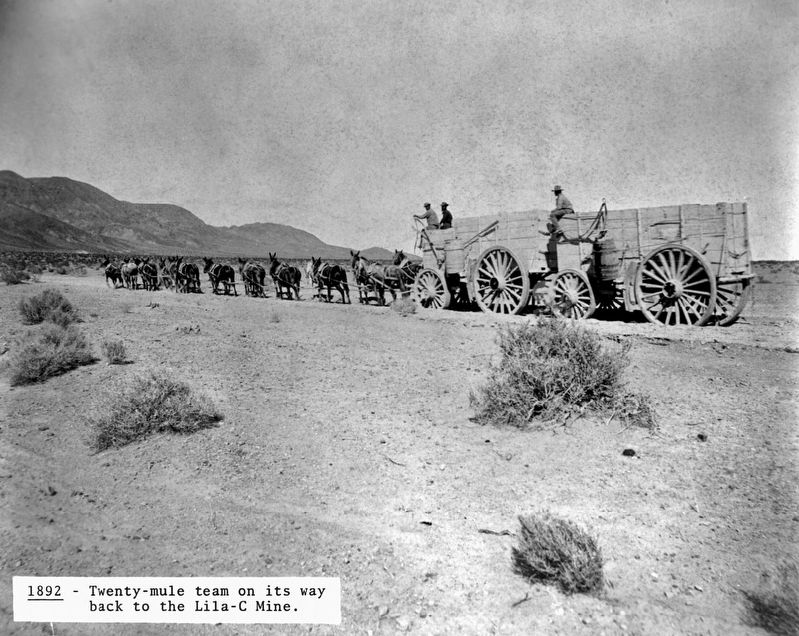
courtesy Denver Public Library, 1892
5. Twenty-Mule team on its way to the Lila-C mine
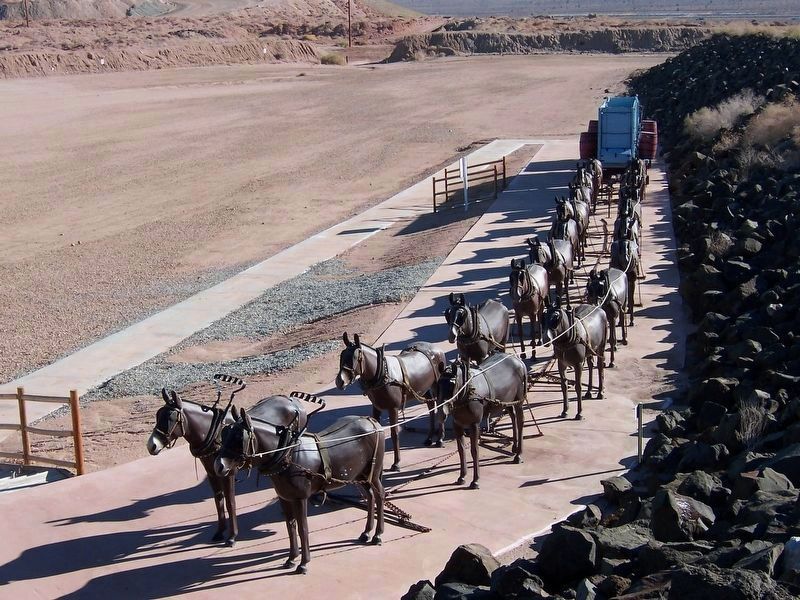
Photographed by Denise Boose, November 18, 2003
6. Twenty-Mule Teams display
Located at U.S. Borax Visitor Center.
Photographed by Denise Boose, April 4, 2026
7. Twenty-Mule Teams Display
Located at U.S. Borax Visitor Center.
Credits. This page was last revised on April 6, 2026. It was originally submitted on October 11, 2025, by Denise Boose of Tehachapi, California. This page has been viewed 82 times since then and 46 times this year. Photos:1, 2, 3, 4. submitted on October 11, 2025, by Denise Boose of Tehachapi, California. 5. submitted on October 11, 2025. 6. submitted on October 11, 2025, by Denise Boose of Tehachapi, California. 7. submitted on April 4, 2026, by Denise Boose of Tehachapi, California. • Andrew Ruppenstein was the editor who published this page.