Rancho Oakey in Las Vegas in Clark County, Nevada — The American Mountains (Southwest)
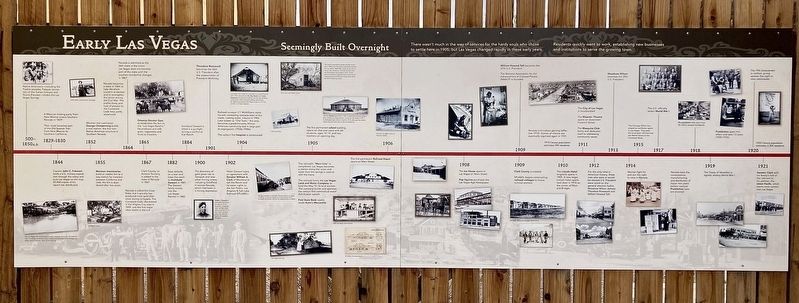
Early Las Vegas
Photographed by Craig Baker, September 18, 2025
1. Early Las Vegas Marker
Seemingly Built Overnight
There wasn't much in the way of services for the hardy souls who chose to settle here in 1905, but Las Vegas changed rapidly in these early years.
Residents quickly went to work, establishing new businesses and institutions to serve the growing town.
500 - 1850 A.D.
Native Americans — including the Pueblo peoples, Patayan (ancestors of the Yuman Groups) and Numa (Paiutes) — inhabit the Las Vegas Springs.
1829 - 1830
A Mexican trading party from New Mexico enters Southern Nevada in 1829. Their route becomes part of the Old Spanish Trail from New Mexico to Southern California.
1844
Captain John C. Frémont leads a U.S. military expedition through the valley and puts Las Vegas on the map. 20,000 copies of his report are distributed.
1852
Mormon mail contractor George Chorpenning builds a mail station, the first non-Native American structure in Southern Nevada.
1855
Mormon missionaries build an adobe fort as a way station for travelers between California and Utah: the fort is abandoned atter two years.
1864
Nevada is admitted as the 36th state in the Union.
Las Vegas does not become part of the state until the southern borderline changes in 1867.
Nevada becomes a state in 1864 to
this page online
Nevada is called the Silver State, but it actually has produced more gold than silver during its history.
The Comstock Lode, discovered in the Virginia City area in 1859, was the first major silver boom in the U.S.
1865
Octavius Decatur Gass re-establishes the fort as the "Los Vegas Rancho." He produces and sells grain, vegetables and fruits to travelers.
1867
Clark County, an Arizona Territory, is added to the state of Nevada in 1867.
1882
Gass defaults on a loan and loses the ranch to Archibald Stewart in 1881. The Stewart family moves into the Los Vegas Rancho in 1882.
1884
Archibald Stewart is killed in a gunfight during a conflict at Kiel Ranch.
Helen J. Stewart is widowed following the death of her husband. Pregnant with her fifth child, she continues to run the ranch successfully and raise her family for another 20 years.
1900
The discovery of gold gives rise to Tonopah and later other mining towns, including Goldfield. It revives Nevada, which had been in a mining depression.
1901
Theodore Roosevelt becomes the 26th U.S. President
Photographed by Craig Baker, September 18, 2025
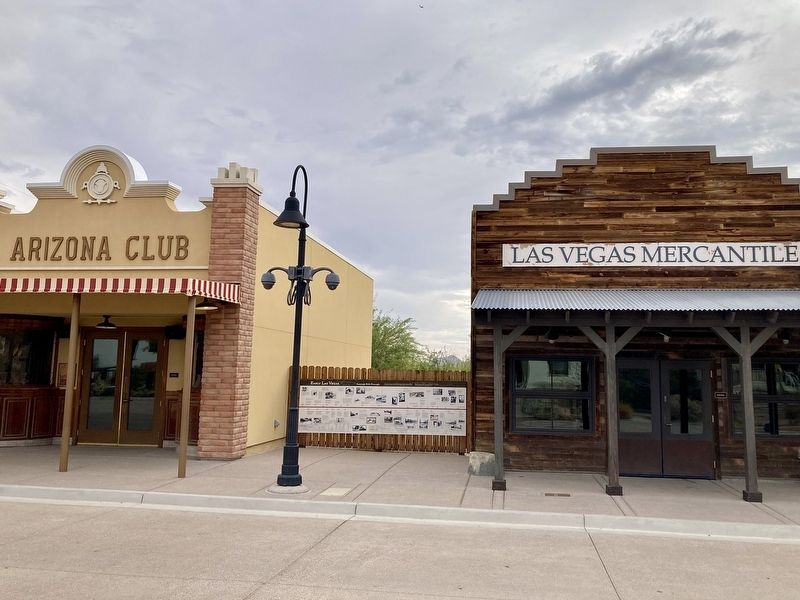
2. Early Las Vegas Marker
1902
Helen Stewart signs an agreement with Senator William A. Clark of Montana to sell the Ranch and its water rights to the San Pedro, Los Angeles & Salt Lake Railroad (SPLA&SL).
1904
Railroad surveyor J.T. McWilliams starts his own competing townsite west of the tracks. Lacking water, it burns in 1905. Later known as "Old Town," this area becomes a predominantly African American community due in large part to segregation. (1930s-1940s)
The valley's first hospital is constructed.
Las Vegas first hospital is located in a wood-framed tent. The railroad hires Dr. Roy Martin and Halle Hewetson to provide medical care for the growing community. After several building relocations, Dr Martin purchases the Palace Hotel in 1917 to furnish a 12-bed hospital.
1905
The railroad's "Main Line" is completed; Las Vegas becomes a station along the route and water from the springs is used to refill the trains.
The railroad forms the Las Vegas Land and Water Company to hold the May 15-16 land auction.
The company builds and operates the valley's first commercial water distribution system.
First State Bank opens inside Kuhn's Mercantile.
The first permanent school building opens on 2nd and Lewis with 64 students, ages
Photographed by Craig Baker, September 18, 2025
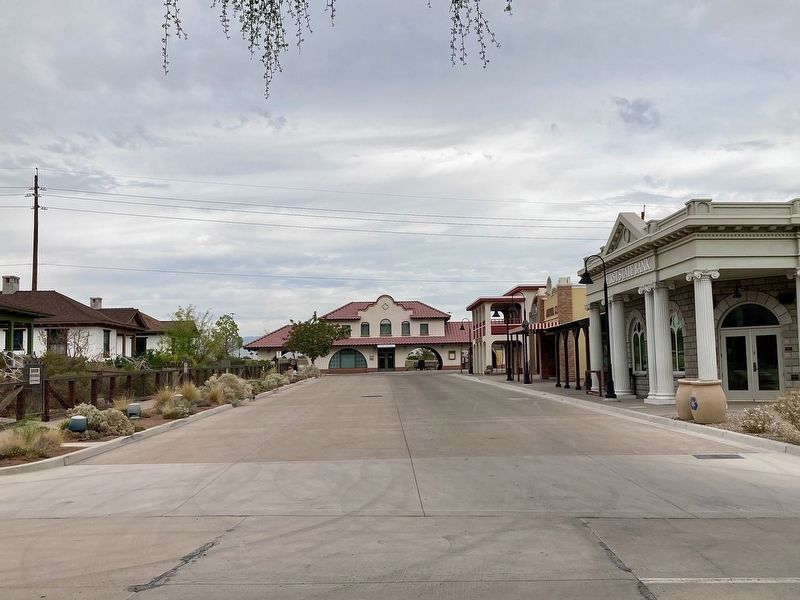
3. "Boomtown 1905"
The marker is on the right side of the street.
The first School was built in 1905. A new Clark County school, later named Las Vegas School, is built on 4th Street in 1911. A dedicated high school is built in 1918, although the school opens late that year due to the flu pandemic.
The town's population grows quickly in the early 1900s, but housing is extremely limited. The so-called "tent city" pops up quickly to house new residents, railroad workers, and the businesses that support them. Some early businesses upgrade their structures by creating wood storefronts made from disassembled shipping crates.
1906
The first permanent Railroad Depot opens on Main Street.
1908
The Ice House opens in Las Vegas on Main Street.
Pop Squires purchases the Las Vegas Age Newspaper.
1909
Clark County is created.
SPLA&S begins constructing railroad cottages to house railroad workers.
William Howard Taft becomes the 27th U.S. President.
The National Association for the Advancement of Colored People (NAACP) is founded.
1910
The Lincoln Hotel originally opens in 1905. A new larger Lincoln hotel opens next door in 1910 on the corner of Main and Bridger.
Nevada criminalizes gaming (effective 1910). Games of chance are eventually legalized again in 1931.
1910 Census population estimates 945 residents.
1911
The City of Las Vegas is incorporated. The Majestic Theatre opens on downtown Fremont Street. The Mesquite Club forms and dedicates itself to addressing community issues.
1912
For the only time in American history, three men who were or would be elected U.S. President were listed on the general election ballot.
Woodrow Wilson defeats Theodore Roosevelt and William Howard Taft.
1913
Woodrow Wilson becomes the 28th U.S. President.
1914
Women fight for and win the right to vote in Nevada.
1915
The Chicago White Sox played an exhibition game in Las Vegas. They beat the local team 14-0 but lost the World Series to the Cincinnati Reds.
1917
The U.S. officially enters World War I.
1918
Flu pandemic kills more than 20 million people worldwide.
Nevada bans the consumption, manufacturing, and distribution of liquor two years before national Prohibition laws are enacted.
1919
The Treaty of Versailles is signed, ending World War I.
1920
The 19th Amendment is ratified, giving women the right to vote nationwide.
Prohibition goes into effect and lasts 13 years (1920-1933).
1920 Census population estimates 2,304 residents.
1921
Senator Clark sells his family's half of the railroad to his partner, the Union Pacific, which exerts more control over Las Vegas.
Topics. This historical marker is listed in this topic list: Settlements & Settlers.
Location. 36° 10.403′ N, 115° 11.47′ W. Marker is in Las Vegas, Nevada, in Clark County. It is in Rancho Oakey. It can be reached from South Valley View Boulevard north of Alta Boulevard. Located inside the Springs Preserve, at the "Boomtown 1905" exhibit. Touch for map. Marker is at or near this postal address: 333 S Valley View Blvd, Las Vegas NV 89107, United States of America. Touch for directions.

Regionally, this marker is in the Mojave Desert. It is also in the American Southwest and in the Mountain West. Globally, it is in North America, the Western Hemisphere, the Western World, and the Anglosphere. Historically, it finds itself in what was once New Spain and also Mexico’s Alta California.
Other nearby markers. At least 8 other markers are within walking distance of this marker: Railroad Cottages (within shouting distance of this marker); Las Vegas Boomtown (within shouting distance of this marker); Intake No. 3 Project - 2015 (about 300 feet away, measured in a direct line); The Big Spring (about 400 feet away); Tap Into History (approx. 0.2 miles away); Las Vegas Springs (approx. ¼ mile away); a different marker also named Las Vegas Springs (approx. ¼ mile away); Las Vegas (The Meadows) (approx. ¼ mile away). Touch for a list and map of all markers in Las Vegas.
Credits. This page was last revised on October 13, 2025. It was originally submitted on October 13, 2025, by Craig Baker of Sylmar, California. This page has been viewed 119 times since then and 59 times this year. Photos: 1, 2. submitted on October 13, 2025, by Craig Baker of Sylmar, California. 3. submitted on October 10, 2025, by Craig Baker of Sylmar, California.
